
died c. 287–303·Feast October 6
St. Faith
Virgin martyr of Agen venerated at Conques
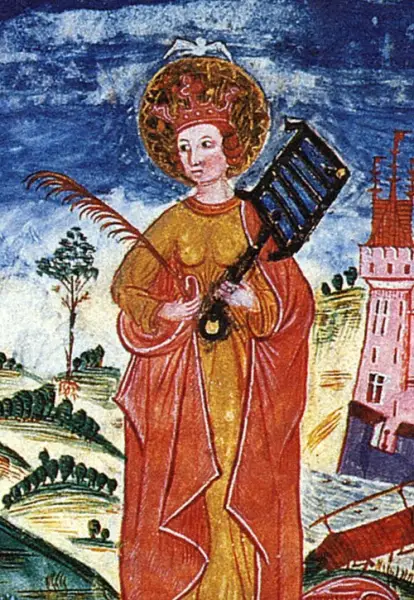
Overview
Saint Faith, known in Latin as Sancta Fides, in French as Sainte Foy and in Spanish as Santa Fe, is honoured as a young girl of Agen in Aquitaine who died rather than deny Christ. Her legend relates that she was seized in the persecution raised against the church by the Roman empire and, when called upon to offer pagan sacrifice, refused; she was then put to death over a red-hot brazier. Traditions divide on the date, some placing her passion in 287 or 290, others in the great persecution begun under Diocletian in 303. The martyrologies list her as a virgin and martyr, and her feast was fixed early on the sixth of October. The centre of her devotion passed in the ninth century from Agen to the abbey of Sainte-Foy at Conques, where a monk carried off her relics, and there, on the road to Compostela, her cult grew into one of the great pilgrim devotions of medieval Europe, spreading to England, Italy and South America. About her shrine arose the Book of Miracles of Bernard of Angers, with its famous tales of the saint's joca; the gilded reliquary that enshrined her head became a masterpiece of Romanesque goldsmiths' work; and the Catalan Cançó de Santa Fe, composed in her honour, stands as the earliest monument of that language.
The Complete Life
A Girl of Agen
Faith was, by the consistent account of her legend, a girl or young woman of Agen, a town of Aquitaine in the Roman province of Gallia Narbonensis. She belonged to the Christian community of that city at a time when profession of the gospel was itself a crime, and she was seized when the persecutions of the empire reached Agen. Her story is wrapped early in legend: from ancient times her figure was confused with the three legendary sisters whose names were Faith, Hope and Charity, whose names made them favourites of preachers and artists, and that confusion coloured her cult for centuries. The documentary trail is meagre but real. She is recorded in the Martyrologium Hieronymianum, the great calendar of martyrs transmitted under Jerome's name, under the sixth of October, though no date of death is given there. An account of her passion, a Passio, once existed but has been lost; it comes down only in an abridgment within the ninth-century martyrology of Florus of Lyon, which keeps the outline of the older narrative. What the earliest traditions unite in affirming is small and solemn: a young Christian of Agen, singled out in a persecution, who would not sacrifice to the gods and paid for her fidelity with her life, her memory guarded thereafter by the whole church.
§ Saint Faith
Refusal and Fire
The heart of Faith's story is a refusal. Summoned, in the manner of the persecutions, to offer sacrifice to the pagan gods and so acknowledge the authority of Rome over the conscience, she would not comply. Her legend recounts the cost: the girl was stripped and tortured naked over a brazier, done to death by the fire itself, and the church remembered her among those who conquered the flame by enduring it. Tradition is divided on the date. Some accounts place her death in 287 or 290, in the reigns that preceded the last great assault; others set it in the large-scale persecution begun under Diocletian in 303, the fiercest the empire ever mounted. All agree on the manner and the meaning: the weakest member of society, a mere girl, stood before the whole apparatus of the state and outlasted it. Her feast was fixed early at the sixth of October, the date under which the calendars record her, and her title in those lists is exact and austere, Sancta Fides, Virgin and martyr. Her martyrdom is first mentioned, among texts that survive, in a late sixth-century transcript of Jerome's martyrology; Jerome himself had died in 420, and the mid-ninth-century Passio later gave her story its full literary form for medieval Christendom.
§ Legend
Companions in Passion
Later legend widened the circle of her passion. A narrative retold in the twelfth century by Simon of Walsingham in his verse life of the saint sets her death under the persecutions of the prefect Dacian. In this account, Caprasius of Agen, a Christian of the same city, fled to Mont-Saint-Vincent, a height near Agen, and watched the execution of Faith from the top of the hill. Discovered or denounced, he was condemned to death in his turn, and he was joined on the way to execution by Alberta, called the sister of Faith though some traditions name her Caprasius' mother, and by two brothers, Primus and Felician. All four were beheaded. The tale entwines Faith's cult with that of Caprasius and Alberta of Agen, and in the twelfth century her devotion was formally fused with theirs; the cult of Caprasius was in turn linked with that of Primus and Felician, honoured as his brothers. Whether history or devotional construction, the companionship of the martyrs records how the church of Agen remembered its confessors: a girl burned over the coals, a watcher on the hill who would not keep silent, and a family led out together to the sword, a single company of witnesses gathered about one act of fidelity.
§ Veneration
Virgin and Martyr in the Calendars
Faith was never the subject of a process; she belongs to the company of martyrs whom the church honoured from the moment of their death, and her canonization is recorded simply as pre-congregation. The calendars enrolled her, the feast was kept on the sixth of October, and a basilica rose in her city within a few centuries of her passion: early in the fifth century the bishop of Agen, Dulcitius, ordered a church built in her honour, which was restored in the eighth century, enlarged in the fifteenth, and stood at Agen until 1892, when an urban renewal scheme brought it down. Yet the centre of her devotion was destined to lie elsewhere, in the abbatial church of Saint Foy at Conques, to which a monk of the neighbouring abbey brought her relics from Agen during the ninth century in the pious thefts the middle ages called translations. There her cult grew into one of the great pilgrimage devotions of France. Her patronage came to embrace pilgrims, prisoners and soldiers, and her iconography gathered the emblems of her triumph: the gridiron, the rods and the sword, together with the crown and the martyr's palm that marked her victory in the art of the medieval churches.
§ Cult and reliquary
Conques, Miracles and Song
The translation of 866 set the course of her later history. Conques lay along the pilgrimage route to Compostela, and her cult spread along the pilgrim ways of the road of St. James and beyond, becoming popular in England, Italy and South America. About 1010 the gilded reliquary at Conques was described by the churchman Bernard of Angers, who composed, between about 1013 and after 1020, the Liber miraculorum sancte Fidis, one of the most vivid documents of medieval devotion. In it the miracles of the saint are called joca, tricks or jokes, the word of the local people themselves; he tells of the castellan Austrin, who kept a ring his dying wife had pledged to the saint and used it to wed a second wife, until the saint swelled the bride's finger with unbearable pain and, on the third night at the shrine, cast the ring ringing onto the pavement far off as if flung from a siege engine. Bernard, who had first attacked the statue as idolatrous, was converted by an economically charged miracle and judged the golden image a vessel pointing to the saint rather than the saint herself. She was famed, too, for restoring the eyes and sight of her faithful clients, sometimes withdrawing the gift when they grew arrogant. Her fame entered literature in the Cançó de Santa Fe, a song of praise in 593 octosyllabic lines and the earliest work of Catalan letters, written down between 1054 and 1076 and often assigned to about 1070; churches of consequence were dedicated to her at Conches, in Normandy, and at Sélestat in Alsace, and about 1105 the Fitzwalters dedicated a priory to her at Horsham in Norfolk, whose murals, hidden behind a refectory wall, came to light in 1969. The reliquary itself, its golden head variously identified as a late Roman imperial portrait or, in Thomas Hoving's view, a death mask of Charlemagne, was enriched again and again into the nineteenth century, and part of her relics passed in 1365 to Sant Cugat in Catalonia; it may be seen at Conques still.
§ Cult and reliquary
Timeline
- 287
One tradition fixes the martyrdom of the young Faith at Agen in this year.
§ Saint Faith
- 866
Her remains were carried from Agen to the abbey church of Conques, on the road to Compostela.
§ Cult and reliquary
- 1010
Bernard of Angers described the gilded reliquary at Conques in his Book of Miracles of Sainte Foi.
§ Cult and reliquary
- 1070
The Cançó de Santa Fe, the first monument of Catalan letters, was set down in her honour, usually dated about this year.
§ Legend
- 1105
Robert and Sybil Fitzwalter raised a priory dedicated to Saint Faith at Horsham in Norfolk.
§ Cult and reliquary
- 1365
Some of the saint's relics reached the monastery of Sant Cugat in Catalonia.
§ Cult and reliquary
- 1892
The ancient basilica of Agen, built in her honour, was demolished under an urban renewal scheme.
§ Cult and reliquary
- 1969
Murals depicting the saint were found concealed behind a refectory wall at the Horsham priory.
§ Cult and reliquary
In Their Own Words
the inhabitants of the place call Sainte Foy's jokes, which is the way peasants understand such things
The Record
- Patron of
- pilgrims·prisoners·soldiers
- Symbols
- gridiron·rods·sword·crown·martyr's palm
- Canonization
- Pre-congregation; honoured as a martyr since the early church
Prayer
Bibliography
Show 6 sources
- Ashley, Kathleen M.; Sheingorn, Pamela (1999). Writing Faith: Text, Sign & History in the Miracles of Sainte Foy. University of Chicago Press.
- Butler, Alban; Farmer, David Hugh; Burns, Paul (2000). Butler's Lives of the Saints. Vol. 4. Liturgical Press.
- Geary, Patrick (2011) [1975]. Furta Sacra: Thefts of Relics in the Central Middle Ages. Princeton University Press.
- Hallam, Elizabeth, ed. (1994). Saints: Who They Are and How They Help You. New York: Simon & Schuster, p. 91.
- Mornin, Edward; Mornin, Lorna (2009). Saints of California: A Guide to Places and Their Patrons. J. Paul Getty Museum.
- Russell, Delbert W. (2012). Verse Saints' Lives Written in the French of England. The French of England Translation Series, Vol. 43. Arizona Center for Medieval and Renaissance Studies.
Profile text adapted from the Wikipedia article, licensed CC BY-SA 4.0.
Pray with this saint every day
Save St. Faith to your favorites, read the full profile, and get feast-day reminders in the Saints app.
Get the Saints AppFree on the App Store for iPhone and iPad