
died c. 585·Feast January 1
St. Fanchea of Rossory
Abbess who converted her brother St. Enda of Arran
Overview
Saint Fanchea of Rossory was an Irish abbess of the sixth century, the sister of Saint Enda of Arran, and is honored as a saint by the Catholic Church, the Church in Wales and the Eastern Orthodox Church. She was one of the four daughters of Conall Derg of Oriel and his wife Briga, and was born at Rathmore near Clogher. When the prince Óengus mac Nad Froích sought her hand in marriage she refused him, having resolved instead on the religious life. Together with Darenia she raised the Rossory Monastery above the shores of Lough Erne, ruling it as abbess. Her best-remembered work was winning Enda to God: her own brother, a prince of Oriel who lived by the sword, brought at last to monastic life — by a legend that confronts him with the corpse of his chosen bride, by her steadiness of counsel, and by miracles in which her sign of the cross pinned his mutinous comrades to the earth. Late in life she visited Enda's great foundation on Inishmore, where a beloved tale tells of her crossing the bay on a cloak spread upon the waters. She died of natural causes around 585 and is buried at Killane; her feast is kept on January 1, and her relics were venerated at Kilhaine near the borders of Meath.
The Complete Life
A Daughter of the Kings of Oriel
Fanchea came from the royal house of Oriel in the north of Ireland. Her father was Conall Derg, her mother Briga, and the four daughters of the marriage all carried holy names in the Irish calendars: Lochinia, Carecha, Darenia and Fanchea herself. Darenia married Angus of Cashel, joining the family to the house of Munster, while Fanchea's own path turned the other way. She was born at Rathmore, near Clogher in Ulster, and while still a young woman attracted the notice of Óengus mac Nad Froích, a prince powerful enough to propose marriage to a king's daughter. She refused him. Whatever inward struggle the refusal cost her, the tradition is clear about its resolution: Fanchea had resolved to become a nun, and no dynastic prospect would move her. The choice set the pattern of her life — a woman of the ruling class who turned the wealth and connections of her family toward the Church, drawing her sisters, her brother and finally a monastery into the service of God. The religious houses of sixth-century Ireland were full of such royal daughters, and Fanchea stands among the most consequential of them.
§ Life
Founding Rossory
Fanchea's resolution took shape in a foundation. Darenia worked at her side to raise the Rossory Monastery above the shore of Lough Erne in Fermanagh's country, and there Fanchea ruled as abbess. The work was of the kind that made the Irish Church: a house of consecrated women set on the water's edge, drawing its members from the same noble kin-groups that had once arranged their marriages. It was here, in this monastery on the Erne, that the decisive event of her life occurred. Enda, her brother, a prince of Oriel and a man of war, came to her with a bargain: he would lay aside his soldier's habits provided she handed over one of the monastery's young women to be his wife. Fanchea agreed — and brought him to the chosen bride already dead. Shaken by the sight and by her words on death and judgement, Enda abandoned his plan and placed himself, for a time, under his sister's direction, digging trenches and raising walls for her monastery like any lay brother. From that obedience came the conversion of one of Ireland's great saints, and Fanchea's share in it is why the calendars remember the abbess of Rossory beside the abbot of Aran.
§ Enda's conversion
Holding Her Brother for God
Converting Enda was one thing; keeping him converted was another. According to one legend, the warriors of his old band came to drag him back to his former place, and Fanchea met them with the sign of the cross: their feet stuck to the ground, for, she reasoned, hearts set on earthly things belonged to the earth that held them, and she released them only when they promised penance. Enda remained under her direction for some time, laboring at the trench and wall of Rossory. On one occasion, hearing that fighting had broken out close by, Oriel men against an enemy clan, the old instinct stirred; Fanchea bade him lay a hand on his head and consider where his loyalty now lay. His fingers found the tonsure — the mark of the life he had exchanged for the sword — and he stayed. The stories are legend rather than chronicle, but they preserve a real dynamic: an abbess whose authority over a warrior prince was steady, clever and unafraid, and who counted his perseverance in monastic life as her victory. When Enda at last left for his own foundation, it was a monk and not a soldier who sailed west to Aran.
§ Enda's conversion
The Visit to Aran and the Crossing
When word came that Enda was establishing his great foundation on Inishmore, the largest island of Aran, Fanchea set out to see the work, accompanied by three of her nuns. What she found edified her: praying, fasting, laboring and building all in progress, together with the copying of Latin gospels and missals — the monastery already a school as well as a sanctuary. At her departure Enda would have withdrawn a couple of his monks from their labor to row the sisters across to the mainland, but she refused the courtesy: We will trust to God for a passage, she said. At the water's edge she traced the cross over the waves, then spread her cloak upon them; the garment grew stiff as a stout board, and the four women, one at each corner of it, crossed calmly over the bay's churning water. It is the favorite miracle of her life — an abbess who commanded the sea as calmly as she had commanded kings. Fanchea died of natural causes around the year 585 and was buried at Killane, the work of her hands standing behind the greatest monastery of the west.
§ Aran
Feast, Relics and Memory
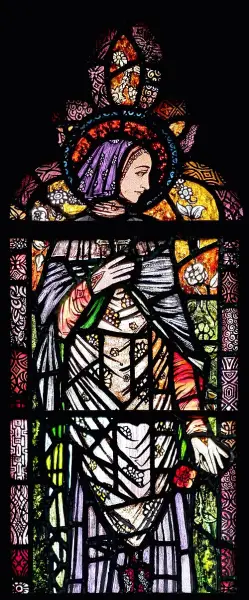
Fanchea's feast has been kept on January 1 in the three communions that honor her — the Catholic Church, the Church in Wales and the Eastern Orthodox Church. Her cult remained local and living through the medieval centuries: the parish church of Rosairthir, in the Clogher diocese of Ulster, celebrated it year by year, while at Kilhaine, by Mount Bregh on the Meath frontier, her relics were honored. The sites of her life stayed marked on the map — Rossory by Lough Erne, Killane where she sleeps, Rathmore where she was born. In a later age the artists of the Irish revival found her again: a stained-glass window of St Fachnea by Harry Clarke, the great Irish glassmaker, stands in St Joseph's Church at Carrickmacross, her figure caught in the jewel tones of the craft. Her enduring fame, however, rests on the arrangement of holy siblings she left — Enda of Aran among them — and on the tradition that the first vocation of Ireland's island of saints was won in a conversation between a brother and his abbess sister, beside a dead girl and an open grave.
§ Introduction
In Their Own Words
We will … trust to God for a passage.
The Record
- Major works
- Rossory Monastery on the banks of Lough Erne
- Canonization
- Pre-congregation; recognized as a saint by the Catholic Church, the Church in Wales and the Eastern Orthodox Church
Prayer
Bibliography
Show 5 sources
- "January 14 / January 1". Holy Trinity Orthodox Church Calendar. https://www.holytrinityorthodox.com/htc/orthodox-calendar/
- Monks of Ramsgate. "Fanchea". Book of Saints, 1921. CatholicSaints.Info. 22 February 2013
- Dunbar, Agnes Baillie Cunninghame. "St. Fanchea", A Dictionary of Saintly Women, Vol. 1, Bell, 1904
- Kennedy, Patrick. "St. Fanchea's Visit to Aran", Legendary Fictions of the Irish Celts, 1891
- Butler, Alban. The Lives of the Saints, Vol I, 1866
Profile text adapted from the Wikipedia article, licensed CC BY-SA 4.0.
Pray with this saint every day
Save St. Fanchea of Rossory to your favorites, read the full profile, and get feast-day reminders in the Saints app.
Get the Saints AppFree on the App Store for iPhone and iPad