
c. 927 – 1000·Feast August 30
St. Fantinus of Calabria
Calabrian Basilian hermit, abbot, and missionary to Greece
Overview
Fantinus of Calabria, sometimes called Fantinus the Younger to distinguish him from the earlier Fantinus the Wonderworker, stands among the notable figures of Greek monasticism in southern Italy. Born around 927 in a Calabrian locality described as the closest to Sicily, he was placed as a boy under the guidance of St. Elias the Cave-Dweller, professed a monk at thirteen, and at thirty-three withdrew to the slopes of Mount Mercurion in northern Calabria, where many monasteries and hermitages lived under the Basilian rule. There he took up a severely mortified way of life: his sole fare was uncooked greens, and his working hours went to duplicating texts by hand, and he was granted a vision of heaven and hell. Though he sought the hermit's solitude, he repeatedly came back from the wilds to guide the disciples who gathered to him, among them Nilus the Younger and Nicodemus of Mammola, and he drew his aged parents, his brothers Luke and Cosmas, and his sister Caterina into the monastic life. After Muslim raiders destroyed the monastery he had founded, an angel directed him to preach in Greece. With two companions he crossed to Corinth, Athens, and Larissa, then settled near Thessalonica, where his presence was credited with cures, the repentance of a corrupt judge, and the city's deliverance from Bulgarian capture. He died in Greece around 1000, and an eleventh-century Greek account of his life survives.
The Complete Life
A Child Given to God in the Calabrian Borderlands
Fantinus was born around 927 in Calabria, in a place his biographers describe as the locality of that region lying closest to Sicily. In the tenth century this southern fringe of Italy was a frontier: Byzantine in its liturgy and culture, exposed to the sea lanes that brought both traders and raiders, and dotted with the settlements of Greek-speaking monks. Into this world his parents, George and Vriena, welcomed a son whom they would one day follow into monastic life. While he was still a child they introduced him to St. Elias the Cave-Dweller, and his spiritual education was entrusted to this celebrated ascetic. The arrangement shaped everything that followed. Fantinus never appears to have weighed any other vocation; the formation he received from Elias set his feet on the monk's path before the ordinary choices of life could distract him. Nor was his example a private thing. In time his aged parents, his brothers Luke and Cosmas, and his sister Caterina all embraced the monastic state, a family converted as it were in a single generation. The sources say little of his earliest years beyond these outlines, but the pattern is clear: a household of faith, a child placed under a holy master, and a vocation that matured early and never wavered.
§ Fantinus Italian saint (c. 927–1000)
Monk, Porter, and Hermit of Mount Mercurion
At the age of thirteen Fantinus became a monk, and, as novices in a disciplined house must, he was given lowly duties: first in the kitchen, later at the door, where he kept the gate and receiving whoever came seeking prayer or counsel. The progression from kitchen to doorway marked him out for something more. At thirty-three he pulled back from communal life to live as a solitary on Mount Mercurion, in the north of Calabria — a district thick with Basilian houses and hermit dwellings. His asceticism there was extreme. He ate only raw vegetables, refusing the comfort of cooked food, and he filled the long hours of silence with the copying of manuscripts, so that his hands served the Scriptures even as his body stood watch. To this regimen was added a mystical grace: he experienced a vision of heaven and hell that confirmed the eternal weight of his chosen life. Yet Fantinus did not disappear into the mountain. He lived now as a hermit, now as a monk and abbot; once he took up strict solitude, he put the men's monastery he had established under his brother Lucas's charge. From the wild he often returned to serve as guide and spiritual teacher to the disciples who sought him, among them Nilus the Younger and Nicodemus of Mammola.
§ Fantinus Italian saint (c. 927–1000)
Across the Sea: Apostolate in Greece
Muslim raiders razed the monastery Fantinus had founded while he still lived — a blow that might have crushed a lesser man, yet it opened the door to the last chapter of his work. An angel bade him evangelize Greece, and in obedience he took leave of Calabria in the company of two disciples, Vitalis and Nicephorus. Even the voyage bore the mark of heaven: when the ship's supply of drinking water failed, Fantinus blessed a vessel of brine with the sign of the cross, and its contents turned sweet enough to drink. In Greece the old ascetic moved through the great stations of the faith. He visited Corinth and Athens, and came to Larissa, where he chose to live near the sepulcher of St. Achillius of Larissa. He spent four months in a monastery dedicated to St. Menas near Thessalonica, and then settled outside the walls of that city. Thessalonica became the theater of his final ministry: he cured the sick who were brought to him, and he brought a crooked magistrate to sorrow for his wrongdoing — a moral conquest no less remarkable than his cures. The citizens went further and credited him with the city's very survival, believing his intercession had held off a Bulgarian assault on Thessalonica.
§ Greece
Exile, Spiritual Fatherhood, and Death in Greece
The last years of Fantinus's life were spent as an exile who had ceased to mourn his exile. The raiders' destruction of his monastery had severed him from the place he had built, yet his spiritual fatherhood traveled with him. Disciples still found him out; he still returned from solitude to teach, and the two companions who crossed the sea with him, Vitalis and Nicephorus, remained witnesses of his final ministry. In the neighborhoods of Thessalonica his days took on the character of quiet apostolate: prayer at the shrine of a sainted bishop in Larissa, residence among the monks of St. Menas, care for the sick, and the unlooked-for conquest of a hardened judge's conscience. The tradition that he averted a Bulgarian assault on the city shows how closely his presence became identified with the safety of the people among whom he had settled. He died in Greece around the year 1000, far from the Calabrian cave where his monastic life had been formed, but among Christians who had come to regard him as their protector. For a hermit who had sought obscurity, his death in a foreign land closed a life that had been, against his own preference for solitude, remarkably public in its effects.
§ Greece
Memory in East and West
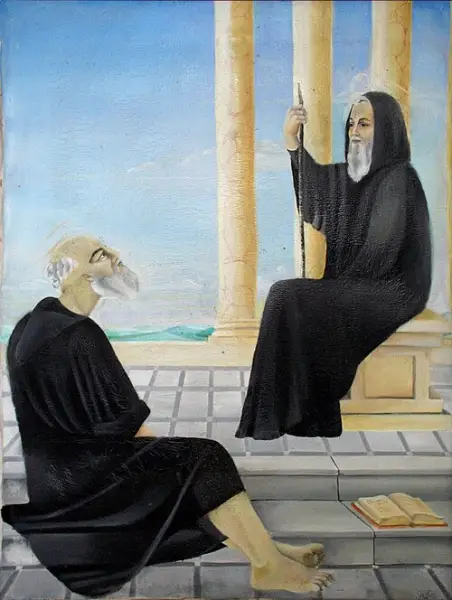
Fantinus belongs to both the churches he served by his life. He is venerated in the Roman Catholic Church and in the Eastern Orthodox Church, and his feast is kept on August 30. Because a formal act of canonization does not attach to his name, he stands among the saints whose cult arose by ancient custom rather than by papal decree. His memory was committed to writing early: an eleventh-century Greek life of Fantinus has come down to us, and modern scholarship has given it new circulation through the edition and Italian translation of Enrica Follieri, published at Brussels under the auspices of the Bollandists. The distinction later writers draw between Fantinus the Younger and the earlier Fantinus the Wonderworker, or the Elder, testifies to how many holy men bore the name in Calabria and how carefully local tradition preserved their identities. His influence continued through the disciples he formed, above all Nilus the Younger, who carried the Basilian tradition forward into the next generation. In art he is remembered at the Sanctuary of San Nicodemo in Mammola, where a painting shows the saint, and the faithful of Calabria and of Greece alike continue to honor the cook, porter, hermit, and missionary who renounced everything and found it restored a hundredfold.
§ References
Timeline
- 927
Born in Calabria, in a locality described as the closest to Sicily
§ Introduction
- 940
Professed a monk aged thirteen; served in turn as cook and then as gatekeeper
§ Introduction
- 960
Became a hermit at thirty-three in the region of Mount Mercurion in northern Calabria
§ Introduction
- 1000
Died in Greece after years of preaching and ascetical witness there
§ Greece
The Record
- Major works
- A monastery for men under the Basilian rule at Mount Mercurion
- Canonization
- Pre-congregation; venerated in both the Roman Catholic and Eastern Orthodox churches
Prayer
Bibliography
Show 5 sources
- Saint of the Day, August 30: Fantinus of Calabria. SaintPatrickDC.org. Retrieved 2012-03-18.
- San Fantino il Giovane. Retrieved 2012-03-18. (in Italian)
- San Fantino il Vecchio (o il Taumaturgo). Retrieved 2012-03-18. (in Italian)
- Orthodox Europe :: Italy
- Follieri, Enrica (1993). La vita di San Fantino il Giovane: introduzione, testo greco, traduzione commentario e indici. Brussels: Société des Bollandistes. ISBN 2873650052.
Profile text adapted from the Wikipedia article, licensed CC BY-SA 4.0.
Pray with this saint every day
Save St. Fantinus of Calabria to your favorites, read the full profile, and get feast-day reminders in the Saints app.
Get the Saints AppFree on the App Store for iPhone and iPad