
1840 – 1889·Feast May 10
St. Damien of Molokai
Apostle of the lepers of Molokai and martyr of charity
Overview
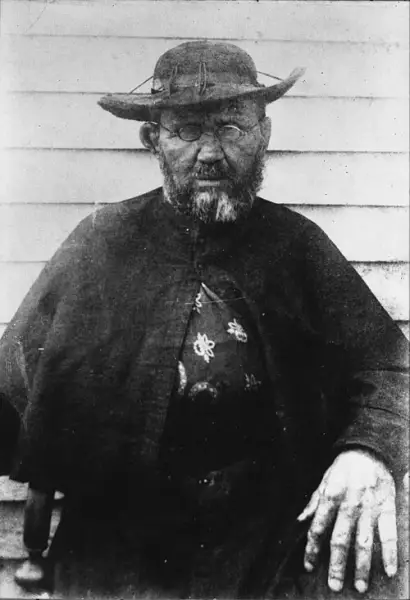
Damien de Veuster, born Jozef De Veuster, was a Belgian priest belonging to the Congregation of the Sacred Hearts of Jesus and Mary, and he gave the final sixteen years of his life serving the leper colony on the Kalaupapa peninsula of Molokai in the Kingdom of Hawaii. The youngest of seven children of a Flemish corn merchant, he left school at thirteen to work the family farm, but a Redemptorist mission in 1858 turned him toward religious life. His superiors doubted his education, yet intensive tutoring carried him through, and in 1864 he reached Honolulu, where he was ordained. When the Hawaiian kingdom, desperate to contain an epidemic of leprosy, quarantined its worst cases to Kalawao on Molokai, Bishop Louis Désiré Maigret asked for volunteers rather than impose the deadly assignment by obedience. Damien was the first of four priests to step forward, arriving at the settlement on 10 May 1873. There he built churches and homes, dressed ulcerated wounds, dug graves, organized farms and schools, and ate from the same bowl as his people. In 1884 he discovered, when scalding water blistered his foot without pain, that he had caught the disease himself; he kept working until he died of leprosy, complicated by tuberculosis, on 15 April 1889, aged forty-nine. Remembered as a martyr of charity, he was canonized by Pope Benedict XVI in 2009.
The Complete Life
A Farm Boy from Flemish Brabant
Jozef De Veuster first saw the light of day on 3 January 1840 at Tremelo, a village of the Flemish countryside in Brabant, the youngest of the seven children of Joannes Franciscus De Veuster, a Flemish corn merchant, and his wife Anne-Catherine Wouters. Religion ran deep in the household: his sisters Eugénie and Pauline would both enter religious orders, and his elder brother Auguste joined the Congregation of the Sacred Hearts of Jesus and Mary. Formal schooling ended early for the boy everyone called Jef; at thirteen he was taken out of school to labor on the family farm. His father saw promise in the boy and enrolled him at a college in Braine-le-Comte with a business career in view; for a while, trade and farming seemed his destined lot. That expectation collapsed in 1858, when the young man attended a mission preached by the Redemptorists. The retreat settled the question of his life: he would give himself to God. What he lacked in learning he would supply in resolve, and the peasant boy from Tremelo began the long road that would carry him to the far side of the world.
§ Early life
Novice at Leuven, Missionary in Spirit
At Leuven, Jozef began his novitiate among the Fathers of the Sacred Hearts of Jesus and Mary, assuming the religious name Damien — most likely in honor of the fourth-century physician and martyr of that name. He was admitted to profession on 7 October 1860, but his path was not smooth. His superiors judged him a poor candidate for the priesthood on account of his insufficient education, though they did not deny his intelligence. The gap was closed by family love: his brother Auguste tutored him intensively in Latin until the superiors permitted him to continue his studies. Through those years Damien cultivated the missionary longing that would define him. Each day he prayed before an image of St. Francis Xavier, the great patron of missionaries, asking to be sent out to the missions. The opportunity came sooner than expected. Auguste had been designated for the Hawaiian mission, but ill health barred his journey, and Damien was allowed to take his brother's place. On 19 March 1864 he landed at Honolulu Harbor on Oahu, and on 21 May 1864 he was ordained a priest at what is now the Cathedral of Our Lady of Peace, beginning a ministry among a people devastated by imported disease.
§ Early life
Hawaii and the Gathering Storm of Leprosy
Damien's first assignment came in 1865, when he was sent to the Catholic mission in North Kohala on the island of Hawaii, and he afterwards served in several parishes on Oahu. He arrived in a kingdom in crisis. Foreign traders, sailors, and immigrants had imported illnesses to which Native Hawaiians possessed no resistance — leprosy, smallpox, cholera, influenza, syphilis, whooping cough — and the death toll ran into the thousands. Leprosy, the illness now named Hansen's disease, is thought to have reached the islands with Chinese laborers during the 1830s and 1840s, and the medicine of the day judged it both incurable and extremely contagious. Fear moved the government to act: in 1865 King Kamehameha V and the Hawaiian Legislature adopted the Act to Prevent the Spread of Leprosy, ordering the gravest cases removed to Kalawao, a settlement on the eastern tip of Molokai's Kalaupapa peninsula, sealed off from the remainder of the island by a sheer mountain wall. Between 1866 and 1969 roughly eight thousand Hawaiians were exiled to that ground. The Royal Board of Health supplied food but had neither the workforce nor the resources for real care, and the Kingdom, though it had not intended a penal colony, provided too little support for the exiles to survive decently. By 1868 disorder reigned in the settlement.
§ Mission in Hawaii
Making Himself a Leper with the Lepers
Bishop Louis Désiré Maigret, vicar apostolic of Honolulu, knew the lepers needed a Catholic priest, and knew equally well that the assignment might be a death sentence. He would not command any man into it under obedience. Four priests offered themselves after prolonged prayer, and Damien was the first chosen, arriving at Kalaupapa on 10 May 1873, when the settlement held six hundred patients. His method was presence. He began at once building a church and founding the Parish of Saint Philomena, but he also dressed the residents' ulcers, built homes and furniture and a reservoir, made coffins, and dug graves with his own hands. He ate poi from a common bowl, shared pipes with the patients, and lived among them as an equal, telling them that however the outside world despised them, they remained precious in the eyes of God. He organized the community: basic laws enforced, shacks rebuilt as painted houses, working farms and schools established, chapels, roads, and hospitals raised. Six months after arriving he wrote to his brother in Europe that he made himself a leper with the lepers to gain them all for Jesus Christ — the sentence that sums up his spirituality of total identification with the afflicted.
§ Mission on Molokai
The Disease He Shared, and a Holy Death
In December 1884, while preparing to bathe, Damien scalded his foot in boiling water and felt nothing. The blistered, painless skin told him what he had long dreaded: he had contracted leprosy. He kept working. In 1885 the Japanese leprologist Masanao Goto arrived in Honolulu; his regimen of nourishing food, moderate exercise, friction, ointments, and medical baths eased some of Damien's symptoms and won the patients' affection, and Damien declared he wanted to be treated by Goto alone, who became a good friend. Knowing his time was short, the dying priest drove himself through a last burst of projects, completing building works, improving orphanages, and continuing his pastoral rounds even as the disease dragged his leg, bandaged his foot, and pinned his arm in a sling. Help arrived in the persons of four volunteers: the Belgian priest Louis Lambert Conrardy, who took over his pastoral duties; Joseph Dutton, a Civil War veteran who maintained the buildings; James Sinnett, a Chicago male nurse who nursed him at the end; and Mother Marianne Cope, who organized a working hospital. Bedridden from 23 March 1889, Damien made a general confession on 30 March and died of leprosy at eight in the morning on 15 April 1889, aged forty-nine. The whole settlement followed his coffin to a grave beneath the pandanus tree where he had first slept on Molokai.
§ Illness and death
From Controversy to the Altars
Damien's cause advanced through the slow juridical paths of the Church. In 1895 Sister Simplicia Hue lay dying in France of an intestinal disorder no physician could cure; she sought Damien's intercession through a novena and found her pain and symptoms gone overnight; in 1977 Pope Paul VI declared him venerable. A second healing followed: in 1997 the Hawaiian woman Audrey Toguchi was diagnosed with liposarcoma, the cancer spread to her lungs, and her physician told her no one survived it; after praying at Damien's gravesite on Molokai she went into remission, without medical explanation, and was still alive in 2016. In April 2008 the Vatican accepted both cases as genuine miracles, and on 3 July 2008 Pope Benedict XVI approved the decree for beatification, promulgated by Cardinal José Saraiva Martins; the ceremony took place in Rome with festivities in Belgium and Hawaii, and afterwards his right hand's relics went back to Hawaii for reburial in his first grave on Molokai. On 21 February 2009 the Vatican announced his canonization, performed on 11 October 2009, with King Albert II and Queen Paola of Belgium and Prime Minister Herman Van Rompuy present. President Barack Obama paid the new saint tribute, saying he had lent a voice to those without one and restored the sick to dignity.
§ Canonization
Honor in Hawaii, Belgium, and the Wider World
Few modern saints have left so wide a wake. King David Kalākaua made Damien a Knight Commander of the Royal Order of Kalākaua, and the medal — which Damien is believed never to have worn — was placed beside him at his funeral. His death, flashed around the globe by steamship, telegraph, and cable, made him an international figure; Robert Louis Stevenson's open letter of 1890 demolished the attacks of the Reverend Charles McEwen Hyde and became the most famous account of his life, while Mahatma Gandhi later credited Damien's example as an inspiration for his own campaigns in India. In January 1936, at the request of King Leopold III, his body was carried home on the Belgian ship Mercator and buried at Leuven, near Tremelo. In 2005 Flemish viewers named him The Greatest Belgian in VRT polling, and he ranked third in the French-speaking RTBF version. Father Damien Day, April 15, is a minor state holiday in Hawaii, where his statue stands at the Capitol and a replica in the National Statuary Hall in Washington. His ministry to leprosy patients is now cited as a model for care of HIV/AIDS sufferers, and schools, parishes, hospitals, and charities on several continents carry his name.
§ Legacy and honors
Timeline
- 3 Jan 1840
Born Jozef De Veuster on 3 January at Tremelo in Flemish Brabant, Belgium, the youngest of seven children
§ Early life
- 1858
Decided to pursue a religious vocation after attending a Redemptorist mission
§ Early life
- 7 Oct 1860
Admitted to religious profession on 7 October, taking the name Damien at the Leuven novitiate
§ Early life
- 19 Mar 1864
Landed at Honolulu Harbor on Oahu on 19 March
§ Mission in Hawaii
- 21 May 1864
Ordained a priest on 21 May at what is now the Cathedral of Our Lady of Peace
§ Mission in Hawaii
- 1865
Assigned to the Catholic mission in North Kohala on the island of Hawaii
§ Mission in Hawaii
- 1865
King Kamehameha V signs the Act to Prevent the Spread of Leprosy, quarantining serious cases to Molokai
§ Mission in Hawaii
- 10 May 1873
Arrived with Bishop Maigret at the Kalaupapa settlement on 10 May and founded the Parish of Saint Philomena
§ Mission on Molokai
- Dec 1884
Realized in December he had contracted leprosy when scalding water blistered his foot without pain
§ Illness and death
- 1885
Underwent treatment by the Japanese leprologist Masanao Goto, who became a close friend
§ Illness and death
- 15 Apr 1889
Bedridden from 23 March, made a general confession on 30 March, and died of leprosy on 15 April at age 49
§ Illness and death
- Feb 1890
Robert Louis Stevenson published his open letter rebutting attacks on Damien's memory
§ Stevenson letter
- 1895
Sister Simplicia Hue reported an overnight cure after praying a novena for Damien's intercession
§ Beatification
- Jan 1936
Body returned to Belgium in January at the request of King Leopold III and buried in Leuven
§ Legacy and honors
- 1977
Declared venerable by Pope Paul VI
§ Beatification
- 4 Jun 1995
Beatified on 4 June by Pope John Paul II; his right hand was afterwards re-interred on Molokai
§ Canonization
- 3 Jul 2008
Pope Benedict XVI approved the decree on the miracles credited to his intercession, promulgated by Cardinal Jose Saraiva Martins on 3 July
§ Beatification
- 21 Feb 2009
The Vatican announced on 21 February that he would be canonized
§ Canonization
- 11 Oct 2009
Canonized on 11 October by Pope Benedict XVI in Rome
§ Canonization
In Their Own Words
If that world at all remember you, on the day when Damien of Molokai shall be named a Saint, it will be in virtue of one work: your letter to the Reverend H. B. Gage.
The political and journalistic world can boast of very few heroes who compare with Father Damien of Molokai. The Catholic Church, on the contrary, counts by the thousands those who, after the example of Fr. Damien, have devoted themselves to the victims of leprosy. It is worthwhile to look for the sources of such heroism.
The Record
- Major works
- Parish of Saint Philomena at Kalawao·Homes, chapels, roads, hospitals, and churches built with the residents of Kalaupapa·Working farms and schools organized within the settlement
- Patron of
- People with leprosy·Outcasts·Diocese of Honolulu·Hawaii
- Canonization
- Beatified 4 June 1995 by Pope John Paul II; canonized 11 October 2009 by Pope Benedict XVI
Prayer
Bibliography
Show 6 sources
- Downes, Patrick (26 April 2013). "St. Damien's feast day not the customary date of death". Hawaii Catholic Herald. Honolulu, HI.
- Tayman, John (2007). The Colony: The Harrowing True Story of the Exiles of Molokai. New York: Simon and Schuster. ISBN 978-0-7432-3301-9.
- Moblo, Pennie (1997). "Blessed Damien of Moloka'i: The Critical Analysis of Contemporary Myth". Ethnohistory. 44 (4). Duke University Press: 691–726. doi:10.2307/482885.
- Stevenson, Robert Lewis (1922). "Father Damien – An Open Letter to the Reverend Dr. Hyde of Honolulu". The Works of Robert Louis Stevenson, Volume 15. pp. 479–501.
- Daws, Gavan (1984). Holy Man: Father Damien of Molokai. Honolulu: University of Hawai'i Press. ISBN 0-8248-0920-3.
- "CATHOLIC ENCYCLOPEDIA: Father Damien". www.newadvent.org.
Profile text adapted from the Wikipedia article, licensed CC BY-SA 4.0.
Pray with this saint every day
Save St. Damien of Molokai to your favorites, read the full profile, and get feast-day reminders in the Saints app.
Get the Saints AppFree on the App Store for iPhone and iPad