
c. 298 – 311·Feast September 20
St. Fausta of Cyzicus
Thirteen-year-old martyr whose courage converted her executioner
Overview
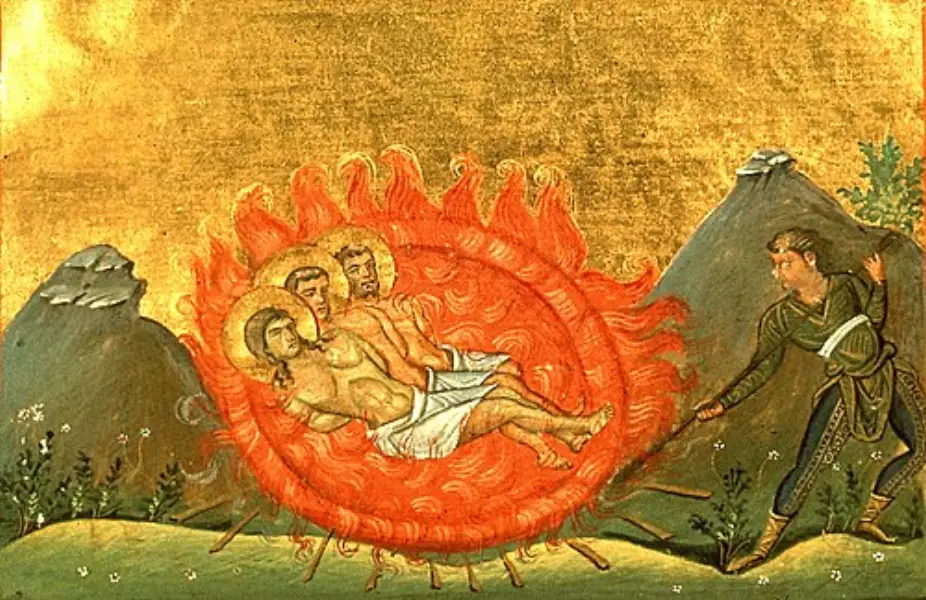
Fausta of Cyzicus was a girl of the great Asian port city of Cyzicus, on the southern shore of the Sea of Marmara in what is now Turkey, who died a Christian martyr at the age of thirteen in about the year 311. Arrested for confessing the faith during the era of the last great persecutions, she was handed over for torture, yet remained unmoved under the torments inflicted upon her. The officer charged with breaking her was a pagan priest named Evilasius. Watching the child resist with a courage his gods could not explain, he was converted on the spot, and for that conversion he too was condemned. When the initial tortures left Fausta untouched, the two confessors were put to death side by side in a vat of scalding water. A third name is joined to theirs: Maximus, the magistrate who sentenced Evilasius, repented at the final moment and stepped into the cauldron beside them. Tradition numbers all three among the martyrs venerated by the Roman Catholic Church, the Eastern Orthodox Church, and the Eastern Catholic Churches. Their memory was already treasured a millennium ago, for an illumination in the Menologion of Basil II, made around the year 1000, shows Fausta standing with Evilasius and Maximus at Cyzicus.
The Complete Life
A Christian Girl of Cyzicus
Fausta was born around the year 298 in Cyzicus, one of the most important cities of Roman Asia Minor, set on the southern shore of the Sea of Marmara in present-day Balıkesir Province, Turkey. She came into the world at the close of the third century, when the Christian communities of Asia Minor were numerous and flourishing but never safe, and her childhood fell in the years of the empire's most determined attempt to destroy them. Of her family and formation the sources say nothing beyond what her fate reveals: by the age of thirteen she was a Christian firm enough in her faith to be arrested for it, in an age when that simple confession carried a capital price. Cyzicus itself, with its harbors, temples, and imperial connections, was a place where the old religion was deeply rooted, and a Christian girl there stood against the current of her whole city. Nothing else of her short life has survived, but the essentials endure — a child of the church at Cyzicus, reared in the faith for which she would soon be asked to die, and found, when the test came, entirely willing.
§ Fausta of Cyzicus 4th-century Christian martyr and saint
Torment, Conversion, and the Cauldron
At thirteen Fausta was arrested, tortured, and condemned to death for her Christianity, in about the year 311. The man charged with extracting her renunciation was Evilasius, a pagan priest, and he applied the torments with the authority of his office. The torments achieved nothing: Fausta stood unmoved beneath all that was inflicted, and the sight of that childlike endurance worked on her persecutor more powerfully than any argument. According to tradition, Evilasius became a Christian then and there, converted by watching her courageous resistance — and for that conversion he was himself condemned to die. The tribunal's answer to both confessors was the same vessel: since the earlier torments had left Fausta untouched, she and Evilasius met their end together, boiled alive. At that point a third figure entered the story. Maximus, the magistrate who had passed sentence on Evilasius, was moved to repentance at the last moment, and tradition holds that he joined the pair in the cauldron, dying with those he had condemned. In this way the execution meant to silence one adolescent believer became, by God's reversal, the birth of three martyrs: the child who would not deny Christ, the priest converted by her bravery, and the judge converted at the brink of eternity.
§ Fausta of Cyzicus 4th-century Christian martyr and saint
Venerated Across Three Traditions
The memory of Fausta did not fade with the cauldron at Cyzicus. She has been honored as a saint since the earliest centuries, without any formal process of canonization, for her cult arose directly from the veneration of the martyrs. She is venerated today in the Roman Catholic Church, which keeps her feast on September 20, and in the Eastern Orthodox Church, which keeps it on February 6, and she is joined in the calendars of the Eastern Catholic Churches with her companions Evilasius and Maximus. The three are remembered as a single company: the tortured girl, the converted persecutor, and the repenting judge, a witness to the power of one young life's fidelity to redraw the destinies of others. Their story was judged worth painting even a thousand years afterwards, when the artists of the Menologion of Basil II, the great Byzantine collection of saints' lives made around the year 1000, depicted Fausta standing with Evilasius and Maximus at Cyzicus. For every generation since, she has remained a patron of Christian youth under pressure, proof that neither weakness of years nor the cruelty of the mighty can separate a believer from the love of Christ.
§ References
Timeline
- 298
Born at Cyzicus around this year.
§ Introduction
- 311
Arrested at the age of thirteen for being a Christian.
§ Introduction
- 311
Tortured by the pagan priest Evilasius, who converted after watching her courageous resistance.
§ Introduction
- 311
Executed with Evilasius in a cauldron of boiling water; the magistrate Maximus repented and joined them.
§ Introduction
- 1000
Shown with Evilasius and Maximus at Cyzicus in the Menologion of Basil II, made around this year.
§ Introduction
The Record
- Canonization
- Pre-congregation; honored as a martyr since antiquity
Prayer
Bibliography
Show 2 sources
- "Saint Who? Saint Fausta of Cyzicus". Magnificat. 20 (9). Magnificat USA: 332. November 2018.
- Catholic Online.
Profile text adapted from the Wikipedia article, licensed CC BY-SA 4.0.
Pray with this saint every day
Save St. Fausta of Cyzicus to your favorites, read the full profile, and get feast-day reminders in the Saints app.
Get the Saints AppFree on the App Store for iPhone and iPad