
1905-1938·Feast October 5
St. Faustina Kowalska
Virgin, Apostle of Divine Mercy
Overview
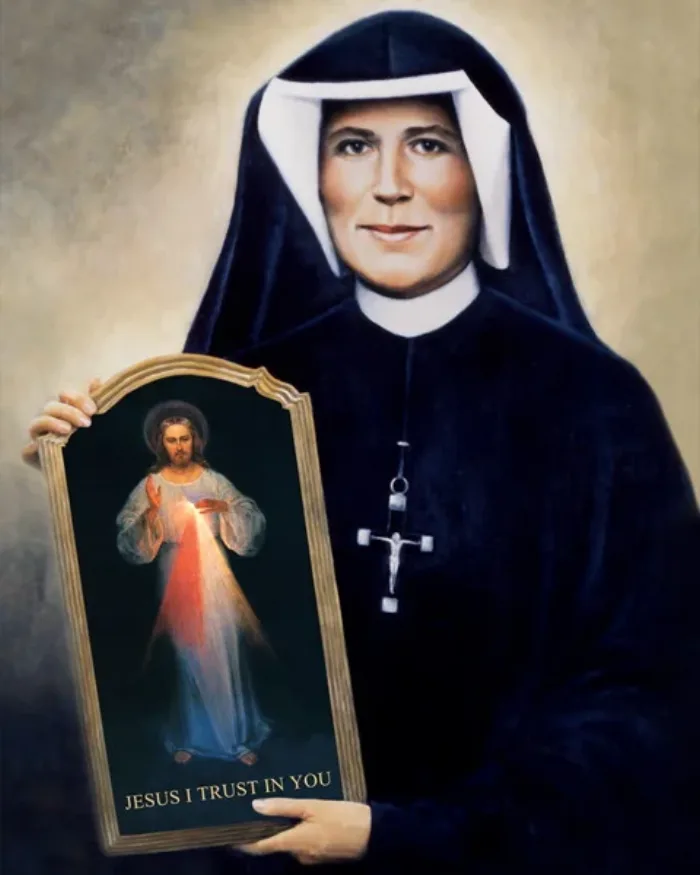
Helena Kowalska was born in 1905 at Głogowiec, third of ten children of a poor carpenter's household. At sixteen she left home to work as a housemaid, though she had already sensed a call to religious life from childhood; at a Łódź dance in 1924 she reported a vision of the suffering Christ asking how long she would put him off, and boarded a train for Warsaw. Accepted after a year of saving her wages, she received the habit in 1926 and the name Maria Faustina of the Blessed Sacrament, professing first vows in 1928 and final vows in 1933. Posted to Płock, then Vilnius, then Kraków as cook and gardener, she carried an interior life of extraordinary intensity: she wrote in her diary that on the night of 22 February 1931 Jesus appeared with red and pale rays streaming from his heart and asked for an image painted with the words 'Jesus, I trust in You.' In Vilnius she found her great support in Fr. Michał Sopoćko — who first had her examined by a psychiatrist — and by June 1934 Eugeniusz Kazimirowski had painted the first Divine Mercy image under her direction. There too she recorded the visions of September 1935 that gave the Church the Chaplet of Divine Mercy. Her writings were banned by the Holy Office from 1959 to 1978, on the basis of faulty translations, before being rehabilitated. Weakened by tuberculosis, she died in Kraków on 5 October 1938, aged thirty-three, and was buried at the Łagiewniki sanctuary where pilgrims now gather by the thousands.
The Complete Life
Early Life
Helena Kowalska was born on 25 August 1905 at Głogowiec in central Poland, the third of ten children of a poor carpenter's household. Her schooling ended at about fourteen; she left home at sixteen to work as a housemaid, first for shopkeepers in Aleksandrów and then in Łódź. She had sensed a call to religious life from childhood, but her parents, needing her wages, would not hear of it. The decisive moment came at a dance in Łódź in 1924 — a pleasure she had allowed herself on her way home from shopping — when, as she tells it in her diary, she saw the suffering Christ asking how long she would keep putting him off. She went at once to a church, was told to pray, and boarded a train for Warsaw the same night, with nothing arranged, to seek a convent.
§ Introduction
Religious Life
In Warsaw she was refused house after house until the Congregation of the Sisters of Our Lady of Mercy accepted her, on condition she first pay her own keep as a domestic. She received the habit in 1926 and the name Maria Faustina of the Blessed Sacrament, made first vows in 1928 and perpetual vows in 1933 at Łagiewniki, Kraków. Her convent life was outwardly unremarkable: she was posted to Płock, then Vilnius, then Kraków, working as cook, gardener and portress, the humble offices of a large community. Inwardly it was extraordinary — visions, locutions, and a continual interior companionship with Christ that her confessers at first doubted and her superiors found tiresome, until her diary made its scope plain.
§ Introduction
The Message of Divine Mercy
On the night of 22 February 1931, at Płock, she wrote that Jesus appeared with red and pale rays streaming from his heart, and asked for an image painted with the words 'Jesus, I trust in You.' The image, the chaplet, and a feast of mercy on the Sunday after Easter — together with an insistence, in the words she recorded, that the greater the sinner the greater the right to his mercy — form the message for which she is called the secretary and apostle of Divine Mercy. In Vilnius she found her great support in Father Michał Sopoćko, a priest who first prudently had her examined by a psychiatrist, found her sane, and then became the promoter of her message; by June 1934 Eugeniusz Kazimirowski had painted the first Divine Mercy image under her direction. The visions of 13-14 September 1935 gave her the Chaplet of Divine Mercy, the prayer since recited by millions.
§ Płock and Divine Mercy image
Final Years
In 1936 she was transferred to Walendów and then to Kraków, where tuberculosis took hold. She was also, in these years, caught between Rome's caution and the growing devotion: her diary was submitted to the Holy Office, and she submitted to its restrictions without complaint, though the message spread meanwhile through Sopoćko's preaching and the image. She spent her last months in the sanatorium at Kraków-Prądnik, writing as her strength allowed, and died in the convent at Łagiewniki on 5 October 1938, aged thirty-three. Her tomb is in the Divine Mercy Sanctuary at Kraków, which now draws pilgrims from every continent.
§ References
Canonization
The rehabilitation of Faustina's cause was one of the astonishing reversals of modern church history. The diary, placed on the Index in 1959 because of faulty translations and misunderstandings, was rehabilitated in 1978 — the year Karol Wojtyła became pope. Pope John Paul II beatified her in 1993 and canonized her on 30 April 2000, the first saint of the new millennium; on the same day he established, for the universal Church, Divine Mercy Sunday on the octave of Easter — the very feast she had recorded being asked for. The miracle accepted for her canonization was the healing of Father Ronald Pytel of Baltimore in 1995.
§ Sainthood
Legacy
Faustina's legacy is one of the largest of any modern saint: the Divine Mercy devotion, with its image, chaplet, novena and feast, is practiced worldwide across every continent of the Church, and the sanctuary at Łagiewniki has become one of the great pilgrimage centers of the world. The message that mankind will not have peace until it turns with trust to God's mercy was taken up by John Paul II, whose own death in 2005 fell on the vigil of Divine Mercy Sunday and was himself canonized on that feast. For Poland she is a national figure; for the universal Church, the secretary of a doctrine — that God's mercy is greater than any sin — that the twentieth century's survivors received as good news indeed.
§ Introduction
Timeline
- 25 Aug 1905
Born Helena Kowalska at Głogowiec, Łęczyca County, third of ten children.
§ Early life
- 1924
At a dance in Łódź she saw a vision of the suffering Christ, then left for Warsaw without her parents' leave to seek a convent.
§ Entering a Warsaw convent
- 1925
After a year working as a housemaid and depositing savings, she was finally accepted into the Warsaw convent.
§ Entering a Warsaw convent
- 30 Apr 1926
Clothed in the habit at age twenty and given the name Maria Faustina of the Blessed Sacrament.
§ Entering a Warsaw convent
- Apr 1928
Completed the novitiate and took her first religious vows, with her parents present.
§ Entering a Warsaw convent
- Feb 1929
Posted to the convent in Vilnius to serve as cook, remaining until April.
§ Entering a Warsaw convent
- May 1930
Transferred to the convent in Płock for nearly two years; that year the first signs of her future illness appeared.
§ Płock and Divine Mercy image
- 22 Feb 1931
Recorded a night vision in her Płock cell of Christ robed in white with red and pale rays streaming from his heart, asking that an image be painted.
§ Płock and Divine Mercy image
- Nov 1932
Returned to Warsaw to prepare for her final vows as a perpetual sister of Our Lady of Mercy.
§ Płock and Divine Mercy image
- 1 May 1933
Made her perpetual vows in a ceremony at Łagiewniki.
§ Płock and Divine Mercy image
- May 1933
Transferred to Vilnius as gardener; there she met Father Michał Sopoćko, her future confessor and supporter.
§ Vilnius and meeting Sopoćko
- Jun 1934
Eugene Kazimierowski finished painting the first Divine Mercy image under her direction, the only such painting she ever saw.
§ Vilnius and meeting Sopoćko
- 28 Apr 1935
Attended the first Mass at which the Divine Mercy image was publicly displayed, closing the Jubilee of the Redemption.
§ Vilnius and meeting Sopoćko
- 13 Sep 1935
Wrote of visions over two days in which she received the Chaplet of Divine Mercy.
§ Vilnius and meeting Sopoćko
- Mar 1936
Told her superiors she wished to leave for a congregation devoted to Divine Mercy, but was transferred to Walendów near Warsaw.
§ Vilnius and meeting Sopoćko
- 1936
Her health failed — from tuberculosis, it is believed — and she was sent to convalesce at the Prądnik sanatorium in Kraków.
§ Kraków and final years
- Nov 1937
A pamphlet titled Christ, King of Mercy appeared, carrying the chaplet, novena, litany and the Divine Mercy image.
§ Kraków and final years
- Apr 1938
Sent to the Prądnik sanatorium for a final stay as her illness advanced.
§ Kraków and final years
- Sep 1938
Brought back from the sanatorium to the Kraków convent as death approached; Sopoćko saw her there for a final time on 26 September.
§ Kraków and final years
- 5 Oct 1938
Died in Kraków aged thirty-three; buried two days later, she now rests in the Basilica of Divine Mercy.
§ Introduction
- Mar 1959
The Holy Office banned circulation of images and writings promoting the Divine Mercy devotion in the forms she proposed.
§ Diary: Divine Mercy in My Soul
- 15 Apr 1978
The Congregation for the Doctrine of the Faith rescinded the 1959 notification, lifting the ban on her work.
§ Diary: Divine Mercy in My Soul
- Mar 1981
Maureen Digan reported a healing while praying at Kowalska's tomb, the miracle cited for her beatification.
§ Miracles
- 1992
The Vatican declared Digan's healing miraculous, clearing the way for beatification.
§ Miracles
- 18 Apr 1993
Beatified in St. Peter's Square by Pope John Paul II.
§ Sainthood
- 20 Dec 1999
Decree recognizing the healing of Father Ronald Pytel as the canonization miracle was promulgated in the Pope's presence.
§ Miracles
- 30 Apr 2000
Canonized in St. Peter's Square by Pope John Paul II, who the same day established Divine Mercy Sunday for the universal Church.
§ Sainthood
- 18 May 2020
Pope Francis inscribed her memorial into the General Roman Calendar as an optional observance.
§ Sainthood
In Their Own Words
Jesus, I trust in You!
there will be a war, a terrible, terrible war
My one occupation is to live in the presence of my Heavenly Father.
My one occupation is to live in the presence of my Heavenly Father.
The Record
- Major works
- Diary: Divine Mercy in My Soul·The Chaplet of Divine Mercy (received in vision)·The Novena of Divine Mercy (received in vision)
- Symbols
- The Divine Mercy image·Signature 'Jesus, I trust in You'
- Canonization
- Canonized by Pope John Paul II on 30 April 2000; the same pope established Divine Mercy Sunday for the universal Church
Prayer
Bibliography
Show 12 sources
- ↑ Alban Butler and Paul Burns, 2005, Butler's Lives of the Saints , Burns and Oats. ISBN 0-86012-383-9 . p. 251.
- ↑ "St. Faustina Kowalska - Information on the Saint of the Day - Vatican News" .
- 1 2 3 Vatican web site: Biography of Faustina Kowalska .
- 1 2 3 Pope John Paul II , Homily for the Canonization of Sr Mary Faustina Kowalska , 30 April 2000 .
- ↑ Martyrologium Romanum (Typis Vaticanis 2004) ISBN 9788820972103 , p. 557
- ↑ Odell, Catherine M. (1998). p. 14 .
- ↑ Guiley 2001 , p. 106.
- ↑ Diary of St. Faustina, par. 9
- ↑ Guiley 2001 , pp. 106–107.
- ↑ The Diary of Saint Maria Faustina Kowalska: Divine Mercy In My Soul , Saint Faustina Kowalska, 2002, Marians of the Immaculate Conception (Notebook I, items 10 and 11).
- 1 2 3 4 5 6 7 8 9 10 11 12 Odell, Catherine M. (1998). Faustina. The Apostle of Divine Mercy . Huntington, Indiana : Our Sunday Visitor Publishing . pp. 191– 194. ISBN 978-08-7973-923-2 .
- ↑ Torretto 2010 , p. 10.
Profile text adapted from the Wikipedia article, licensed CC BY-SA 4.0.
Pray with this saint every day
Save St. Faustina Kowalska to your favorites, read the full profile, and get feast-day reminders in the Saints app.
Get the Saints AppFree on the App Store for iPhone and iPad