
c. 405 – c. 490·Feast September 28
St. Faustus of Riez
Abbot and bishop who opposed Pelagianism in Gaul
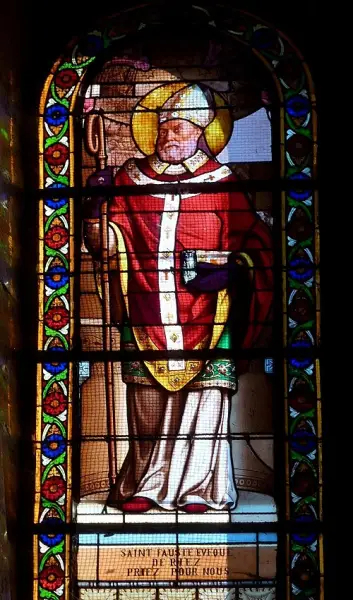
Overview
Faustus of Riez was among the most influential churchmen of fifth-century Gaul, remembered above all as the ablest opponent of Pelagianism in his generation. Born in Britain in the opening years of the fifth century, he abandoned a promising secular career — possibly in law — at the urging of a mother famed for holiness, and embraced monastic life on the island of Lérins. Ordained a priest there, he was chosen abbot in 432 and led the community for roughly two decades, winning renown as an eloquent preacher and a stern ascetic. Summoned from the cloister to the episcopate as successor to Maximus at Riez, he governed the Provençal see without softening his discipline, founded monasteries throughout his diocese, and fought Arianism so vigorously that the Visigothic king Euric banished him for eight years. As a theologian he resisted both the fatalism of the predestinarians and the errors of Pelagius, teaching a doctrine of grace that stirred controversy after his death. He died between 490 and 495 with a reputation for sanctity, revered by the people of his own diocese.
The Complete Life
From Britain to the Schools of Gaul
Faustus was born between 400 and 410, and two distinguished contemporaries — Avitus of Vienne and Sidonius Apollinaris — agree in naming Britain as his homeland. Of his family and childhood the sources say almost nothing, but they record the direction of his youthful gifts: he gave his youth to eloquence and to Christian thought, the usual formation of an educated man in the dying Roman world. Some have thought he practised as a lawyer, and the supposition fits what his later career would show — a mind trained in argument, capable of holding its own in the theological battles of the age. Whatever his prospects, however, they did not hold him. His mother, celebrated for her own sanctity, exercised a decisive influence over him, and as a young man he walked away from secular advancement to seek a different kind of distinction. The move was not a flight from talent but its consecration: the skills of rhetoric and reasoning refined in his youth would one day be placed, whole and undiminished, at the service of the Church. The sources that preserve these details are the appreciations of men who knew the later bishop, and they hint at how completely the boy was given to books and argument before he ever saw an island cloister.
§ Biography
The Monastery of Lérins
Faustus found his path at Lérins, the island monastery off the Provençal coast that shaped so much of fifth-century Gallic Christianity. His ordination to the priesthood followed quickly, and after about eight years of monastic observance the community raised him, in 432, to be its head, in succession to Maximus, who had just been raised to the bishopric of Riez. The choice proved the beginning of a long and formative leadership: his tenure as abbot lasted some twenty or twenty-five years, a period in which Lérins acquired under him a reputation for both learning and rigour. Two qualities marked his government of the community. The first was his gift as an extempore preacher — a wonder-working fluency that drew hearers and made his voice known well beyond the island. The second was his stern asceticism, a personal discipline so demanding that it became the measure of the house. Under such leadership Lérins stood at the height of its influence, and it was from the abbot's office there that Faustus would be called to the still heavier burden of the episcopate.
§ Biography
Bishop in a Troubled Province
When Maximus died, Faustus left the island for the see of Riez, and the change of office left his regimen untouched. The austerity he had practised as abbot went with him to the see, and he returned often to Lérins to renew his fervour at its source. His episcopate was energetic on every front. A zealous advocate of monasticism, he established many monasteries across his diocese, planting the island's spirit deep in the Provençal mainland. He took part in all the theological controversies of his time and became known above all as a stern opponent of Arianism in every form it took — a costly position, for southern Gaul had passed under the rule of the Arian Visigoths. His teaching on the corporeity of the human soul was said to deepen the offence he gave. Euric, the Visigothic king, drove him from his see, and the exile lasted eight years, softened only by the help of loyal friends who sustained him far from his flock. Not until Euric's death could he return, and he went back to the head of his diocese without bitterness, labouring there to the end of his life.
§ Biography
The Doctrine of Grace
From first to last Faustus fought Pelagius, branding him a spreader of plague, and he proved equally firm against the contrary extreme of predestination, which he denounced as erroneous, blasphemous, heathen, fatalistic, and friendly to immorality. When the presbyter Lucidus pushed that doctrine to its strongest form and two synods, at Arles and Lyons in 475, condemned him, the bishops — especially Leontius of Arles — asked Faustus to give the Church a constructive answer. The result was his two books on the grace of God and human free choice, the work by which he is best remembered theologically. His teaching held the two truths together: grace goes before, encourages, and assists the will, yet the will is real, and what it accomplishes under mercy is gift rather than merit. Later ages would label his position Semipelagianism, and the Second Synod of Orange in 529, affirming prevenient grace, condemned the moderate Pelagianism his work was thought to carry. He also taught that the soul has something material in its make-up, since God alone is spirit in the pure sense. The opposition never fully crystallized while he lived, and he died with his reputation for holiness intact.
§ Works and theological position
Return and Rest
The eight years of exile under Euric were the last great trial of Faustus's life. Deposed from a see he had governed with tireless energy, cut off from the monasteries he had founded and the island community that had formed him, he depended in those years on the loyalty of friends who risked aiding a bishop condemned by the king. The exile ended as abruptly as it began. With Euric dead, the way home stood open, and Faustus resumed his labours at the head of the diocese of Riez as though nothing had been able to separate him from it for long. He did not long survive. He died between 490 and 495, an old man who had been, in succession, student, monk, abbot, bishop, and exile, and who had never in all those changes let go of the severity of life he had first embraced on Lérins. The return from banishment gave his last years a quiet completeness: the shepherd who had been driven from his sheep ended his days among them, governing the see to the very end. The men of his own generation had watched the whole course of it; they knew what they had seen, and their judgment has not been revised since.
§ Biography
A Saint of His Own People
Faustus was never canonized by any formal process, for he lived in an age when the Church recognized its saints by acclamation rather than by decree. The witness that matters comes from the people who knew him best: the Christians of his own diocese reckoned him among the saints, and they gave that conviction architectural form by raising a basilica to his memory. For the Christians of Riez this was not flattery of a deceased administrator but a judgment on a life — the ascetic who never relaxed his discipline when he gained power, the preacher whose words instructed an entire province, the exile who returned without vengeance to the flock that had watched him go. Both the Eastern Orthodox and the Roman Catholic Churches preserve his memory, keeping his feast each year on 28 September. Little more was needed: sanctity recognized by those who lived beside it has rarely had a surer foundation. His veneration thus stands where it began, rooted in the affection of a local church and flowing outward from it, a remembrance carried through fifteen centuries without the need of any act beyond the devotion of the faithful themselves.
§ Biography
Books, Controversies, and Afterlives
Faustus's literary legacy proved both durable and tangled. His great work on grace continued to be read for centuries, though the position it defended would eventually be judged wanting by the Synod of Orange; his two books on the Holy Spirit circulated so widely that they were long and wrongly ascribed to the Roman deacon Paschasius; and his short polemic against the Arians and Macedonians, mentioned by Gennadius of Massilia, has disappeared entirely. His correspondence and sermons survive in modern critical editions, and scholars still turn to him as a witness to the theological ferment of fifth-century Gaul — the Oxford Dictionary of National Biography gives him an entry, and studies of his treatise on grace situate it in the long argument between Augustine and his critics. The controversy he embodied was resolved, at least officially, at Orange in 529, yet the questions he wrestled with — what grace does, and what the will remains free to do — have never left the Church. His feast on 28 September marks a man whose influence outlived every judgment passed upon his theology.
§ Works and theological position
Timeline
- 400
Born in Britain between 400 and 410, as his contemporaries Avitus of Vienne and Sidonius Apollinaris attest.
§ Biography
- 432
Chosen head of the monastery of Lérins, succeeding Maximus, who had become Bishop of Riez, after some eight years as a priest there.
§ Biography
- 475
After synods at Arles and Lyons condemned the presbyter Lucidus's doctrine, he wrote his two books on grace at the bishops' request.
§ Works and theological position
- 490
Died at Riez between 490 and 495, restored to his see after the death of King Euric had ended his eight-year exile.
§ Biography
- 529
The Second Synod of Orange condemned the moderate Pelagianism marked in his teaching on grace.
§ Works and theological position
In Their Own Words
God's grace always encourages, precedes and helps our will; and whatever free will alone will have acquired by virtue of the labour of a pious mercy is not our merit, but grace's gift.
The Record
- Major works
- Libri duo de Gratia Dei et humanae mentis libero arbitrio·Libri duo de Spiritu Sancto·Libellus parvus adversus Arianos et Macedonianos (lost, known through Gennadius of Massilia)
- Canonization
- Pre-congregation; his own flock revered him as a saint and raised a basilica in his honour
Prayer
Bibliography
Show 6 sources
- Stancliffe, Clare (2004). 'Faustus [Faustus of Riez] (400x10–c. 490)'. Oxford Dictionary of National Biography. Oxford University Press.
- Healy, Patrick. 'Faustus of Riez.' The Catholic Encyclopedia, Vol. 6. New York: Robert Appleton Company, 1909.
- Franceschini, Chiara (1 January 2014). 'Erasmus and Faustus of Riez's De gratia'. Rivista di Storia del Cristianesimo. XI (2): 367–390.
- Denzinger, Enchiridion. Freiburg, 1908.
- Merrington, John. 'The Nature of the Self in Fifth-Century Gaul'. intellectualhistory.web.ox.ac.uk.
- Faustus of Riez. Catholic Online.
Profile text adapted from the Wikipedia article, licensed CC BY-SA 4.0.
Pray with this saint every day
Save St. Faustus of Riez to your favorites, read the full profile, and get feast-day reminders in the Saints app.
Get the Saints AppFree on the App Store for iPhone and iPad