
284 – 304·Feast June 25
St. Febronia of Nisibis
Consecrated virgin martyred under Diocletian
Overview
Known in the tradition also as Phebronia of Sebapte, Febronia served as a nun in the Mesopotamian city of Nisibis, on the eastern edge of the Roman Empire — the city that survives today as Nusaybin in Turkey — when the last and fiercest of the imperial persecutions broke over the Church. Born around 284, she had bound her life to Christ as a consecrated virgin within a monastic community. When Diocletian's persecution reached Nisibis, she was brought before the authorities and offered a bargain engineered to look like mercy: her freedom, on two conditions — that she renounce her faith and that she marry Lysimachus, the emperor's nephew, a young man already leaning towards Christianity. She refused both terms. For that refusal she was tortured, mutilated, and put to death around the year 304. Her endurance accomplished what no argument had: watching her suffer, Lysimachus converted to the faith he had been circling. Her tomb became the centre of a monastery bearing her name at Himo, near Qamishli in northeastern Syria, and her cult spread across East and West; she is one of the 140 saints whose statues adorn the colonnades of St. Peter's Square.
The Complete Life
A Nun of Nisibis
Febronia belonged to the monastic world of Nisibis, a fortified city on the eastern frontier of the Roman Empire in what is now Turkey, and she is sometimes distinguished by a second name, Phebronia of Sebapte, preserved by the tradition. Her setting was one of the great centres of early Syriac Christianity, a city whose schools and monasteries would shape the theology of the East for centuries. Within that world she had taken the most radical commitment a Christian woman of the time could take: the life of a consecrated virgin, vowed to Christ and living in community under a discipline of prayer. The vocation carried a public meaning in the ancient world. A woman who refused marriage for Christ made a visible claim — that her body and her future belonged to another Bridegroom — and pagan society understood the claim well enough to attack it precisely there. When the persecution came, the offer made to Febronia was therefore not random. It aimed at the heart of her consecration, demanding both the renunciation of her faith and the marriage her vows had set aside, as though the two together might dissolve a resolve that neither alone could touch.
§ Febronia of Nisibis
The Bargain and the Witness
Under Diocletian, whose persecution of the Church from 303 onward was the most systematic the empire had waged, Febronia was arrested and confronted with an offer crafted for maximum effect. She was promised her freedom if she would renounce her faith and marry Lysimachus, a nephew of the emperor himself — a man of the imperial family, and one already inclined, the account notes, towards conversion to Christianity. The proposal was a masterpiece of temptation: it wrapped apostasy in marriage, and marriage in kindness, so that yielding might have looked like good fortune rather than betrayal. Febronia refused, and her refusal set in motion the slow cruelty of the law against confessors. She was tortured, she was mutilated, and she was put to death around 304. Yet the account preserves a fact more startling than her sufferings: Lysimachus, watching her endure them, was converted. The persecution meant to extinguish one Christian ended by gaining another, and the emperor's own kinsman became the firstfruits of her sacrifice. Her death thus bore the exact fruit her tormentors had never intended — a conversion wrought not by persuasion but by fidelity under fire.
§ Febronia of Nisibis
Holy Virgin and Martyr
Febronia's sanctity was recognized by the ancient and continuing devotion of the Church rather than by any formal process, and she is honoured across the divided families of Christianity: the Eastern Orthodox Church, the Oriental Orthodox churches, and the Roman Catholic Church all keep her memory. Tradition gives her the title of Holy Virgin Martyr, joining in one phrase the two commitments for which she died — her consecrated virginity and her witness unto blood. Her standing in the universal Church was given a visible form in modern times: she is counted among the 140 Colonnade Saints whose statues ring St. Peter's Square in Rome, so that pilgrims entering the great basilica pass beneath her image among the confessors of every age and nation. No decree was ever needed to make her a saint; the Church simply never stopped praying through her. In that, her story is the story of the martyrs as a class: recognized by devotion before definition, and held in honour because the faithful could not do otherwise. In that she stands with the great company of the early martyrs, whose canonization was accomplished in the moment of their death and confirmed by the undying gratitude of the communities that inherited their memory.
§ Febronia of Nisibis
From Nisibis to Sicily and Rome
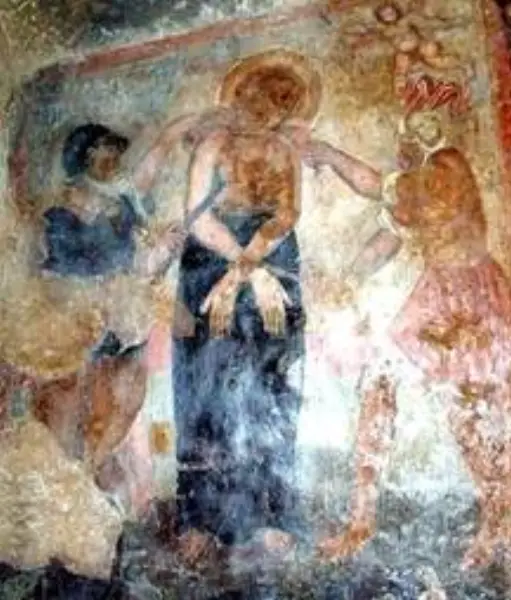
The cult of Febronia spread astonishingly far from the frontier city where she died. Her feast is kept on 25 June in the Roman Catholic and Greek Orthodox calendars, on 12 February in the Eastern Orthodox Church, on 1 Epip in the Coptic Church — corresponding to 8 July on the Gregorian calendar — and and in the Armenian Apostolic rite on the Tuesday following the second Sunday in the season of the Exaltation of the Cross, a spread of dates that maps the reach of her veneration across the Christian East. Her tomb rests in the Syrian monastery that bears her name at Himo, a village outside Qamishli in the country's northeastern corner, a living centre of devotion in the Syriac Christian world. In Rome, her major shrine is at San Carlo ai Catinari. Her cult also crossed to the Western island of Sicily, where she is the patron of Palagonia and where a Byzantine monastery preserves a fresco of her martyrdom. In iconography she carries the palm of martyrdom together with the shears used in her mutilation, an emblem that keeps her testimony unsoftened: she loved Christ, and the price did not matter.
§ Febronia of Nisibis
Timeline
- 284
Birth of the virgin martyr remembered at Nisibis, according to the traditional year recorded for her.
§ Introduction
- 304
Martyred at Nisibis under Diocletian: refusing to renounce her faith or wed his nephew Lysimachus, she died after torture and mutilation, and her persecutor converted.
§ Introduction
The Record
- Patron of
- Palagonia, Sicily
- Symbols
- Palm of martyrdom·The shears used to mutilate her
- Canonization
- Pre-congregation; venerated as a Holy Virgin Martyr from antiquity
Prayer
Bibliography
Show 5 sources
- 'Dall'Oriente all'Occidente il culto millenario di Santa Febronia' (in Italian).
- 'Febronia of Nisibis'. Patron Saint Index. Archived from the original on 13 September 2009.
- 'Syrian Christians: Life Between War and Migration'. Daraj, 3 June 2022.
- 'St. Peter's Square — The Saint Statues on the Colonnades'. stpetersbasilica.info.
- Ghaly, Michael. 'Abib Month Coptic Calendar — Coptic Synaxarium'. st-takla.org.
Profile text adapted from the Wikipedia article, licensed CC BY-SA 4.0.
Pray with this saint every day
Save St. Febronia of Nisibis to your favorites, read the full profile, and get feast-day reminders in the Saints app.
Get the Saints AppFree on the App Store for iPhone and iPad