
died 665·Feast January 20
St. Féchín of Fore
Irish Abbot and Founder of Fore Abbey
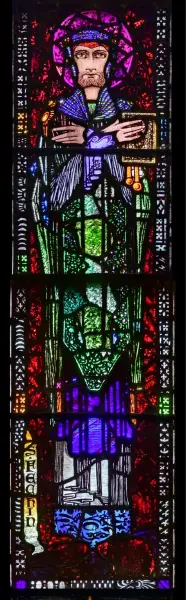
Overview
Féchín, also called Féichín or Mo-Ecca, was a seventh-century Irish abbot remembered above all as the man who founded the great house at Fore in County Westmeath, a community that numbered three hundred monks by the time of his death. Tradition places his birth at Bile, probably Billa in County Sligo, among peoples who claimed him — the Luigne, the Gailenga and the Fothairt — and names his mother as Lassair, said in the Irish Life to belong to a royal Munster line. Trained in monastic life by St Nath Í of Achonry, he went on to Clonmacnoise before founding his own houses. His first foundations stood on the islands of Omey and Ardoilén off the Galway coast, under the protection of the Connacht king Guaire Aidne mac Colmáin, but his principal monastery was Fobur, now Fore. The medieval Lives, one Latin and one Irish, present him as a mediator between peoples and a worker of wonders, including the mill he is said to have built with his own hands. He died in the great plague that devastated Ireland in the 660s, numbered by the Annals of the Four Masters among the saints claimed by the pestilence. Holy wells dedicated to him survive throughout the west of Ireland, and his cult spread as far as Scotland, where he was honored as Vigeanus.
The Complete Life
A Birth Claimed by Three Peoples
The medieval sources disagree about exactly where Féchín began his life, and the disagreement is itself revealing. His birthplace is claimed by three peoples: the Luigne, the Gailenga and the Fothairt. The Lives place his birth at Bile — Billa of the present parish of Ballisodare in County Sligo, most probably. His mother appears in the sources as Lassair, whom the Irish text's first part traces to a royal Munster line, a pedigree that would have connected the saint across half of Ireland. The late Irish Life adds that the saint's house at Fore, in Mide, stood among the Luigne, while Féchín was of the Luigne of Connacht — the monastery thus bridging between two branches of the same people, the more powerful Luigne of Meath on whose territory Fore stood and the humbler Luigne of his own kindred in the west. The annals complicate the picture in their own way: an entry for the year 814 in the Chronicon Scotorum suggests his church was tied to both the Gailenga and the Luigne, while an entry in the Annals of Ulster under the year 993 styles a bishop of Fore as bishop of the peoples of the Luigne, lending support to the account in the Lives. His name, in one tradition, means little raven.
§ Background
Formation at Achonry and Clonmacnoise
The Lives agree that Féchín received his monastic training under St Nath Í of Achonry, the great monastic school of Connacht, and that he afterwards moved on to Clonmacnoise, the celebrated monastery on the Shannon. His time at Clonmacnoise was not without friction. A note added to the Félire Óengusso preserves a story explaining his byname Moéca, glossed as backslider: while herding the oxen of Ciarán of Clonmacnoise, Féchín felt aggrieved at the reward he was given for the work, and he left in anger, traveling eastwards. When he was summoned back, he refused to return facing forward and walked the whole way backwards instead, so that the nickname fixed itself to his memory. The same note explains that the name Féchín itself carries the meaning little raven, formed from the Old Irish word for raven with a diminutive ending, a name his mother is said to have given him when she saw the child gnawing a bone and exclaimed over her little raven. Behind these tales of grievance and bird-omens stands the outline of a demanding formation: a monk shaped by two of the great schools of the early Irish Church, restless, proud of his dignity, and already drawing to himself the stories that communities tell of the men they cannot forget.
§ Background
Islands and the Foundation of Fore
Féchín's first monastic foundations, according to the tradition, stood on islands off the coast of Galway: Omey and Ardoilén, the latter known today as High Island. Both houses fell under the protection of Guaire Aidne mac Colmáin, king of Connacht, whose patronage shielded the young communities in their early years. The principal foundation, however, was yet to come. On the territory of the Luigne of Meath, at a place then called Fobur and now known as Fore in County Westmeath, Féchín established the monastery that his memory has been attached to ever since. The site became one of the great religious houses of the Irish midlands, and by the time of the founder's death it numbered three hundred monks. Its later history was turbulent: between the years 771 and 1169 the monastery of Fore was burned at least twelve times, yet it rose again after every burning. On Omey Island the ruins of the saint's church and a holy well still stand among the remains of the community, and other foundations and churches associated with him stretch from Cong Abbey in Mayo to Termonfeckin in County Louth, testimony to how far the network of his foundations and his cult extended across the island.
§ Foundations
Wonder-Worker and Healer
The tradition that grew around Féchín portrays a saint whose holiness expressed itself in material and miraculous ways. Gerald of Wales, the medieval chronicler, related the legend of the mill at Fore, which Féchín was said to have raised by the saint's own hands within the face of a rock; no woman might set foot in it, nor in the saint's church either, and which the local people reverenced as highly as any church dedicated to him. Gerald attached to the mill a story of sudden judgment on an archer of Hugh de Lacy's troops who violated a girl there and died that same night. Beyond such tales, supernatural powers and healing abilities were widely attributed to the saint, and holy wells were dedicated to him throughout Ireland, with a particular concentration of sites in the west of the country. On Omey Island a holy well rises amid the ruins of his monastic settlement, still sought out by pilgrims for people seeking a physical cure from ailments of every kind. The connection between the saint and the healing springs of the Irish landscape made his cult a living practice for centuries, linking the sufferer's prayer at the water's edge with the memory of the abbot who first hallowed the ground.
§ Veneration
Death in the Great Plague
Féchín died during the terrible pestilence that struck Ireland in the 660s, the plague remembered in the annals as the Buidhe Connail. The Annals of the Four Masters date his death to 14 February in the year given as 664 or 665, and they record him at the head of a mournful catalogue of the saints of Ireland who perished in that mortality, among them St Ronán son of Bearach, St Aileran the Wise, and the abbots of Clonard and of Clonmacnoise. A darker story about his end survives twice over: in the Latin Life of Saint Gerald of Mayo, and among the notes the Liber Hymnorum appends to the Sén Dé hymn of Colmán moccu Clúasaig. There Ireland's two reigning high-kings, Diarmait and Blathmac, sons of Áedo Sláine, petition Féchín and his fellow churchmen, bidding them invoke a dreadful plague upon the lower classes of society so as to thin their numbers. Féchín was among the churchmen who granted the request, and he perished in the very pestilence he had helped summon, while Gerald of Mayo kept his distance and survived. His fellow victims in the plague were said to include St Rónán mac Beraig, founder of the monastery of Druim Inesclainn, whose relics were enshrined in the year 801.
§ Death
A Cult Rooted in Pre-Congregation Ireland
Féchín belongs to the company of saints whose veneration predates the formal machinery of canonization: he was honored as a saint by the Irish Church from an early period, his name entering the martyrologies and his feast fixed on 20 January in Ireland. He is venerated today in both the Catholic and the Orthodox churches. The places of his cult map the geography of his life's work: Fore Abbey in County Westmeath, Cong Abbey in County Mayo, Omey Island and Ardoilén, also called High Island, in County Galway, together with Inishmaan, Claddaghduff, Cleggan and Termonfeckin. Around the year 1200 the Norman lords known as the De Lacys built a Benedictine priory dedicated to St Féchín and St Taurin at Fore. At Ballysadare in County Sligo the ruins of St Fechin's Church stand above the west bank of the river, and the Catholic church of neighboring Colooney keeps a stained-glass image of him. Tradition in that locality names him a brother of St Adomnán of Skreen and Iona, the biographer of St Colm Cille, and records Gilla an Choimded Ó Duillénnáin among the coarbs or erenaghs who held his church in succession.
§ Veneration
From Connacht to Scotland
Féchín's memory crossed the Irish Sea. In Scotland he is venerated under the Latinized form of his name, Vigeanus, and the village of St Vigeans near Arbroath in Angus preserves a major collection of early medieval sculpture from a monastery dedicated to him, perhaps founded among the Picts in the eighth century under circumstances now lost. Other Scottish places have been connected with his cult as well: Ecclefechan in Dumfriesshire and Torphichen in West Lothian, and Lesmahagow, originally dedicated to him under the devotional form of his name, Mo-Ecu. The written memory of the saint proved as durable as his holy wells. Of the two surviving medieval Lives of Féchín, one was composed in Latin around the year 1400 by Augustine mac Graidín of the monastery on Saints' Island in Lough Ree, drawing chiefly on a Life that originated in Féchín's own monastery on Omey Island. The other, the Irish Betha Féchín Fabair, was set into writing in 1328 by Nicol Óg, whose father headed the monastery of Cong, and it preserves matter reaching back to still earlier Latin sources; both Lives agree that Ailerán of Clonard, a contemporary of the saint, had already composed an account of his good works. In the seventeenth century John Colgan produced a further Latin Life from three Irish ones, carrying the saint's story into the modern scholarly age.
§ Veneration
The Record
- Major works
- Monastery at Fore (Fobur), County Westmeath·Monastic houses on Omey Island and Ardoilén (High Island), County Galway·The miraculous mill at Fore, built with his own hands according to the legend recorded by Gerald of Wales
- Patron of
- Fore Abbey·Cong Abbey·Omey Island·Ardoilén (High Island)·those seeking cures for ailments
- Canonization
- Pre-congregation saint, venerated since the early Irish Church in both the Catholic and Orthodox traditions.
Prayer
Bibliography
Show 7 sources
- Breen, Aidan (2010). "Féchín (Mo-Ecca)". Dictionary of Irish Biography. Cambridge University Press.
- Charles-Edwards, T.M. Early Christian Ireland. Cambridge, 2000.
- Ó Corráin, Donnchadh (2005). "Ireland c. 800. Aspects of Society". In Dáibhí Ó Cróinín (ed.). A New History of Ireland. Vol. 1. Oxford. p. 549.
- Stalmans, Nathalie and T.M. Charles-Edwards, "Meath, saints of (act. c.400–c.900)". Oxford Dictionary of National Biography. Oxford University Press, Sept 2004; online edition, May 2007.
- Stokes, G.T. "St. Fechin of Fore and his monastery." Journal of the Royal Society of Antiquaries of Ireland 22 (1892) (series 5, vol. 2): 1–12.
- Nicol Óg, Betha Féchín Fabair "The Life of Féchín of Fore" (written in 1329), preserved in MS G5 (NLI, Dublin), ed. and tr. Whitley Stokes, "Life of St. Féchín of Fore." Revue Celtique 12 (1891): 318–53.
- Giraldus Cambrensis, Topography of Ireland, Book 2, ch. 52.
Profile text adapted from the Wikipedia article, licensed CC BY-SA 4.0.
Pray with this saint every day
Save St. Féchín of Fore to your favorites, read the full profile, and get feast-day reminders in the Saints app.
Get the Saints AppFree on the App Store for iPhone and iPad