
c. 160 – c. 250·Feast January 24
St. Felician of Foligno
First bishop to receive the pallium, martyred in old age
Overview
Felician of Foligno — San Feliciano di Foligno in Italian — was among the first bishops of northern Italy and one of its earliest martyrs. Born around 160 at Forum Flaminii, a town on the Via Flaminia corresponding to the present San Giovanni Profiamma, he was raised in a Christian family and formed spiritually under Pope Eleuterus. As an evangelist he carried the gospel through the towns of Umbria — Assisi, Spello, Foligno, Bevagna, Perugia, Trevi, Norcia, Spoleto, and Plestia — before his consecration as Foligno's bishop at the hands of Pope Victor I around 204 — an event remembered for a first: the pallium, symbol of the episcopal office, was given to him before anyone else. His episcopate lasted more than fifty years, and among those he ordained to the priesthood was Valentine of Terni. Seized in his ninety-fourth year during Decius's persecution because he would not worship the Roman deities, he was tortured and scourged in prison, consoled there by the visits of his disciple Messalina, and died on the road out of Foligno as his captors were taking him to Rome to die. He is the patron saint of Foligno, whose cathedral preserves his shrine.
The Complete Life
A Christian Son of the Via Flaminia
Felician was born around the year 160 at Forum Flaminii, a Roman town on the great Flaminian highway that ran from Rome over the Apennines to the Adriatic, and which corresponds today to San Giovanni Profiamma. He came into the world a Christian — the tradition states plainly that his family was Christian — which means he belonged to a second-generation faith in a region where the gospel had arrived only decades before. His formation was placed under the best patronage available: he became a spiritual student of Pope Eleuterus, the bishop of Rome himself, in an age when the papal office was still being defined by persecution and by the practical work of holding scattered communities together. Growing up beside one of the empire's major roads gave the boy an early picture of the Church's future as a pilgrim institution — a faith carried along the arteries of the empire from town to town. The road that brought travelers and goods to Umbria would also, in time, carry Felician himself, walking out of his birthplace to evangelize the valleys and hilltowns on either side of it.
§ Biography
Bishop with the Pallium
Around the year 204 Felician was consecrated bishop of Foligno by Pope Victor I, and the tradition attaches to that consecration a distinction no other bishop claims: he was, it is said, the first to receive the pallium, the band of wool that became the enduring badge of a metropolitan's office. Whether or not every detail of the claim survives historical scrutiny, it records how the early Church remembered him — as a figure standing at the origin of ordered episcopal life in central Italy. The Pallium aside, his tenure was remarkable for its sheer length: his episcopate lasted more than fifty years, spanning the reigns of multiple emperors and the shifting fortunes of the Church between persecutions. He stood among the very first bishops northern Italy could claim, a pioneer of the episcopate in a land where the institutional church was still young. And his ministry remained personal to the end: among the men he ordained to the priesthood was Valentine of Terni, whose own name would become forever linked with the feast of love. A shepherd who formed shepherds — that is how his long episcopate was handed down.
§ Biography
Apostle of the Umbrian Towns
Before and throughout his episcopate, Felician worked as an evangelist, and the list of places associated with his preaching reads like a map of central Umbria: Assisi, Spello, Foligno, Bevagna, Perugia, Trevi, Norcia, Spoleto, and Plestia. These were small walled towns set in hill country along the Flaminian corridor, each with its temples, its civic life, and its own resistance to a new and illegal religion. Into each of them, the tradition says, Felician carried the gospel, planting communities that would in time become dioceses with long histories of their own. The scale of the itinerary tells its own story: this was not the career of a bishop who administered from a cathedral chair but of one who took to the road, walking the same highways and byways the Roman couriers used, staying long enough to baptize and ordain, and moving on. The Umbria he helped convert would later give the Church Francis of Assisi, Clare, and Rita of Cascia — a harvest of holiness from fields he was among the first to sow. His mission gave central Italy its Christian foundation, one town at a time.
§ Biography
Martyrdom at Ninety-Four
The persecution of the emperor Decius, which demanded sacrifice to the Roman gods of every subject in the empire, reached Foligno when Felician was about ninety-four years old — a man who had served the church of that region for the better part of a century. He was arrested for refusing to sacrifice, and age earned him no mercy. In prison he was tortured and scourged, and in his captivity he received one great human consolation: one of his own disciples, Messalina of Foligno, found means to visit him and stand by him as the end approached. The old bishop did not live to reach the capital. He died outside Foligno while being conveyed along the road to Rome for execution, his strength spent under the weight of his torments before the imperial tribunal could claim him. In the economy of his witnesses, the place of his death was fitting: he had spent fifty years of episcopate among these towns, and it was on their soil, in sight of the city he had shepherded, that his long obedience finally ended — not in a courtroom in Rome, but at home, where his people could keep him.
§ Biography
Relics on the Road Again
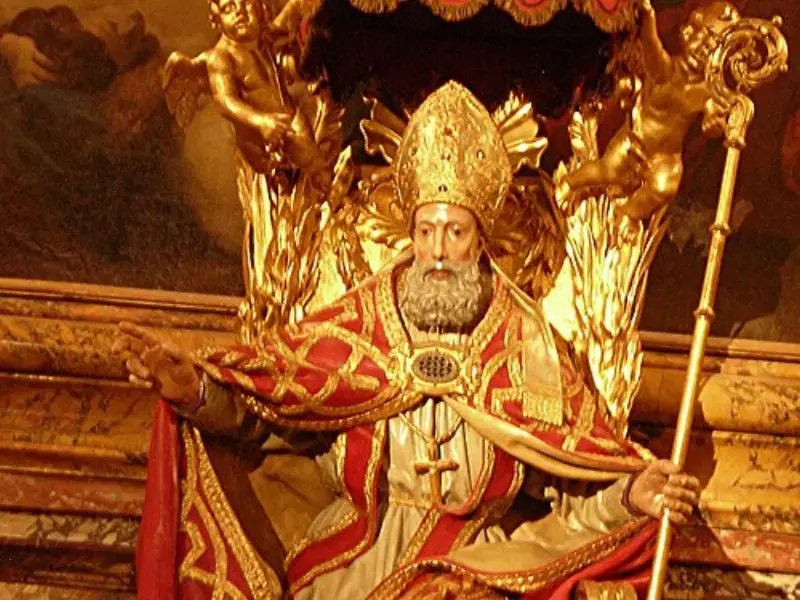
The Christians of Foligno built a church over their bishop's grave, and the city has never transferred its allegiance: Felician remains its patron saint to this day. His relics, however, took journeys as extensive as any he made in life. In 965 some of them were translated to Minden in Germany, and in 970 others were transferred to Metz on 4 October — movements that produced an enduring confusion, for Felician came to be erroneously considered a bishop of the German city, an error that even entered the Roman Martyrology and earned him a separate feast on 20 October. In 1673 and 1674 some of his relics made their way home to Foligno. There the cathedral preserves his memory in silver and bronze: a statue of the saint by the sculptor Giovanni Battista Maini stands among its treasures, alongside artistic depictions of scenes from his life. In art he is shown as an old bishop bearing the marks of his torture — holes bored through his feet and hands — an iconography that refuses to separate the first pallium from the final scourging, and holds the whole of his long life in one image.
§ Veneration
Timeline
- 160
Born at Forum Flaminii, on the Via Flaminia, into a Christian family.
§ Biography
- 204
Consecrated bishop of Foligno by Pope Victor I, reputedly the first bishop to receive the pallium.
§ Biography
- 250
Arrested at about ninety-four under Decius, tortured, and died outside Foligno while being taken to Rome.
§ Biography
- 965
Some relics translated to Minden in Germany, leading to the erroneous belief that he was bishop of that city.
§ Veneration
- 4 Oct 970
His relics were transferred to Metz.
§ Veneration
- 1673
Some of his relics were returned to Foligno, where the cathedral preserves a statue of him in silver and bronze.
§ Veneration
The Record
- Patron of
- Foligno
- Symbols
- An aged bishop with holes bored through his feet and hands
- Canonization
- Pre-congregation; ancient cult as bishop and martyr
Prayer
Bibliography
Show 4 sources
- 'February 6 / January 24'. Holy Trinity Orthodox Calendar.
- Husenbeth, Frederick Charles. Emblems of Saints: By which They are Distinguished in Works of Art. Longman, Green, Longman, and Roberts, 1860, p. 63.
- 'San Feliciano di Foligno'.
- 'Patron Saints Index: Saint Felician of Foligno'. Archived 26 October 2007 at the Wayback Machine.
Profile text adapted from the Wikipedia article, licensed CC BY-SA 4.0.
Pray with this saint every day
Save St. Felician of Foligno to your favorites, read the full profile, and get feast-day reminders in the Saints app.
Get the Saints AppFree on the App Store for iPhone and iPad