
c. 101 – 165·Feast November 23
St. Felicitas of Rome
Martyr Mother of the Seven Holy Brothers
Overview
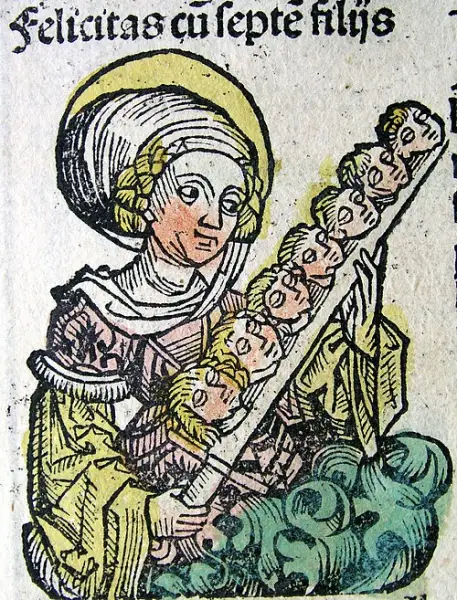
Felicitas of Rome, whose name is anglicized as Felicity, is a martyr of the Roman church traditionally dated to the middle of the second century. Historians sound one caution at the outset: her name apart, history can affirm almost nothing with confidence beyond this — she was laid to rest in the Cemetery of Maximus along the Via Salaria, and the church has kept the memory of that burial on the twenty-third of November. A venerable legend, however, fills out her figure. It presents her as a wealthy and devout Christian widow, mother of seven sons, whose generosity and example brought many pagans to the faith. Her success provoked the resentment of the priests of the old gods, who denounced her to the emperor Marcus Aurelius; she and her children were handed to the prefect Publius, and neither flattery nor threats could move them. The seven young men were condemned to executions of different kinds, and their mother, who had begged God to outlive them so that she might strengthen each in turn, accompanied them to death with joy before being martyred herself. Her cult is among the oldest in Rome: Gregory the Great preached above her tomb, her crypt was rediscovered in 1885, and her relics are venerated at Santa Susanna and at Montefiascone.
The Complete Life
A Widow of Rank in Imperial Rome
The legend that has shaped devotion to Felicitas for fifteen centuries describes her as a Christian widow of means, raising seven sons in the city of Rome in the middle of the second century. Wealth in her hands became an instrument of the gospel: she devoted herself to works of charity, and the witness of her life drew so many to the Christian faith that her house became, in effect, a mission station within the pagan capital. Such visibility carried a price. The priests of the Roman gods watched a matron of standing, with a whole company of sons, live openly as a Christian and win converts from among their own people, and their resentment hardened into a formal denunciation laid before the emperor Marcus Aurelius himself. They argued that the anger of the gods threatened the state while this family refused them sacrifice, and they demanded that Felicitas and her children be compelled to worship. The scene the legend sets — a cultivated, prosperous household whose only crime was the faith — made an immediate impression on the Christian imagination, and it explains why the mother rather than the sons became the centre of the story: it was her example that had made martyrs of them all.
§ Legend of Felicitas and the Seven Holy Brothers
Trial Before the Prefect Publius
When the emperor acceded to the priests' demand, the case passed to Publius, prefect of Rome, and the legend lingers over the machinery of intimidation he employed. Taking the mother aside, away from her children, he tried plea after plea and threat after threat to induce her to honour the pagan gods; she stood unmoved. He fared no better with the seven sons, who followed their mother's example with a unanimity that startled the court. The law then did what Roman procedure did with obstinate Christians: the family was divided among four judges, each instructed to obtain sacrifice by whatever means he chose. The division was grimly exact — tradition later observed that the four judgeships corresponded to the four cemeteries in which the brothers would be buried. Januarius, the firstborn, died beneath the lash; clubs beat down Felix and Philip; Silvanus was flung from a cliff; and the sword ended the three youngest of the family — Alexander, Vitalis, and Martialis. Scholarly opinion treats these Acts with reserve, noting that their earliest form is no older than the sixth century and rests on a Greek original. Yet the outline they preserve — seven martyrs of 10 July, buried in four cemeteries — matches the oldest Roman calendar evidence, which is why the legend has never been discarded outright.
§ Legend of Felicitas and the Seven Holy Brothers
A Mother's Intercession Unto Blood
At the heart of the legend stands a prayer that made Felicitas a patron of bereaved parents. Confronted with the destruction of her family, she asked God for only one thing: that she be permitted to die last, so that no son should pass through his torture without his mother's voice to hold him to his confession. The request was granted in the story's terms, and she accompanied each of the seven to his execution, encouraging them one by one until all had received the crown. After every death the officials offered her a way out — a single act of apostasy would spare her — and after every death she refused to act against her conscience. Popular piety compressed this ordeal into a striking phrase: she passed through death eight separate times, seven of them at her sons' sides and the eighth her own. Her spirituality, as the legend renders it, is not the ecstasy of the mystic but the costly, clear-eyed love of a mother who refuses to make faith easier for her children by making it smaller for herself. Precisely for this reason, Christian tradition assigned her the protection of parents who have lost a child, of widows, and of those who pray for the faith of their families.
§ Legend of Felicitas and the Seven Holy Brothers
Death and Burial on the Via Salaria
The tradition places the death of Felicitas herself in Rome around the year 164, immediately after the executions of her sons, and records that she was laid to rest in the Cemetery of Maximus on the Via Salaria, beside the martyr Silvanus — one of the seven whose tomb adjoined hers. This burial notice is the kernel of historical fact within the legend: the Roman itineraries, the guidebooks to the graves of the martyrs that pilgrims once carried, locate her there, and specify that her resting place lay in a church built above the catacomb. Her feast, kept on the twenty-third of November, preserves the day of that burial. The crypt in which her body was deposited was later enlarged into an underground chapel, a sign of sustained pilgrimage, and after centuries of oblivion it was brought to light again in 1885. During the early Middle Ages another memorial to her stood closer to the city's heart: a chapel bearing her name, installed in an old Roman building close to the ruined Baths of Titus. The physical trail of her cult — cemetery, basilica, crypt, and chapel — is unusually rich for a martyr about whom so little else is known.
§ History of Saint Felicitas
Pre-Congregation Honours of the Roman Church
Felicitas belongs to the company of saints canonized by no decree, her recognition resting on the immemorial practice of the church. The documentary record of her veneration reaches back further than that of almost any Roman martyr. Her feast appears in the Martyrologium Hieronymianum, the earliest layer of the Latin martyrologies, assigned there to the twenty-fifth of January; and from a very early period the Roman church solemnly kept her as a martyr on that date, as the calendar evidence shows. The surest proof of that early solemnity is literary: on the twenty-fifth of January Pope Gregory the Great delivered a homily in the basilica that had been raised directly over her tomb — a pope preaching at a martyr's grave on her feast is itself a canonical act of cult. The seven martyrs whom legend calls her sons had their feast fixed on the tenth of July in the Depositio Martyrum, drawn up in the middle of the fourth century under Pope Liberius, though that document does not yet call them brothers. No formal canonization process was ever needed or imagined; the continuous prayer of the church at her tomb was her canonization.
§ History of Saint Felicitas
Crypt, Relics, and the Critics' Reserve
The memory of Felicitas today is carried by three streams: places, relics, and scholarship. Of places, the chief is the crypt in the Cemetery of Maximus, rediscovered in 1885, with the church that once crowned it; relics of the saint are venerated in the Capuchin church at Montefiascone in Tuscany and in the church of Santa Susanna in Rome, where her cult found its modern centre. Of legend, the afterlife has been long: one of the seven brothers, Martialis, is patron of Torricella Peligna in the Abruzzo and of Isca sullo Ionio in Calabria, and communities in the United States still hold a San Marziale festival around the tenth of July; until the calendar revision of 1969 the seven were kept throughout the Roman rite as "The Seven Holy Brothers", a designation some traditionalists retain. Of scholarship, the reserve is frank: the Acts of the brothers cannot be traced before the sixth century, rest on a Greek original, and their details have fared badly under scrutiny. Were Felicitas truly their mother, critics object, her name ought to show up in the celebrated Roman calendar of the fourth century — yet it never does. The likeliest explanation, proposed long ago, is that her adjoining tomb suggested a kinship that devotion then elaborated. Her surest title remains the oldest one: a martyr buried on the Via Salaria and remembered each twenty-third of November.
§ Origin of the legend
Timeline
- 101
Born at Rome, per the traditional dating given for the martyr's life.
§ Introduction
- 23 Nov 164
Laid to rest in Rome's Cemetery of Maximus beside the Via Salaria, on the one date recorded with certainty of her.
§ Introduction
- 164
According to the legend, the Christian widow watched her seven sons condemned by four judges and executed before she herself won the martyr's crown.
§ Legend of Felicitas and the Seven Holy Brothers
- 350
The Depositio Martyrum, compiled in Pope Liberius's era, already lists the seven martyrs honoured together on 10 July across four Roman cemeteries.
§ Association with the seven martyrs venerated on 10 July
- 500
By the sixth century the Acts presenting the seven martyrs as her sons circulated, since Gregory the Great later cited them.
§ Origin of the legend
- 25 Jan 590
Gregory the Great preached a homily in the basilica standing over her tomb, on her long-kept Roman feast.
§ History of Saint Felicitas
- 1885
The crypt where she was buried, long ago enlarged into an underground chapel, was rediscovered.
§ History of Saint Felicitas
- 1969
The revised General Roman Calendar dropped the grouping of the seven martyrs as the Seven Holy Brothers.
§ Association with the seven martyrs venerated on 10 July
The Record
- Patron of
- parents who have lost a child in death·the death of children·martyrs·against sterility·expectant mothers praying for sons·widows
- Symbols
- sword·seven sons
- Canonization
- Pre-congregation; her feast appears in the Martyrologium Hieronymianum and was kept in Rome from the earliest centuries
Prayer
Bibliography
Show 7 sources
- Husenbeth, Frederick Charles. Emblems of Saints: By which They are Distinguished in Works of Art. Longman, Green, Longman, and Roberts, 1860, p. 63
- Calendarium Romanum. Libreria Editrice Vaticana, 1969, pp. 129, 146
- "St Patrick Catholic Church - Saint of the Day: November 23 Felicitas of Rome". Archived from the original on 2015-09-24
- De Rossi, Roma sotterranea, I, pp. 176-77
- Martyrologium Romanum. Libreria Editrice Vaticana, 2001. ISBN 88-209-7210-7
- Hoever, Rev. Hugo (ed.). Lives of the Saints, For Every Day of the Year. Catholic Book Publishing Co., New York, 1955, pp. 261-262
- "St. Felicitas", Catholic Encyclopedia
Profile text adapted from the Wikipedia article, licensed CC BY-SA 4.0.
Pray with this saint every day
Save St. Felicitas of Rome to your favorites, read the full profile, and get feast-day reminders in the Saints app.
Get the Saints AppFree on the App Store for iPhone and iPad