
d. c. 90 (legendary); 4th century (probable)·Feast June 13
St. Felicula
Roman Virgin Martyr of the Via Ardeatina
Overview
Felicula is honoured as a martyr of the Roman church whose historical outline is brief and whose legendary elaboration is rich. Critical tradition judges her to have been a fourth-century Roman martyr; a romanticized strand of hagiography instead carries her back to the first century, among the earliest virgin witnesses of the faith. What stands on firm ground is her liturgical commemoration and one dated act of reverence toward her remains: around the year 592 Pope Gregory the Great gave her relics to John, bishop of Ravenna. The Roman Martyrology keeps her name on 13 June with a notation locating her passion at the seventh milestone from Rome along the Via Ardeatina. The legend preserved in the Acts of Saints Nereus and Achilleus makes her the foster sister of Saint Petronilla, arrested after Petronilla refused the hand of a Roman official, and tells that she was left without food or water in prison and finally thrown into a sewer, where she died; the priest Nicomedes retrieved her body for burial. Venerated by Catholics and Orthodox alike, she belongs to the company of Roman women whose witness outlived every record of it.
The Complete Life
The Passion of a Legendary Witness
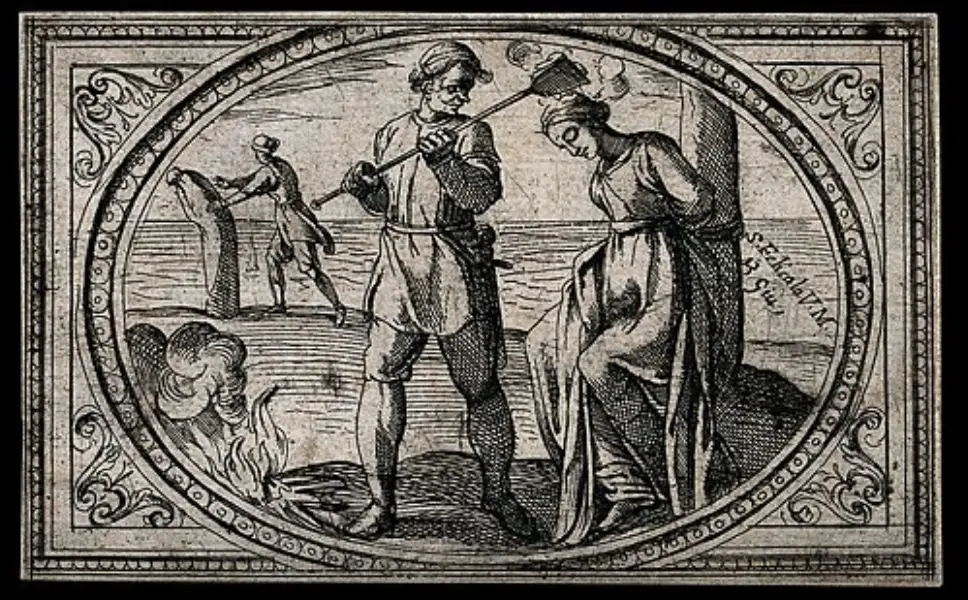
The narrative passion of Felicula comes to us in a heavily romanticized form, preserved in the Acts of Saints Nereus and Achilleus, which places her among the very first virgin martyrs of the Christian name and assigns her death to about the year 90. In that account she is the foster sister of Saint Petronilla, the daughter figure of the apostolic circle in Rome. The story turns on Petronilla's refusal to marry a Roman official: when the maiden would not yield, the machinery of the state turned on her household, and Felicula was seized in her place. Held in custody, she was denied both food and water — a slow execution by deprivation intended to break her resolve. When endurance alone could not kill her, her captors resorted to degradation, throwing her into a sewer to die among the refuse of the city. Even there the legend insists on the church's care: Saint Nicomedes came, recovered her body, and saw it laid to rest with honour. Whatever weight the historian gives the tale, it shaped centuries of devotion to a woman remembered for suffering that was at once hidden and glorious.
§ Introduction
From Rome to Ravenna: Relics and the Martyrology
Beneath the legend lies a slender but solid line of historical memory. Critical opinion regards Felicula as a martyr of Rome, most probably of the fourth century, whose cult was attached to a site along the Via Ardeatina, the old road that runs southeast out of the city. The liturgical books fix her there precisely: the Roman Martyrology commemorates her on 13 June at the seventh milestone from Rome on that road, a formula that preserves the location of her passion or burial as the Roman church received it. A further dated witness shows her relics honoured at the highest level of the papacy: about the year 592 Pope Gregory the Great handed her remains to John, bishop of Ravenna, a gift that carried the martyr from the roads of Rome to the imperial churches of the Adriatic, where her cult took root. She is venerated today in the Roman Catholic Church, the Orthodox Church, and the True Orthodox Church. Her dossier — a martyrology line, a papal gift of relics, and a saintly legend — sketches in miniature how the memory of an obscure Roman martyr was gathered, carried, and kept alive.
§ Introduction
Timeline
- 90
According to the legendary Acts of Nereus and Achilleus, she suffered martyrdom near Rome at about this time
§ Introduction
- 592
Pope Gregory the Great gave her relics to Bishop John of Ravenna
§ Introduction
- 13 Jun 2004
The Roman Martyrology, published in that year by the Vatican press, records her on 13 June at the seventh milestone of the Via Ardeatina
§ Introduction
The Record
- Canonization
- Pre-congregation; listed in the Roman Martyrology on 13 June
Prayer
Bibliography
Show 4 sources
- Martyrologium Romanum. Typis Vaticanis, 2004, p. 336
- "Santa Felicola di Roma", Santi e Beati
- Acts of Saints Nereus and Achilleus (Bollandists), chapter V
- "St. Felicula", Catholic Online
Profile text adapted from the Wikipedia article, licensed CC BY-SA 4.0.
Pray with this saint every day
Save St. Felicula to your favorites, read the full profile, and get feast-day reminders in the Saints app.
Get the Saints AppFree on the App Store for iPhone and iPad