
died 286·Feast September 11
St. Felix and Regula
Martyred siblings and patron saints of Zürich
Overview
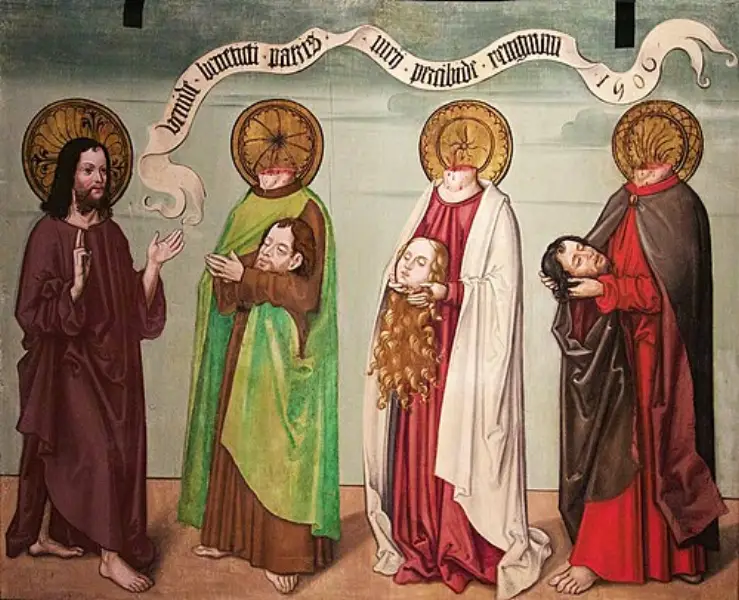
Felix and Regula were brother and sister honored as martyrs by the Coptic Orthodox, Eastern Orthodox, Oriental Orthodox, and Roman Catholic churches, and they stand as the patron saints of Zürich. Tradition makes them members of the Theban Legion, an Egyptian corps under Saint Maurice posted at Agaunum in the Valais. When that legion refused to offer sacrifice to the emperor Maximian and was condemned, the two siblings escaped with their servant Exuperantius, traveling by way of Glarus to Zürich, then known as Turicum. Captured there, they were tried and beheaded in 286 for their Christian faith. Legend tells that after the sword fell, the martyrs rose, lifted their own heads, climbed forty paces up the hill, and prayed before lying down in death on the eminence later crowned by the Grossmünster. A monk named Florentius reportedly received the story in a dream during the eighth century, and the tale helped bring the surrounding region to Christianity. Churches rose over their grave and their execution place, their images filled the city's seals and coinage, and Zürich became the foremost pilgrimage town of the diocese of Konstanz. The Reformation scattered their relics, though two skulls linked to the saints endure, one of which may date from Roman times.
The Complete Life
Siblings of the Theban Legion
Felix and Regula were, according to the tradition preserved at Zürich, brother and sister who belonged to the Theban Legion, a military unit drawn from Egypt and placed under the command of Saint Maurice. The legion was stationed at Agaunum, in the Swiss Valais, a posting that carried the siblings from their North African homeland into the Alpine provinces of the Roman Empire. Their household also included their servant Exuperantius, who shared their fate and is honored beside them. The decisive moment came when Emperor Maximian required the soldiers to sacrifice to the pagan gods. The legion refused, and the order was given for its execution. For Felix and Regula, that command turned soldiers of an imperial army into witnesses of a persecuted faith. The account of their Egyptian origins binds them to the wider memory of the Theban Legion, whose members were remembered as Christians of the Nile valley serving far from home. Many modern historians regard the story of the legion as fictitious, while others hold that historical and archaeological evidence places such a force in Switzerland at that time. Whatever the scholarly verdict, the siblings' legend rooted the Christianity of Zürich in the witness of Egyptian soldiers.
§ History
Faith Reckoned as Treason
The legend states the charge against Felix and Regula plainly: they were beheaded for converting to Christianity. Within a legion already condemned for refusing to sacrifice, that conversion sealed their fate. When the execution order fell upon their comrades, the two fled rather than comply, taking Exuperantius with them. Their road ran first to the region of Glarus and then onward to Zürich, which the Romans called Turicum. Flight bought them no safety; they were overtaken, brought to trial, and condemned with their servant. The liturgical memory of the three preserves the breadth of their veneration. Their feast is kept on 11 September in the Gregorian calendar, and Eastern churches using the Julian reckoning observe the same day, corresponding to 24 September in the Gregorian count. The Coptic Orthodox Church of their Egyptian homeland commemorates them on the fourteenth of Tout, a detail that quietly carries the saints' African birthright in the calendar of their native church. In the story as Zürich received it, the siblings' vocation was fulfilled not in battle but in the witness of bodies offered rather than gods denied.
§ History
Martyrdom on the Hill Above the Limmat
At Turicum the fugitives were caught, examined, and put to death in the year 286. The legend adds a detail that fixed their memory in stone: after the sword had fallen, the three rose upright, lifted their severed heads in their own hands, climbed the slope some forty steps, and knelt in prayer before surrendering to death. Their grave was dug where they came to rest at last, on the hilltop that would later carry the Grossmünster. The geography of Zürich still maps their passion. The Wasserkirche, the Water Church, stands by the Limmat at the place of execution, and its crypt preserves the so-called Martyr stone, honored as the site where the siblings died. Across the river, the Fraumünster Abbey long displayed important relics of the saints to the public. A sixteenth-century plan of the city shows all three at once: the burial church, the execution chapel, and the abbey that guarded the relics. In this way the topography of the medieval city became a continuous recounting of the legend, so that a visitor walking from river to hilltop retraced the forty paces the martyrs were said to have walked.
§ History
A Dream, a Monastery, and a City's Seal
Felix and Regula were never canonized by papal process; they belong to the earliest ranks of the martyrs, venerated by the Coptic Orthodox, Eastern Orthodox, Oriental Orthodox, and Roman Catholic churches. The story that made them the saints of Zürich was said to have come to a monk named Florentius in his sleep during the eighth century. The tale is credited with contributing enormously to the conversion of the region's inhabitants, and its grip on the city endures in the saints' presence on the seal of Zürich to this day. By the ninth century a small monastery stood at their burial place, then outside the settlement on the left bank of the Limmat. From about the year 1100 the Grossmünster rose over their graves, and the Wasserkirche marked the execution site. From the thirteenth century the saints' images appeared on the city's official seals and on its coins. Each year at their feast the relics went in procession from the Grossmünster to the Fraumünster, and the two monasteries' contest over their possession drew pilgrims in such numbers that Zürich ranked as the leading shrine of the entire see of Konstanz.
§ History
Empty Graves, Wandering Skulls, and Civic Memory
The Reformation broke the cult open along with the graves. When Huldrych Zwingli dissolved the monasteries in 1524, the saints' possessions were confiscated and the martyrs' tombs were opened. Conflicting accounts describe what followed. Heinrich Bullinger, the Protestant theologian, claimed the graves held nothing but scattered splinters of bone, which received pious burial in the shared churchyard beyond the walls. Catholics answered that the reformers intended to cast the saints' remains into the river, until a fearless man from Uri, himself an exile, carried them off by night to Andermatt and won amnesty by the deed. The two skulls of Felix and Regula, it is said, can still be viewed there now; the other remains came home to Zürich in 1950, entering the Catholic church of St. Felix und Regula that had just been raised. Radiocarbon testing has complicated the picture: one skull dates to the Middle Ages, and the other is assembled from fragments of two skulls, one medieval and one that could genuinely belong to the Roman era. The feast of the saints served the early modern republic as its national holiday, and the city's Knabenschiessen competition, begun in 1889, grew out of that September observance.
§ History
Timeline
- 11 Sep 286
Beheaded with Exuperantius at Turicum (Zürich) after fleeing the condemned Theban Legion; buried on the hilltop of the future Grossmünster.
§ History
- 750
A monk called Florentius receives the martyr story in a dream, aiding the mass conversion of the region's inhabitants.
§ History
- 850
A small monastery stands at the burial place, then outside the settlement on the left bank of the Limmat.
§ History
- 1100
The Grossmünster is begun over the saints' graves; the Wasserkirche marks the spot of their execution.
§ History
- 1250
Images of the saints appear on Zürich's official seals and coins, and their feast draws processions between the Grossmünster and Fraumünster.
§ History
- 1524
Huldrych Zwingli's dissolution of the monasteries leads to the opening of the martyrs' graves and the dispersal of their relics.
§ History
- 1950
Relics are returned to Zürich and placed in the newly built Catholic church of St. Felix und Regula.
§ History
The Record
- Patron of
- patron saints of Zürich
- Symbols
- depicted carrying their severed heads
- Canonization
- Pre-congregation canonization; venerated as martyrs from antiquity by the Coptic Orthodox, Eastern Orthodox, Oriental Orthodox, and Roman Catholic churches
Prayer
Bibliography
Show 6 sources
- Bischof, Franz Xavier. "Felix and Regula." Religion Past and Present, 2011. ISBN 9789004146662.
- Dupraz, Louis. Les passions de st Maurice d'Agaune: Essai sur l'historicité de la tradition et contribution à l'étude de l'armée pré-Dioclétienne (260–286) et des canonisations tardives de la fin du IVe siècle. Fribourg, 1961. Appendix I (Codex Parisiensis, Bibliothèque nationale, 9550).
- Woods, David. "The Origin of the Legend of Maurice and the Theban Legion." Journal of Ecclesiastical History 45 (1994), pp. 385–95.
- "The First Christians in Zurich: The Legend of Felix and Regula." Zurich Tourism (PDF).
- "Siblings carry their severed heads 40 paces to become Zürich's patron saints." le News, June 12, 2016.
- Etter, Hansueli, Urs Baur, Jürg Hanser, and Jürg Schneider (eds.). Die Zürcher Stadtheiligen Felix und Regula. Legenden, Reliquien, Geschichte und ihre Botschaft im Licht moderner Forschung. Zürich: Hochbauamt der Stadt Zürich / Büro für Archäologie, 1988. ISBN 3-905243-01-6.
Profile text adapted from the Wikipedia article, licensed CC BY-SA 4.0.
Pray with this saint every day
Save St. Felix and Regula to your favorites, read the full profile, and get feast-day reminders in the Saints app.
Get the Saints AppFree on the App Store for iPhone and iPad