
early 5th century – fl. late 5th century·Feast Not recorded
St. Felix of Bilibio
Fifth-century hermit and master of Aemilianus
Overview
Felix of Bilibio, remembered in Spanish as San Felices de Bilibio, was a hermit and holy man of fifth-century Roman Spain. He made his home at Bilibio's castellum, within what is today La Rioja, apparently having been born in the first half of the fifth century. His reputation for holiness reached the young Aemilianus, the future Saint Millán, who sought him out at Bilibio and offered himself as his servant and disciple. Braulio of Zaragoza records the encounter in the Vita Aemiliani, his biography of Aemilianus written between 635 and 640, and draws from it a lesson: no one, he says, walks safely toward the blessed life unless older hands have taught him the way. By that account the obscure hermit of Bilibio helped form one of the most revered saints of the Iberian Peninsula. In time Felix himself was numbered among the saints. In 1090 his remains were carried from Bilibio to San Millán de la Cogolla, the abbey bearing his disciple's name, and early in the twelfth century the monk Grimaldo set down the Translatio et miracula sancti Felicis presbyteri, recounting that translation and eight wonders worked at the saint's intercession.
The Complete Life
The Hermit of Castle Bilibio
Everything known of Felix comes to us through the memory of another man's disciples. He was born, apparently, in the first half of the fifth century, and he settled as a hermit at the castellum of Bilibio, a fortified place in what is today La Rioja in northern Spain. There he lived as a holy man whose reputation traveled beyond his solitude. The biographer Braulio of Zaragoza, writing the Vita Aemiliani between 635 and 640, preserves the moment when that reputation bore its greatest fruit. Word of the hermit reached Aemilianus, later the patron saint of the region, and the young man hurried to Bilibio, readily offering himself as a servant and asking to be instructed in the way to the kingdom above. Braulio drew a deliberate lesson from the scene: no one, he insisted, walks the road to the blessed life safely unless his elders have taught him the way. In this way the sources present Felix not as a wonderworker but as a master of the spiritual life, the elder whose counsel shaped the conversion and discipline of Aemilianus, one of the most honored saints of the Iberian Peninsula.
§ Introduction
Relics at San Millán and a Book of Miracles
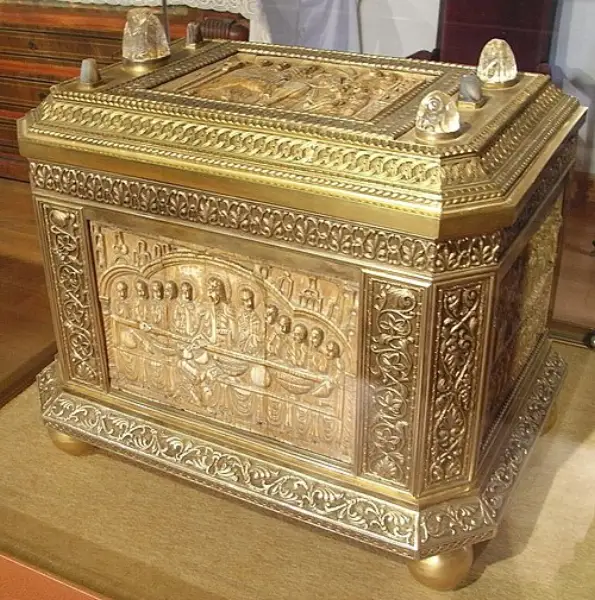
In time Felix's reputation for sanctity took hold, and his memory settled where his disciple's had. In 1090 his remains were brought from Bilibio to San Millán de la Cogolla, the abbey named for Aemilianus, the very man whom Felix had once instructed; his casket is preserved there still. Two decades later the community set its memory of the saint in writing. In 1109–1110, on his abbot's orders, the monk Grimaldo de San Millán composed two hagiographic pieces in Felix's honor, issued under the joint title Translatio et miracula sancti Felicis presbyteri, the Translation and Miracles of holy Felix the elder. The book tells of the saint's removal to the abbey and records eight wonders credited to his intercession across the years 1090 to 1098. The sequence is telling: a hermit known only through another man's biography became, by the movement of his bones and the testimony of reported wonders, an intercessor with a shrine, a liturgical following, and a written legend of his own. It was the ordinary path by which the medieval Spanish church honored its holy dead, and in Felix's case it preserved, across six silent centuries, the memory of a master whose only recorded work was the forming of a saint.
§ Introduction
Timeline
- 400
Born, apparently in the first half of the fifth century; he later lives as a hermit at the castellum of Bilibio in present-day La Rioja.
§ Introduction
- 480
Late in the same century, Aemilianus, guided by rumor of his holiness, comes to Bilibio and offers himself as his disciple.
§ Introduction
- 637
Braulio of Zaragoza commemorates Felix as Aemilianus's spiritual master in the Vita Aemiliani, written between 635 and 640.
§ Introduction
- 1090
Felix's remains are moved from Bilibio to the abbey church of San Millán de la Cogolla.
§ Introduction
- 1098
By this year eight miracles credited to the hermit's intercession since his translation had reportedly occurred.
§ Introduction
- 1109
At his abbot's request, the monk Grimaldo de San Millán writes the pair of hagiographic pieces issued under the joint title Translatio et miracula sancti Felicis presbyteri (1109–1110).
§ Introduction
In Their Own Words
Rumor had brought [Aemilianus] word that a certain hermit named Felix, a most holy man whom he might properly offer himself as a disciple, was then living in Castle Bilibium.
The Record
- Canonization
- Pre-congregation canonization; Felix came to be regarded as a saint through popular veneration, and his relics were translated in 1090
Prayer
Bibliography
Show 3 sources
- Barlow, Claude W. (1969). Iberian Fathers, Vol. 2: Braulio of Saragossa, Fructuosus of Braga. The Fathers of the Church, Vol 63. Catholic University of America Press.
- Martín-Iglesias, José Carlos (2024). "La Traslación y milagros del presbítero san Felices (BHL 2861-2862)". In Martín-Iglesias, José Carlos; Henriet, Patrick; Esteban Martínez, Carmen (eds.). Hagiografía hispana de los siglos IX–XIII en los reinos de Aragón y Castilla y León. Brepols. pp. 36–43.
- Vivancos Gómez, Miguel C. (2018). "Felices de Bilibio, San". Diccionario Biográfico Español. Real Academia de la Historia.
Profile text adapted from the Wikipedia article, licensed CC BY-SA 4.0.
Pray with this saint every day
Save St. Felix of Bilibio to your favorites, read the full profile, and get feast-day reminders in the Saints app.
Get the Saints AppFree on the App Store for iPhone and iPad