
died 8 March 647 or 648·Feast March 8
St. Felix of Burgundy
Apostle of East Anglia and first bishop of Dunwich
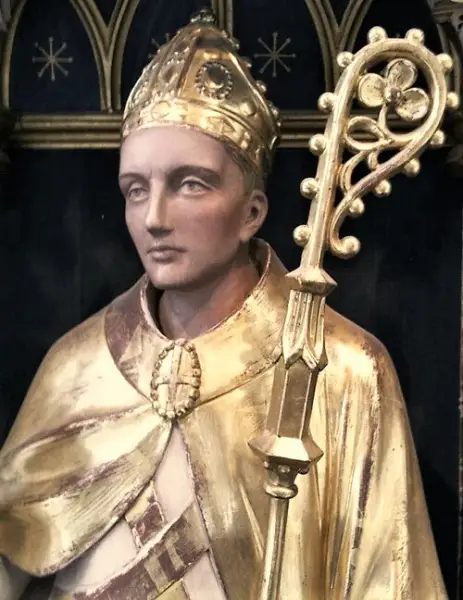
Overview
Felix of Burgundy, known also as Felix of Dunwich, held the first bishopric of the East Anglian kingdom and is widely credited with introducing Christianity there. A native of the Frankish land of Burgundy, he was ordained there and may have been connected with the monasteries founded by the Irish missionary Columbanus; some scholars identify him with a bishop of Châlons deprived of his see after the death of King Chlothar II in 629. He reached Canterbury and was sent by Archbishop Honorius to the court of King Sigeberht of East Anglia around 630, establishing his see at Dommoc, generally identified with Dunwich in Suffolk. Bede credits him with opening a school for the teaching of letters to boys, supplying the kingdom with instructors, and declares that he freed the whole kingdom from long-standing evil and unhappiness. Felix served seventeen years as bishop and died on 8 March 647 or 648, probably in the reign of King Anna. His remains were carried first from Dommoc to Soham, and later on to Ramsey. Venerated long before the Great Schism, he is remembered by Anglicans, Orthodox, and Catholics alike, with six English churches dedicated to his name.
The Complete Life
A Bishop from Burgundy
Felix's homeland was the Frankish realm of Burgundy, though his very name prevents historians from settling his nationality with certainty. Bede records that he was ordained in Burgundy, and the religious landscape of that land offers the likeliest setting for his formation. The historian Peter Hunter Blair suggested that Felix may have been linked to the Irish missionary movement in Francia, one concentrated in Burgundy around Columbanus and Luxeuil Abbey: Columbanus had arrived in Francia around 590 and soon founded Luxeuil, and his disciples strongly influenced the Christians of northern Burgundy. Links of another kind tied Burgundy to the small Anglo-Saxon kingdom of East Anglia — Frankish goods reach Sutton Hoo, and the East Anglian dynasty maintained ties with the abbess Burgundofara at Faremoutiers, a foundation inspired by Columbanus and his successor Eustace. Some scholars connect Felix with the Burgundian king Dagobert I, who had dealings both with King Sigeberht of East Anglia and with Amandus, a disciple of Columbanus; others propose Luxeuil, Châlons, or the region of Autun as his origin. In 626 or 627 the see of Châlons was held by a bishop called Felix, who lost it after the death of King Chlothar II in 629 — possibly, as Judith McClure and Roger Collins note, because he had become a political fugitive in Francia before reaching England.
§ Background and early life
Sent by Honorius to a King Who Shared His Faith
The call that brought Felix to England came through two men: an archbishop and a king. According to Bede, Honorius, Archbishop of Canterbury, dispatched Felix to spread Christianity among the East Angles, a fellow graduate of the Roman mission to the English. The king who awaited him was Sigeberht, the first English king already baptized when he took the throne. Driven into exile during the reign of his brother Eorpwald, Sigeberht had grown in Gaul into a devout Christian and a scholar; after Eorpwald was killed by Ricberht, Sigeberht took the throne of the East Angles in 630. The historian Marios Costambeys observes that Felix's arrival coincided with the new order Sigeberht established at his accession, and suggests that the accession itself may have decided Honorius to send his bishop. The Anglo-Saxon Chronicle first mentions Felix under the year 633, saying that he proclaimed Christ's faith to the East Angles; its 11th-century Manuscript F expands the notice, recording that the bishop came from the region of Burgundy, called by King Sigeberht, and received the bishopric of Dommoc, in which he sat seventeen years. Local East Anglian tradition added a landing scene: Felix founded the church at Babingley in Norfolk in 631, near the estuary where he was said to have come ashore, and the ruins of that church stand there still. Peter Hunter Blair argued that the initiative was Honorius's, not a joint journey with Sigeberht from Francia.
§ Arrival in the kingdom of the East Angles
The See of Dommoc and a School for Boys
Soon after reaching Sigeberht's court, around 630 or 631, Felix fixed his episcopal chair at Dommoc, a site most scholars place at Dunwich in Suffolk, later a thriving medieval town and now, after centuries of coastal erosion, largely lost to the sea. Richard Hoggett has argued instead for Walton Castle near Felixstowe, a former Roman fort that would have made, in his words, an appropriate seat for the king's new bishopric, close to the royal settlement of Rendlesham and the Sutton Hoo burial ground; a church and priory dedicated to Felix stood at Walton by the time of Roger Bigod, soon after 1106. From his see, Felix undertook the works that fixed his reputation. Bede relates that he opened a school in which boys were taught their letters, providing Sigeberht's kingdom with instructors; their origin is left unclear, though Kent, with its system of priestly education dating from the Augustinian mission of 597, is the likeliest source. The Liber Eliensis adds that Felix founded Soham Abbey and a church at Reedham in Norfolk, and Margaret Gallyon judged that the great size of the East Anglian diocese made a second establishment at Soham very probable. Bede crowned it all with his verdict: Felix freed the whole kingdom from long-standing evil and unhappiness. In his episcopate the church of East Anglia grew stronger still when the Irish monk Fursey arrived and founded a monastery at Cnobheresburg, probably Burgh Castle in Norfolk.
§ Bishop of the East Angles
Seventeen Years, and a Death in the Reign of Anna
Felix's episcopate ran unbroken for seventeen years, an unusually long and stable tenure in a century when royal conversions rose and fell with the fortunes of kings. He died on 8 March, in 647 or 648, the two dates the sources preserve; the Anglo-Saxon kalendars kept the eighth of March as the day of his commemoration. His death probably fell within the reign of Anna of East Anglia, Sigeberht's successor in the Christian line of the Wuffingas dynasty, under whom the Christian settlement Felix and Sigeberht had built continued. The bishop was buried at Dommoc, the see he had founded and governed, in the manner of the episcopal founders of the English church. His successor was Thomas, described as a Fenman, who became the second bishop of the East Angles and carried on the line that would later divide into the sees of Dunwich and Elmham. Felix had lived to see his mission complete: a kingdom once ruled by kings who wavered between altars now possessed an episcopal line, a school, monasteries, and a Christian dynasty. The Burgundian who had crossed the North Sea in obedience to an archbishop died, after seventeen years, as the settled apostle of a Christian realm.
§ Death and veneration
A Saint of the Undivided Church
Felix was venerated as a saint from the generation after his death, and his canonization belongs to the era before formal processes: his canonization antedates the schism of 1054, so that East and West alike have venerated him, a saint of the undivided church. His cult took liturgical form in the Anglo-Saxon calendars — his feast on 8 March is the day fixed by two Anglo-Saxon kalendars — and it has never lapsed in England. The Church of England remembers him with a commemoration on 8 March; the Eastern Orthodox Church and the Catholic Church number him among the saints as well. In the Catholic Church in England, Felix is counted among the patron saints of the Catholic diocese of East Anglia, the modern successor of the very mission field he opened. The geography of dedication tells the same story: six churches in England bear his dedication, all of them in either North Yorkshire or East Anglia, the two regions where his cult took deepest root. At the mouth of the Deben and across the Suffolk countryside, the parish churches of villages still gather congregations under the name of the Burgundian bishop whom Bede praised as the apostle who freed their ancestors from long-standing evil and unhappiness.
§ Death and veneration
Relics in the Fen Fog, and a Name on the Map
Felix's remains had a wanderer's history. According to the twelfth-century historian William of Malmesbury, his relics were removed from Dommoc to Soham; there the Vikings desecrated his shrine when they destroyed the church. Some time later, William records, the saint's body was sought out, recovered, and laid to rest at Ramsey Abbey. Ramsey was famous for its enthusiasm for collecting relics of the saints, and tradition embroidered the translation accordingly: in an apparent attempt to steal a march on their rivals of Ely, the Ramsey monks were said to have rowed their boats through thick Fenland fog carrying the bishop's precious remains. Norwich Cathedral preserves an effigy believed to portray Felix, and a statue of 1885 stands at St Peter Mancroft in that city. His name settled into the landscape itself: the Yorkshire village of Felixkirk and the port town of Felixstowe may both derive from the saint, though scholars have offered another reading of Felixstowe, as the stow of Filica. The ruined church at Babingley, one of three East Anglian churches carrying his dedication, preserves the memory of his legendary landing place. Seventeen years of preaching thus outlasted the kingdom that received it, surviving conquest, erosion, and reformation alike.
§ Death and veneration
Timeline
- 590
Columbanus arrives in Francia and soon founds Luxeuil Abbey, the Irish missionary milieu in Burgundy with which Felix may be connected.
§ Background and early life
- 626
A bishop named Felix is recorded holding the see of Châlons; this may be the future apostle of the East Angles.
§ Background and early life
- 629
After the Frankish king Chlothar II dies, the bishop of Châlons is stripped of his see, possibly forcing Felix into exile.
§ Background and early life
- 630
Sent by Archbishop Honorius of Canterbury, Felix reaches King Sigeberht's kingdom and establishes his episcopal see at Dommoc.
§ Arrival in the kingdom of the East Angles
- 631
Local tradition holds that Felix founds the church at Babingley, Norfolk, near where he is said to have landed by sea.
§ Arrival in the kingdom of the East Angles
- 633
The Anglo-Saxon Chronicle records under this year Felix proclaiming Christ's faith to the East Angles.
§ Arrival in the kingdom of the East Angles
- 8 Mar 647
Felix dies on 8 March, probably during the reign of King Anna of East Anglia, after seventeen years as bishop; Thomas succeeds him.
§ Death and veneration
In Their Own Words
Here there came from the region of Burgundy a bishop who was called Felix, who preached the faith to the people of East Anglia; called here by King Sigeberht; he received a bishopric in Dommoc, in which he remained for seventeen years.
As soon as he began to reign he made it his business to see that the whole kingdom shared his faith. Bishop Felix most nobly supported his efforts.
the whole of this kingdom from long-standing evil and unhappiness
The Record
- Major works
- Founded a school where boys could be taught letters, providing the East Anglian kingdom with teachers·Established the episcopal see of Dommoc, the first bishopric of the East Angles·Founded Soham Abbey, according to the Liber Eliensis·Founded a church at Reedham, Norfolk, according to the Liber Eliensis
- Patron of
- one of the patron saints of the Catholic Diocese of East Anglia
- Canonization
- Pre-congregation canonization; canonized before the Schism of 1054 and venerated in both East and West
Prayer
Bibliography
Show 7 sources
- Bede (1999) [731]. McClure, Judith; Collins, Roger (eds.). The Ecclesiastical History of the English People. Oxford: Oxford University Press. ISBN 978-0-19-283866-7.
- Blair, Peter Hunter (1990). The World of Bede. Cambridge: Cambridge University Press. ISBN 978-05213-9-819-0.
- Costambeys, Marios (23 September 2004). "Felix [St Felix]". In Watt, Norma (ed.). Oxford Dictionary of National Biography (online ed.). Oxford: Oxford University Press. doi:10.1093/ref:odnb/9253.
- Higham, N. J. (1997). The Convert Kings: Power and Religious Affiliation in Early Anglo-Saxon England. Manchester; New York: Manchester University Press. ISBN 978-0-7190-4828-9.
- Hoggett, Richard (2010). The Archaeology of the East Anglian Conversion. Woodbridge, UK: The Boydell Press. ISBN 978-1-84383-595-0.
- Swanton, Michael, ed. (1997). The Anglo-Saxon Chronicle. London: Routledge. ISBN 978-0-415-92129-9.
- Yorke, Barbara (2002). Kings and Kingdoms of Early Anglo-Saxon England. London and New York: Routledge. ISBN 978-0-415-16639-3.
Profile text adapted from the Wikipedia article, licensed CC BY-SA 4.0.
Pray with this saint every day
Save St. Felix of Burgundy to your favorites, read the full profile, and get feast-day reminders in the Saints app.
Get the Saints AppFree on the App Store for iPhone and iPad