
1515 – 1587·Feast May 18
St. Felix of Cantalice
Capuchin questor and first Capuchin saint
Overview
Felix of Cantalice, born Felice Porri, was an Italian Capuchin friar of the sixteenth century and the first of his order to be raised to the altars. Born at Cantalice on 18 May 1515 to a family of poor farmers, he spent his youth shepherding and laboring in the fields until his twenty-eighth year, praying as he worked. A near-fatal plowing accident, from which he rose uninjured, moved him to enter the newly founded Capuchins in 1543 as a lay brother. In 1547 his superiors dispatched him to Rome as quaestor, the friar who begged alms, and for the remaining forty years of his life he walked the streets barefoot with a sack on his shoulder, gathering provisions for his community and for the poor, especially widows with many children. His habitual greeting, "Deo Gratias," earned him the nickname Brother Deo Gratias. He preached penance in the streets, rebuked the corrupt, composed simple canticles to teach children the catechism, and became a friend of Philip Neri. During the famine of 1580 the civic authorities borrowed his skill to collect food for the whole city. He died in Rome on 18 May 1587, his seventy-second birthday, and was canonized by Clement XI in 1712.
The Complete Life
The Farmhand Whom the Plow Spared
Felice Porri was born at Cantalice, in the Sabine hills of the Papal States, on 18 May 1515, the third of four sons of Santi and Santa Porri, poor farmers who had little to give their children beyond work and faith. At about the age of ten the boy was hired out to a family at Cittàducale as a shepherd, and there he passed into farm service, laboring with flocks and fields until his twenty-eighth year. The long apprenticeship to poverty left its mark: Felix acquired the habit of praying while he worked, turning the monotony of labor into a continual colloquy with God. One day while plowing, the oxen were spooked and Felix fell beneath them. He was trampled, and the plow passed over his body. From what should have been a farmhand's death he rose entirely uninjured. Felix read the accident as providence and answered it without delay: in gratitude for his preservation he immediately entered a Capuchin monastery. The liturgy of his later life — the bare feet, the sack, the canticles — all of it grew from those first twenty-eight years of shepherding, haymaking, and prayer woven into physical toil.
§ Life
Lay Brother of a Young Order
The order Felix joined in 1543 was itself young. Toward the end of the autumn of that year he joined the Capuchins, then a young congregation, taking the lay brother's habit at their friary of Citta Ducale near Anticoli Corrado, the lowest rank in a community that prized it. Contemporaries noted him there for his piety, and after four years his superiors gave him the work that would define the rest of his life. In 1547 Rome became his post: quaestor of the friary of St. Bonaventure, the brother charged with begging the alms that kept the house alive. He would spend his remaining forty years in that office, going out daily into the capital's streets to gather what his confreres needed for their care of the sick and the poor. For a farmhand who had prayed over his plow, the city became a new field and begging a new labor, and Felix brought to it the same method: work treated as prayer. The friars recognized what they had received; the office of quaestor, humble as it was, would make him one of the most familiar figures in Rome.
§ Life
Brother Deo Gratias in the Streets of Rome
Rome came to know Felix as a familiar sight: a barefoot friar with his sack riding his shoulders, rapping at doors for donations. His superiors permitted him to extend his collections beyond the friary's needs to assist the needy, especially widows with many children, and his alms sack, Romans said, held as little bottom as his heart did. Every benefactor and every passerby received his humble blessing — Deo Gratias, thanks be to God — until the city renamed him Brother Deo Gratias. His success was such that when famine struck in 1580, Rome's political chief borrowed Felix from the Capuchins and set him to gathering provisions for a whole hungry population, and the friars agreed. The beggar also preached. He rebuked corrupt politicians and officials to their faces, exhorted young men to abandon dissolute lives, and composed simple teaching canticles, organizing children into little singing bands so that the verses would teach them the catechism. Philip Neri counted him a good friend and Charles Borromeo an acquaintance; a reputation as a healer gathered around him; and when Cardinal Santori offered his influence to relieve the aging friar of the burden of questing, Felix refused it. The streets had become his cloister, and he would not leave them.
§ Life
Carrying the Infant Christ
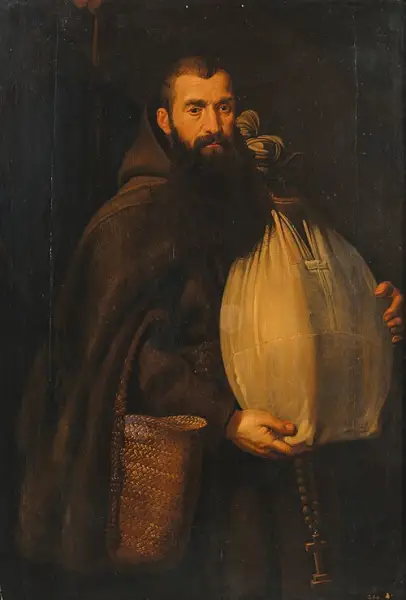
The image by which the world remembers Felix came from a vision. It is said that the Virgin appeared to him and placed the Infant Jesus in his arms, and from that time artists have shown him exactly so: a Capuchin holding the Christ Child, or walking with his filled beggar's sack. The two images are one. Pope John Paul II observed that artists show him with the Child in his arms because Felix, shouldering the needs of the destitute, had borne the poor Christ in his embrace — the sack of alms and the vision of the Child expressing a single spirituality. Everything in Felix's interior life ran in that direction. He had prayed while plowing as a farmhand and prayed while begging as a friar; he greeted every encounter with thanks to God; he poured out what he gathered on those with less than himself. The plain-spoken brother offered no treatises and founded nothing, yet his way of holding Christ — literally in the iconography, daily among the widows and children of Rome — taught generations a theology of the poor that learned men could only admire. The paintings that followed his death, of the Virgin appearing to the kneeling friar, fixed the vision in the imagination of the order he sanctified.
§ Iconography
Death on His Birthday
Felix grew old in the office he would not abandon. As age advanced, his superior commanded him, for his health's sake, to put on sandals, a small concession wrung from a man who had walked Rome barefoot for decades. The offer of Cardinal Santori, who offered to pull every string so that the aged friar might be spared his weary rounds of questing altogether, met with a refusal: the morning round of the sack and the doorway was, for Felix, not a burden to be set down but the very form of his discipleship. He died in Rome in 1587 on 18 May, the day on which he turned seventy-two, as though the span of his life closed exactly where it had opened. The Capuchins buried him in the crypt of the Church of Santa Maria della Concezione dei Cappuccini, the friary church his order served in the heart of the city, not far from the streets he had walked for forty years. Pilgrims came to the tomb of the beggar they remembered as Brother Deo Gratias, and the miracles sought there prepared the processes that would carry him to the altars.
§ Life
First of the Capuchins
The cause of the humble quaestor moved quickly by the standards of the Roman curia. Urban VIII beatified him on 1 October 1625, less than forty years after his death; Clement XI inscribed him among the saints on 22 May 1712. With that act Felix became the first friar of the Capuchins ever to receive the honor, the crown not of a founder or a martyr but of a lay brother whose sanctity was worked out in a beggar's rounds — a judgment of the church on what sanctity is. The canonical record was completed a generation later, when Pope Benedict XIII promulgated the canonization bull, Rationi Congruit, on 4 June 1724. His feast is celebrated on 18 May, the day of his birth and death, on the Calendar of Saints of the Franciscan Order, and his major shrine remains the church of Santa Maria della Concezione dei Cappuccini in Rome, where he lies in the crypt. The papacy that had been rebuked by the barefoot friar in the street thus set its seal, twice over, on the holiness of his street.
§ Veneration
Churches, Sisters, and an Enduring Image
Devotion to Felix took institutional form on two continents. Rome raised a titular church in his name at Centocelle, San Felice da Cantalice, giving the beggar of God a permanent place in the city's sacred geography. In nineteenth-century Poland the Felician Sisters, Franciscan women of the Third Order Regular whose congregation had been founded to serve the poor, adopted Felix as their patron saint, binding the memory of the Roman beggar to a new community of charity that carried his name across the world. Artists continued to return to him: Guercino painted Felix reviving a dead child, and Gillis Backereel depicted the apparition of Mary to the kneeling friar, while the circle of Rubens left a portrait that shows the Capuchin face the city knew. In the iconography that prevails he holds the Infant Jesus in his arms, because of the vision in which the Virgin placed the Child there. Between the titular church, the sisters who serve the poor in his name, and the inexhaustible image of the friar with the Child and the sack, the legacy of Brother Deo Gratias has remained what it was in life: charity with a face and thanks on its lips.
§ Veneration
Timeline
- 18 May 1515
Born at Cantalice in the Papal States, third of the four sons of Santi and Santa Porri, poor farmers.
§ Life
- 1543
After a plowing accident leaves him uninjured, enters the young Capuchin order as a lay brother at the friary of Citta Ducale, in the Anticoli Corrado district.
§ Life
- 1547
Named quaestor of the Capuchin friary of St. Bonaventure in Rome, beginning forty years of begging alms for the sick and the poor.
§ Life
- 1580
During the famine of that year, lent to Rome's political leader to gather food and supplies for the whole hungry city.
§ Life
- 18 May 1587
Dies in Rome on his 72nd birthday and is buried in the crypt of Santa Maria della Concezione dei Cappuccini.
§ Life
- 1 Oct 1625
Beatified by Pope Urban VIII.
§ Veneration
- 22 May 1712
Canonized by Pope Clement XI, becoming the first Capuchin friar raised to the altars.
§ Veneration
- 4 Jun 1724
Pope Benedict XIII publishes the Bull of Canonization, Rationi Congruit.
§ Veneration
In Their Own Words
Deo Gratias!
shown bearing the Infant Jesus in his arms because in bearing the burdens of the needy he had carried in his arms the poor Christ himself
The Record
- Major works
- Simple teaching canticles, sung by children in groups to learn the catechism·Forty years of questing (begging alms) for the Capuchin Friary of St. Bonaventure in Rome
- Patron of
- Spello
- Symbols
- Capuchin habit·holding the Christ Child·a filled sack
- Canonization
- Beatified 1 October 1625 by Pope Urban VIII; canonized 22 May 1712 by Pope Clement XI
Prayer
Bibliography
Show 5 sources
- Hess, Lawrence. "St. Felix of Cantalice." The Catholic Encyclopedia, Vol. 6. New York: Robert Appleton Company, 1909.
- Foley, Leonard, O.F.M. "St. Felix of Cantalice." Saint of the Day, Lives, Lessons and Feast (revised by Pat McCloskey, O.F.M.). Franciscan Media.
- Pope John Paul II. Address to the Sisters of Saint Felix of Cantalice. Libreria Editrice Vaticana, June 16, 2000.
- "Who is St. Felix of Cantalice?" Felician Sisters International, May 17, 2013.
- Bullarium Romanum, Vol 22. Benedict XIII (1724-1730). Taurini Ed, 1871. P. 41-44.
Profile text adapted from the Wikipedia article, licensed CC BY-SA 4.0.
Pray with this saint every day
Save St. Felix of Cantalice to your favorites, read the full profile, and get feast-day reminders in the Saints app.
Get the Saints AppFree on the App Store for iPhone and iPad