
514 – 584·Feast July 7
St. Felix of Nantes
Bishop of Nantes and peacemaker between Bretons and Franks
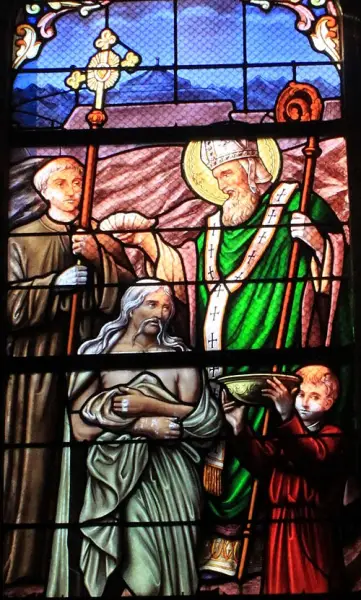
Overview
Felix governed the church of Nantes through the middle decades of the sixth century. Born around 514, he was a married man when he was raised to the episcopate in 551 at the age of thirty-seven; upon his ordination his wife entered religious life, and each embraced a separate calling. As bishop he sold the inheritance he had held and gave the proceeds to the poor, and he completed a cathedral within the city walls that his predecessor, Evemer, had planned. His civic achievements at Nantes were admired far beyond his own diocese: the poet Venantius Fortunatus praised the municipal improvements in verse. Felix also acted as a mediator between the Bretons and the Frankish kings, and on one occasion persuaded Guerech, Count of Vannes, to withdraw from a destructive raid and conclude a peace. He took his seat at the Paris assembly of 557 and again at the Tours gathering of 567, occasions that observed how old ancestor-cult practices of Gallo-Roman origin still persisted. He died on January 8, 584, at the age of seventy, after thirty-three years as bishop. The Church keeps his memory on July 7.
The Complete Life
A Married Man Called to the Altar
The record of Felix's origins is spare: he was born around the year 514, most likely in the Gallo-Roman west, and nothing survives of his childhood or family beyond the fact that he entered adult life as a married man. That married state, far from disqualifying him, forms the most distinctive feature of his story. In the sixth century the Church still occasionally raised married men to the episcopate, with the understanding that the couple would thereafter live continently and that the spouse would embrace religious life. When Felix was chosen for the see of Nantes in 551, at the age of thirty-seven, his wife did exactly that, entering a convent so that her husband might give himself wholly to the church. The arrangement speaks of a household of unusual mutual charity: two mature Christians, long companions, freely reordering their lives in the same hour so that each could follow a stricter path. It also suggests the esteem Felix already enjoyed in his city, for episcopal elections were contested affairs and a candidate had to command the confidence of clergy and people alike. Out of that settled domestic world came one of the most active bishops of sixth-century Gaul.
§ Life
Bishop of Nantes
Felix's first acts as bishop revealed the temperament that would mark his whole administration: a disregard for personal security and a passion for the visible good of his city. He disposed of the patrimony he had inherited, converting the family property into alms for the destitute, so that the wealth that had sustained his household became the sustenance of Nantes's poor. He then turned to the great unfinished work of his predecessor Evemer: a cathedral standing within the city walls. Under Felix the project was carried through, giving the Christian community of Nantes a church commensurate with its dignity and sheltered by the urban defenses in an age when such protection mattered. These undertakings were not merely pious gestures; they belonged to a broader program of municipal renewal that contemporaries found remarkable. The poet Venantius Fortunatus, the most celebrated Latin versifier of the Merovingian court, devoted poems to the improvements Felix accomplished at Nantes, an honor few bishops of the age received. In Felix the roles of pastor, patron, and civic builder were joined: he governed his see as a steward of both souls and stones, and left the city materially stronger than he found it.
§ Life
Peacemaker Between Brittany and the Franks
The position of Nantes placed its bishop on the fault line between two worlds: the Breton west, with its own counts and customs, and the Frankish kingdom that claimed overlordship over Gaul. Felix spent much of his episcopate bridging that divide. The clearest instance came when Guerech, Count of Vannes, plundered the neighboring dioceses and repulsed the troops King Chilperic sent against him, leaving the region poised for wider bloodshed. At the entreaty of Bishop Felix the count consented to withdraw his forces and make peace, a diplomatic success that spared the church and its people further ravaging. Felix's standing as an intermediary rested on trust earned on both sides of the frontier. He also served the wider Church in its councils, taking his place at Paris in 557 and at Tours ten years on. The minute of the latter gathering records, uneasily, that the old Gallo-Roman ancestor-cult rites still endured in the countryside, a reminder of how old paganism and Christianity mingled in the countryside Felix shepherded. Between royal courts and rural parishes alike, his episcopate was a long labor of reconciliation.
§ Life
Thirty-Three Years at the Helm
Felix held the see of Nantes for thirty-three years, an exceptionally long tenure in a century when bishops were deposed, exiled, or killed with depressing frequency. That endurance itself testifies to the steadiness of his administration: he weathered the wars of Chilperic's reign, the Breton raids, and the slow religious transitions of his province without ever losing the confidence of his flock or of the kings whose mediation he undertook. He reached the age of seventy, venerable years for the sixth century, and died on January 8, 584, still in office. He was buried as a bishop who had completed his course, mourned by a city he had rebuilt and by the poor he had fed with his own inheritance. The brevity of the surviving record should not obscure the shape of that final period: a man who had been called at thirty-seven laid down his charge thirty-three years later, having seen through a cathedral, a program of civic improvement, and countless acts of peacemaking. The memory of that long stewardship kept his name alive in the calendar of the saints.
§ Life
Memory and Feast
Felix's reputation outlived him in two forms: poetry and liturgy. Venantius Fortunatus's verses about the improvements at Nantes ensured that the bishop's civic achievements were remembered by readers far beyond the Loire, for Fortunatus's poems circulated throughout the Frankish world and remain a principal literary source for sixth-century Gaul. The Church, meanwhile, inscribed Felix among its saints, honoring him in the manner of the early centuries, when holiness of life and the acclaim of the faithful sufficed for veneration without any formal process. His feast is kept on July 7 in the General Roman Calendar, a date that keeps alive the memory of the bishop who fed the poor with his patrimony and reconciled Breton and Frank. For the city of Nantes he remained a founding figure of its Christian topography, the builder of the cathedral that anchored civic and religious life. Later hagiographers associated his story with that of other Breton frontier saints, such as Martin of Vertou, who evangelized the same border country. In all these remembrances the consistent image is of a peacemaker: a man whose patience ended quarrels that soldiers could not.
§ Life
Timeline
- 514
Born; the sources place his birth around this year.
§ Life
- 551
Chosen Bishop of Nantes at age thirty-seven; his wife enters religious life.
§ Life
- 557
Attends the Council of Paris as bishop of Nantes.
§ Life
- 567
Attends the Council of Tours, which notes lingering Gallo-Roman ancestor worship.
§ Life
- 8 Jan 584
Dies at age seventy, after thirty-three years in office.
§ Life
The Record
- Major works
- Cathedral of Nantes, raised within the city walls on the plan of his predecessor Evemer
- Canonization
- Pre-congregation; venerated as a saint in the Catholic Church since the sixth century.
Prayer
Bibliography
Show 3 sources
- Goyau, Georges. "Nantes (Nannetes)." The Catholic Encyclopedia, Vol. 10. New York: Robert Appleton Company, 1911.
- Bridgett, Thomas E. Britons, Picts, Scots, and Anglo-Saxons. London: C. Kegan Paul, 1881, p. 34.
- Butler, Alban. "St. Felix, Bishop of Nantes, Confessor." The Lives of the Saints, vol. VII, July (1866).
Profile text adapted from the Wikipedia article, licensed CC BY-SA 4.0.
Pray with this saint every day
Save St. Felix of Nantes to your favorites, read the full profile, and get feast-day reminders in the Saints app.
Get the Saints AppFree on the App Store for iPhone and iPad