
1715 – 1787·Feast June 2
St. Felix of Nicosia
Capuchin questor and healer of Sicily
Overview
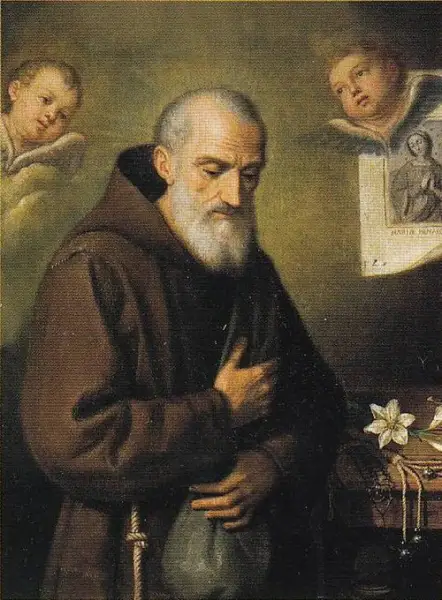
Felix of Nicosia, born Filippo Giacomo Amoroso on 5 November 1715 in Nicosia, Sicily, was a Capuchin lay brother whose long waiting and humble service made him one of the most beloved friars of his island. His father died three weeks before his birth, and as a boy he worked in a shoemaker's shop beside a Capuchin friary, where the friars' daily example taught him their manner of living. Repeatedly refused admission to the Order because he was illiterate, he persevered for eight years until he was finally accepted, entering the novitiate at Mistretta on 19 October 1743 and receiving the name Brother Felix. Professing vows the following year, he was assigned against custom to his hometown friary and given the office of quaestor, begging alms across the region for thirty years and more. He answered every rebuff, even violence, with gratitude to God. Endowed with a reputation for healing and, according to his brethren, the grace of bilocation, he tended the sick of Cerami during the malignant epidemic of 1777. He died at Nicosia on 31 May 1787, and was raised to the altars by Pope Benedict XVI in 2005.
The Complete Life
The Shoemaker's Boy by the Friary
Filippo Giacomo Amoroso was born at Nicosia in the Sicilian interior on 5 November 1715, in circumstances of hardship from the first: his father had died on 12 October, roughly three weeks before the child's arrival, leaving the mother to raise the boy alone in straitened circumstances. With no prospects for schooling, Filippo was sent out to work while still young, finding a place in the workshop of a shoemaker whose premises stood near a Capuchin friary. That accident of geography shaped his whole life. The boy saw the friars daily, learned the rhythm of their prayer and their poverty, and came to admire their way of life before he could have articulated any theology of it. The workshop became his first school of both craft and devotion; the friary gate, the chapel, and the friars' simple charity offered an education no classroom could match. From these early years came the two marks that would define him: an unlettered simplicity that never sought learning for itself, and a fixed desire to belong to the Order of Friars Minor Capuchin. Whatever else his story would contain, the direction was set by those childhood hours beside the friary wall.
§ Life
Eight Years at a Closed Door
At about the age of twenty, Filippo approached the Guardian of the friary and asked him to intercede with the Minister Provincial at Messina for his admission to the Order as a lay brother. His illiteracy barred him from candidacy as a cleric, and even for the lay brotherhood his petition was rejected again and again. Most applicants would have read in the refusals a verdict from heaven and gone home; Filippo returned instead, year after year, so constant in his request that his perseverance itself became his argument. After eight years the friars concluded that a man who would not be discouraged was precisely what the Order needed, and he was admitted to the novitiate at Mistretta. On 19 October 1743 he received the habit and the name Brother Felix, honoring the first Capuchin raised to the altars, and a year later he professed his vows. His superiors then did something contrary to the norms of the Province: they posted the young professed to the friary of his own hometown, ordinarily forbidden lest family and friends entangle a novice's heart. In Felix's case they judged his detachment so complete that the danger scarcely existed, and Nicosia received its own son back as a friar.
§ Life
The Beggar of Nicosia
The office assigned to Brother Felix was that of quaestor, the friar who goes out daily to beg alms for the support of the community and its works. For the remainder of his life he walked the roads around Nicosia knocking on doors, inviting every household to share its prosperity with the poor friars. The work exposed him to every human temperature: courtesy and contempt, generosity and rough handling. His response became legendary among the people of the region, for he thanked everyone who gave and blessed God even when he was manhandled, exclaiming that it should all be for the love of God. Alongside this daily round there grew up a reputation for the extraordinary. He was credited with power to heal ailments of both body and soul, and nothing pleased him more than caring for the sick himself. His brethren attested that he bilocated, appearing at a distance while remaining present at his duties. When a malignant epidemic ravaged the nearby town of Cerami in March 1777, Felix answered the call without hesitation, moving among the dying and the abandoned; his ministry there was crowned, the sources record, with great success, and the town remembered the beggar friar who came when others kept away.
§ Life
Hidden Prayer and Relentless Humiliation
Beneath the busy exterior of the quaestor lay a life of concentrated devotion. Felix's love centered on Jesus Christ and the Virgin Mary, expressed in habits fixed over decades. Every Friday he contemplated the Passion and death of Christ, and on the Fridays of Lent he fasted on bread and water in union with the suffering Lord. His particular tenderness was reserved for the Blessed Sacrament: after a day of refusals and abuse on the roads he would spend hours kneeling before the tabernacle, silent in adoration, restoring in prayer what the day had spent. God's favor, he seemed to believe, was to be found precisely where pride would feel it least, and Providence arranged for him a long school of this conviction. For thirty-three years he lived under a guardian who took it as his role to sanctify the brother by relentless severity and extraordinary humiliations, testing him without respite. Felix bore it all with heroic patience, refusing to claim any right against the man who governed him. This union of exterior charity and interior mortification was the secret of his influence: the people who met a smiling beggar at their door sensed they were dealing with a soul at prayer.
§ Life
Permission to Die
In May 1787, while working in the friary garden, Felix was overtaken by a sudden and raging fever. He told the doctor, who prescribed medicines that proved useless, for the illness was his last. The end came as his life had been lived: in obedience. So thoroughly had the vow shaped his soul that even in dying he requested permission from the guardian of the community before he would let go, asking leave as he had once asked admission, with the same patient deference. He died at Nicosia on 31 May 1787, at two in the morning, in his seventy-second year. The brothers who had watched the old quaestor walk their roads for decades recognized at once that a saint had gone to God, and the people of the city began almost immediately to honor him. His death closed a life of remarkable internal consistency: he had knocked on the Order's door until it opened, knocked on the city's doors until they blessed him, and finally knocked, as it were, on heaven's gate, waiting for the permission of obedience before entering. The body that had carried alms for thirty years was laid to rest with the veneration his neighbors already paid him.
§ Life
From Beatification to the Altars of Peter
The Church's judgment of Felix unfolded over more than a century after his death. Pope Leo XIII beatified him on 12 February 1888, confirming the devotion that Sicily had never allowed to cool. In 1891 his remains were carried to the city's cathedral, bringing them within easier reach of the crowds who wished to venerate him, and the cathedral of St. Nicholas became his principal shrine. The formal cause for canonization was opened on 19 June 1902, but the process, like the man's own admission to the Order, required patience measured in decades; more than a century separated beatification from the final verdict. That verdict came at last from Pope Benedict XVI, who canonized Felix of Nicosia on 23 October 2005, enrolling the eighteenth-century beggar among the saints of the universal Church. The long delay itself proved a fitting commentary on his life: a friar who had persevered eight years for a habit, and thirty-three years under a harsh superior, was not ill-served by a cause that took a hundred years. The Church confirmed what the people of Nicosia had known all along, that sanctity had walked their streets in a mendicant's habit.
§ Veneration
The Saint of Small Doors
Felix of Nicosia endures in the memory of the Church as the saint of ordinary tasks transfigured. His feast is kept on June 2, and his remains rest in the cathedral of St. Nicholas at Nicosia, where pilgrims continue to pray at the shrine of the town's native son. To Capuchins everywhere he remains a model of the lay brotherhood: a man of no learning and no office whose fidelity to the quaestor's round of knocking, thanking, and enduring was judged worthy of the altars. His story commends virtues the modern world finds difficult to advertise — perseverance that outlasts rejection, gratitude under injury, obedience carried into dying — and shows how a life without position or writings can nevertheless move an entire island. The miracle traditions that gathered around him, the healings and the bilocations reported by his brethren, belong to the popular piety of Sicily, but the durable core of his legacy is simpler: the eight years of patient asking, the daily thanksgiving at every door, the hours before the tabernacle after every insult. Poets and preachers have found in him proof that no work is too small for sanctity, and no door too often closed for a heart that knocks in love.
§ Veneration
Timeline
- 12 Oct 1715
His father dies at Nicosia, roughly three weeks before Filippo's birth.
§ Life
- 5 Nov 1715
Born Filippo Giacomo Amoroso at Nicosia, Sicily, weeks after his father's death.
§ Life
- 1735
At about twenty, asks the Capuchin Guardian to petition for his admission to the Order.
§ Life
- 19 Oct 1743
Enters the novitiate at Mistretta, taking the name Brother Felix.
§ Life
- 1744
Professes his vows and is assigned to the Capuchin friary in his native Nicosia.
§ Life
- Mar 1777
Ministers to the sick during the malignant epidemic devastating Cerami.
§ Life
- 31 May 1787
Dies at Nicosia after a sudden fever, having asked leave to die from his guardian.
§ Life
- 12 Feb 1888
Beatified by Pope Leo XIII.
§ Veneration
- 1891
His relics are translated to the cathedral of Nicosia for public veneration.
§ Veneration
- 19 Jun 1902
The cause for his canonization is formally opened.
§ Veneration
- 23 Oct 2005
Canonized by Pope Benedict XVI.
§ Veneration
In Their Own Words
Let it be for the love of God
The Record
- Major works
- Quaestor of the Capuchin friary of Nicosia, gathering alms for the friars and their works for three decades
- Canonization
- Beatified by Pope Leo XIII on 12 February 1888; canonized by Pope Benedict XVI on 23 October 2005.
Prayer
Bibliography
Show 6 sources
- Staley, Tony. "St. Felix of Nicosia never gave up his dream." The Compass, Diocese of Green Bay, Wisconsin, 2009.
- "Felix of Nicosia (1715-1787)." Vatican News Service.
- "Saint Felix of Nicosia." Capuchin Franciscans, Province of St. Mary, White Plains, NY.
- "St. Felix of Nicosia, OFM Cap." Capuchin Franciscans Western America Province.
- Index ac status causarum beatificationis servorum dei et canonizationis beatorum. Typis polyglottis vaticanis, January 1953, p. 68.
- de Grèzes, Henri. Vie du bienheureux Félix de Nicosie, de l'ordre des FF. mineurs capucins. 1888.
Profile text adapted from the Wikipedia article, licensed CC BY-SA 4.0.
Pray with this saint every day
Save St. Felix of Nicosia to your favorites, read the full profile, and get feast-day reminders in the Saints app.
Get the Saints AppFree on the App Store for iPhone and iPad