
c. 200 – c. 260·Feast January 14
St. Felix of Nola
Priest, confessor under Decius, and friend of spiders
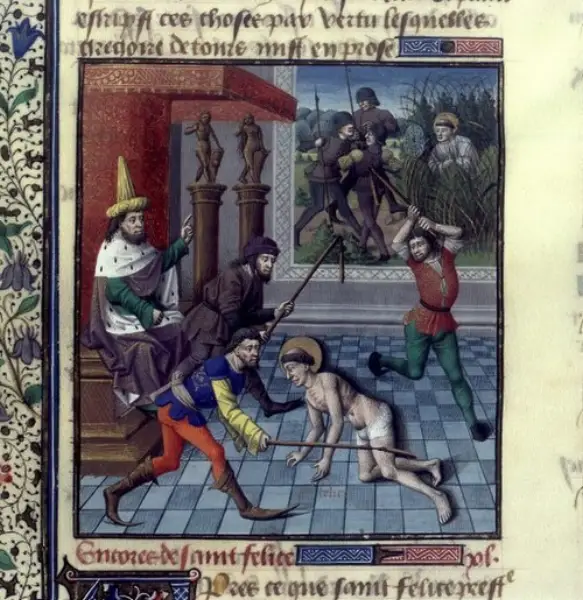
Overview
Felix of Nola was a priest of the Italian town of Nola, near Naples, whose endurance under the Decian persecution made him one of the most celebrated confessors of the early Church. The firstborn of Hermias, a centurion from Syria who had settled in retirement at Nola, Felix sold most of his inheritance after his father's death, gave the money to the poor, and entered the service of the church as an assistant to Bishop Maximus. When the persecution of Emperor Decius broke out, Maximus fled to the mountains and Felix was arrested and beaten in his place. He escaped prison, freed by an angel according to the legend, and hid the ailing bishop from the soldiers, twice spared when a spider's web spun across a doorway convinced searchers the building was abandoned. After the persecution ended with Decius's death in 251, the people wished to make him bishop, but Felix declined in favor of Quintus and remained a simple priest, farming his small remaining land and giving most of its produce to those poorer than himself. Traditions of his martyrdom under Valerian gathered around his memory, though he is listed in the General Roman Calendar as a confessor who survived his tortures.
The Complete Life
Son of a Syrian Centurion
Felix was born at Nola in Campania in the early years of the third century, the firstborn child of Hermias, a centurion of Syrian origin who, after his army service, had settled in this quiet town near Naples. From his father he inherited the standing of a settled family and, presumably, the property that went with it; from the Christian community he received a very different inheritance, one that turned his back on accumulation. When Hermias died, Felix took stock of everything he owned and made the decision that defined his life: he put most of his lands and belongings up for sale and gave what they fetched to the destitute. Having emptied himself of his patrimony, he pursued a clerical vocation and was ordained by Maximus, the bishop of Nola, serving as the bishop's priest and close co-worker. The pattern — a hereditary landholder deliberately reduced to poverty for the sake of the Gospel — was becoming familiar in the African and Italian churches of the age, and it shaped Felix so deeply that even after persecution stripped him of nearly everything, he continued to farm what little remained and give most of the harvest away.
§ Life
Priest of Nola
Felix's vocation was lived out in the second rank of the clergy, and he guarded that position even when the first was offered to him. Ordained by Bishop Maximus, he worked at the bishop's side in the ordinary ministry of the Nolan church — and when the storm of the Decian persecution broke over Campania in 250, it was this partnership that was tested. Maximus, an aged bishop, withdrew to the mountains to escape arrest, and the persecutors seized his priest instead. Felix's conduct during those months made his reputation: arrest, beating, imprisonment, a miraculous escape, and then the reckless charity of returning from flight to find and shelter the sick and helpless Maximus. When peace returned and Maximus died, the people of Nola naturally turned to the hero of the persecution as their next bishop. Felix declined. He gave his voice instead to Quintus, a priest senior to him by exactly seven days of ordination, and settled back into the life of a simple presbyter. The episode reveals the man: he judged the honor belonged to the senior priest, and he never treated the episcopal dignity as a prize. For the rest of his days he remained what he had chosen to be — a priest of Nola.
§ Life
Confessor in the Decian Storm
The persecution of Emperor Decius aimed at forcing every Christian to sacrifice to the gods, and it produced martyrs and confessors across the empire. At Nola it produced Felix. Arrested in place of the fugitive Bishop Maximus, he was beaten and cast into prison for his faith. There, according to the legend that grew around him, an angel freed him so that he could go to the aid of his bishop — and he used his liberty not for his own safety but for Maximus's. He found the old man alone, ill, and helpless, and carried him to a vacant building where he hid him from the soldiers. Once both were sheltered within, a spider wove its web across the doorway, and the searchers, judging the web proof that the building had long been abandoned, passed on without looking inside. A second attempt to arrest Felix met the same sign: hiding in a ruined structure, he saw a web again spun across the entrance, and again the soldiers were deceived. The two Christians remained concealed until the persecution collapsed with the death of Decius in 251. The Church remembered him for these trials; the Roman Martyrology records that he sustained most bitter torments in prison for the faith.
§ Life
Poverty, Providence, and the Smallest Creatures
The spirituality that shines through Felix's story is one of radical trust. He had learned it first as a property owner who sold everything for the poor, banking his security entirely on God rather than on land or money; he proved it again in prison, and yet again when he emerged from hiding and quietly resumed a poor man's life. The famous spider's webs, whether history or legend, became the emblem of this trust: God's providence working through the most despised and fragile of creatures, a few threads of silk defeating the power of an empire's police. That is why, in later devotion, Felix became the patron of spiders and of lost animals — the small things that the mighty overlook. His daily life after the persecution continued the same witness. He farmed the little land that remained to him, kept almost nothing of its produce, and gave the greater share to people even poorer than himself, preferring to be preceded in poverty rather than to preside over abundance. When peace came he lived withdrawn and hidden until old age, an unconquered confessor in the words of the Martyrologium Romanum, embodying the conviction that the faith is confessed as much by quiet charity as by public endurance of chains.
§ Life
Old Age and the Question of Martyrdom
The end of Felix's life is wrapped in the uncertainty that surrounds many heroes of the persecutions. One strand of tradition, recorded by Butler, says that after the peace of the Church he returned home and lived in poverty and seclusion until old age, dying full of years on the fourteenth of January. Another, legendary, strand assigns him a martyr's death — either in 255 under Emperor Valerian, or in another version amid the general persecution of Decius himself. The calendar has kept both memories in tension: he is honored with the title of martyr in much popular devotion, yet the General Roman Calendar nowadays ranks him among the confessors who outlived their torments. Either way, the shape of his last years is consistent with everything else in his life: poverty, hiddenness, and fidelity. He had refused the episcopate, declined prominence, and given away the means of comfort, so it is fitting that tradition pictures him dying quietly at Nola rather than in a second arena. The date of his death, 14 January, became his feast day, and the Church of Nola began almost at once to gather at his grave.
§ Life
Confessor of the Faith
Felix was never canonized by any process, for he belongs to the earliest generation of saints whose veneration arose spontaneously from the devotion of the communities that knew them. He is honored in both the Catholic Church and the Orthodox Church, a rare breadth that testifies to how far his fame traveled from the small Campanian town. The official tradition carefully preserves the distinction between martyr and confessor: the Martyrologium Romanum, citing St. Paulinus, commemorates the priest who was thrown into prison under the raging persecutions and sustained acerbissima tormenta — most bitter torments — and who, when peace was finally restored, returned home to live out his old age in poverty as an unconquered confessor of the faith. The Calendarium Romanum of 1969 keeps his name in the General Roman Calendar on 14 January, ranked among the confessors. This classification, far from diminishing him, honors the particular character of his witness: he endured the persecutor's prison and emerged alive, then spent decades more confessing Christ through daily poverty. His cult is thus one of the oldest continuous in the Latin Church, reaching without interruption from third-century Nola to the present calendar.
§ Life
The Basilicas of Cimitile and the Poet's Memory
Nearly all that is known about Felix is drawn from the correspondence and verse of Paulinus, bishop of Nola, the aristocrat who a century and a half later renounced his wealth at the saint's own shrine and became Nola's most famous bishop. Through Paulinus's verses Felix's cult spread across the Latin world, and pilgrims traveled from far away to visit his burial place, which lay outside the precincts of the city of Nola. Around that first grave there eventually rose five churches, built at or near the site in the complex now associated with Cimitile — one of the great pilgrimage landscapes of early Christianity. Felix's precious remains are kept in the cathedral of Nola, while portions are venerated at Rome, Benevento, and other places, evidence of how widely his relics were sought. In time a new church within the city itself was dedicated under his name. His legend, carried in art as the beaten saint hidden behind a spider's web, made him a favorite of popular devotion and the acknowledged patron of spiders and lost animals. Few saints of the third century left such a rich material and literary footprint from so modest a life.
§ Life
Timeline
- 200
Born in the early third century at Nola, Campania, elder son of Hermias, a retired Syrian centurion.
§ Life
- 250
During the persecution of Decius, Felix is arrested and beaten; he escapes prison and hides Bishop Maximus from the soldiers.
§ Life
- 251
The death of Emperor Decius ends the persecution, and Felix and Maximus emerge from hiding in safety.
§ Life
- 255
Legend assigns his martyr's death under Emperor Valerian, though Butler records he died in good old age.
§ Life
- 14 Jan 260
Traditional date of his death at Nola; the calendar ranks him a confessor, not a martyr.
§ Life
- 1969
The 1969 Calendarium Romanum keeps his name on the General Roman Calendar, ranked among the confessors.
§ Life
The Record
- Major works
- Five churches were built at or near his first burial place outside the walls of Nola
- Patron of
- patron of lost animals·patron of spiders
- Symbols
- depicted beaten and hidden by a spider's web
- Canonization
- Pre-congregation; venerated as a saint in the Catholic Church and the Orthodox Church from the early centuries.
Prayer
Bibliography
Show 7 sources
- "Felix of Nola." Orange County Catholic, Roman Catholic Diocese of Orange, January 18, 2018.
- Calendarium Romanum. Libreria Editrice Vaticana, 1969, p. 112.
- Butler, Alban. The Lives of the Saints, Vol. I, 1866.
- Coleman, Ambrose. "St. Felix of Nola." The Catholic Encyclopedia, Vol. 6. New York: Robert Appleton Company, 1909.
- Ghezzi, Bert. Voices of the Saints. Loyola Press, ISBN 978-0-8294-2806-3.
- Martyrologium Romanum. Libreria Editrice Vaticana, 2001, ISBN 88-209-7210-7.
- Attwater, Donald, and Catherine Rachel John. The Penguin Dictionary of Saints, 3rd edition. New York: Penguin Books, 1993, ISBN 0-14-051312-4.
Profile text adapted from the Wikipedia article, licensed CC BY-SA 4.0.
Pray with this saint every day
Save St. Felix of Nola to your favorites, read the full profile, and get feast-day reminders in the Saints app.
Get the Saints AppFree on the App Store for iPhone and iPad