
fl. c. 386 – 399·Feast March 26
St. Felix of Trier
Bishop of Trier caught in the Priscillian tragedy
Overview
Felix of Trier was bishop of the great imperial city of Trier from around 386 to 398, an episcopate defined by one of the darkest episodes in the early Church's history: the trial and execution of Priscillian of Ávila and his followers, condemned for heresy and witchcraft in what can be seen as the Church's first inquisitorial action. The death sentences, imposed despite the vigorous opposition of western bishops such as Martin of Tours and Ambrose of Milan, brought bitter consequences for those associated with the trial. Pope Siricius, Martin, Ambrose, and other bishops broke off fellowship with every bishop who had taken part, and Felix — charged with having lent too little strength to the opposition against the verdict — found himself cut off. At a synod at Turin in 398 the other bishops were readmitted to communion with Rome on condition that they have nothing to do with Felix, leaving him all but alone. In 398 he gave up his see. His memory rests less on that disgrace than on a work of piety: he brought the relics of Paulinus of Trier back from Phrygia and raised a sanctuary for them, an ancestor of today's St. Paulinus' Church, beneath whose crypt he now rests. His feast is kept on 26 March.
The Complete Life
Bishop in the Imperial City
Felix took charge of the church of Trier around the year 386, succeeding Britto in one of the most exalted sees of the Latin Church. Trier in the late fourth century was no provincial town: it had been a residence of the emperors of the west, the administrative heart of the Gallic prefecture, and its bishop stood among the leading prelates of the empire. Felix held the office from about 386 to 398, a decade in which the city's ecclesiastical life was dominated not by pastoral expansion but by the aftershocks of a judicial catastrophe. The honor and the burden of the see came to him together. Into his episcopate fell the final act of the Priscillianist affair: the trial of the Spanish bishop Priscillian and his followers, their condemnation for heresy and witchcraft, and their execution by the secular power — an outcome regarded as the first inquisitorial action in the Church's history and one that horrified many of the greatest bishops of the age. Felix inherited, at the summit of his career, a question that the Church had never faced before: how to answer a heresy that the state had answered with the sword.
§ Introduction
The Priscillian Affair and Its Consequences
The execution of Priscillian and his followers for heresy and witchcraft scandalized the episcopate of the west. Martin of Tours and Ambrose of Milan, among many others, had opposed the recourse to the imperial tribunals with all their vigor, and when the sentences were carried out, the consequences rebounded on every bishop connected with the proceedings. Pope Siricius, together with Martin, Ambrose, and the rest of the western episcopate, severed communion with every bishop who had joined in the trial of Priscillian — an extraordinary act of collective discipline aimed at the judgment itself. Among those tainted was Felix of Trier, whose see had been the stage of the affair. His fault, as his accusers framed it, was not that he had demanded the deaths but that he had not campaigned vigorously enough against the verdict: a failure of protest rather than an act of malice. Yet in a matter where the greatest voices of the age — Martin, Ambrose, the pope himself — had spoken without ambiguity, silence counted as complicity. Felix bore the brunt of the Church's horror at what she had done, and his isolation became the visible sign of the western episcopate's resolve that doctrine must never again be defended by the executioner.
§ Introduction
Isolation, Renunciation, and the Relics of Paulinus
Felix's downfall was sealed at a synod of bishops held at Turin in 398. The assembly readmitted to communion with Rome all the bishops who had been involved in the Priscillian affair, but on a hard condition: they were to undertake to have nothing to do with Felix. The man whose sin had been insufficient protest was thus left to bear alone the penalty that the others escaped, and he found himself largely isolated within the very church he governed. In that same year, 398, Felix renounced his bishopric, and the see of Trier passed to Mauritius II. Yet the end of his episcopal office was not the end of his works of piety. It was Felix who brought back to Trier the relics of Paulinus, the revered fourth-century bishop of the city who had died in exile in Phrygia, and he built a church to house them — an ancestor of today's St. Paulinus' Church, in whose crypt Felix himself was laid to rest. The man remembered in calendars with the feast of 26 March is thus a double figure: the bishop broken by the Priscillian tragedy, and the devout restorer who gave the city's greatest confessor back to his people.
§ Introduction
A Troubled Memory and a Living Shrine
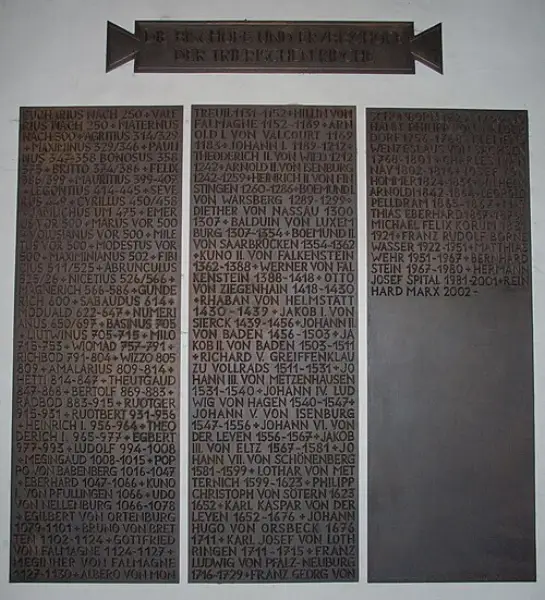
Felix of Trier left no writings, and the sources preserve his name chiefly through the Priscillianist catastrophe; yet the Church of Trier never erased him from its memory. The feast of 26 March keeps him among its venerable bishops, and the episcopal lists record his decade between Britto and Mauritius II with unembroidered brevity. His most tangible legacy stands in the city itself: the church he built for the relics of Paulinus, carried home from Phrygia, began the chain of sanctuaries that culminates in the present St. Paulinus' Church, one of Trier's great shrines, beneath whose altar Felix's own remains rest. There is a quiet fitness in that burial. The bishop who was cut off from the communion of his colleagues lies in the crypt of the confessor he honored, and the Church that once decreed his isolation now prays at his tomb. Historians of the period see in his fall the western Church's first great reckoning with the union of heresy trials and capital punishment; the faithful of Trier see a penitent bishop whose final act was a work of veneration. Both memories belong to him, and both are kept alive at the shrine on 26 March.
§ Introduction
Timeline
- 386
Felix becomes bishop of Trier, succeeding Britto; the trial and execution of Priscillian and his followers mark his episcopate.
§ Introduction
- 398
A synod of bishops at Turin readmits the other bishops to communion on condition they avoid Felix, isolating him.
§ Introduction
- 398
Felix renounces his bishopric; he is succeeded by Mauritius II.
§ Introduction
The Record
- Major works
- Church built to house the relics of Paulinus of Trier, among the predecessors of the present St. Paulinus' Church
- Canonization
- Pre-congregation; venerated locally as a saint, with feast on 26 March.
Prayer
Bibliography
Show 3 sources
- Sauser, Ekkart. Saints and Blessed in the Diocese of Trier, 1987.
- "Trier." The Catholic Encyclopedia.
- "Diocese of Trier." GCatholic.
Profile text adapted from the Wikipedia article, licensed CC BY-SA 4.0.
Pray with this saint every day
Save St. Felix of Trier to your favorites, read the full profile, and get feast-day reminders in the Saints app.
Get the Saints AppFree on the App Store for iPhone and iPad