
1127 – 1212·Feast November 4
St. Felix of Valois
Cistercian hermit and co-founder of the Trinitarians
Overview
Felix of Valois was a French hermit who, late in a long life of contemplation, helped bring one of the medieval Church's great redemptive orders into being. Born on April 16, 1127 and surnamed for the province of Valois, he had lived as a Cistercian before retiring to a hermitage deep in the woods of the Diocese of Meaux, consecrating his days to prayer. There the young doctor of divinity John of Matha found him, and proposed a daring project: a religious order dedicated to ransoming Christians held captive. Felix, though about seventy, agreed, and the two traveled to Rome, where Pope Innocent III approved the Order of the Holy Trinity for the Redemption of Captives in December 1198. Felix carried the new institute back to France, won the patronage of King Philip Augustus, and raised its motherhouse at Cerfroid. Within forty years the Trinitarians possessed some six hundred monasteries across Europe. Felix died among his brethren at Cerfroid on November 4, 1212, at about eighty-five years of age.
The Complete Life
A Nobleman Who Walked Away
Felix was born on April 16, 1127, and took his surname from the province of Valois, of which he was a native. The sources preserved by his cult, notably Alban Butler's account, place his birth in that year, and his later life shows a man formed by both privilege and renunciation. Before his eremitical years he belonged to the Cistercian world, one of the great reforming monastic families of the twelfth century, and the discipline of that tradition marked his spirituality. At some point he abandoned his possessions entirely and withdrew into a dense forest within the Diocese of Meaux. There, far from the courts and abbeys that might have claimed his talents, he built a hermitage at a place that came to be called Cerfroid. For years he lived a life of prayer and contemplation, unknown to the wider world but slowly becoming known to it by reputation, as holy solitaries often were in that age. Travelers and spiritual seekers began to find their way to his forest retreat. Among them, in God's time, would come a young Provencal nobleman and scholar whose visit would change the direction of Felix's long life and give his solitude a mission.
§ Life
The Visitor from Provence
The hermit of Cerfroid might have ended his days in obscurity had John of Matha not heard of him. John, a young nobleman from Provence who had earned the degree of doctor of divinity and had since been ordained a priest, sought out the celebrated solitary and placed himself under his spiritual direction. The student and the hermit must have recognized in each other the same restless charity, for out of their conversations came a plan far larger than either forest solitude: John proposed that they found a religious order whose specific work would be the redemption of captives. In an age when Mediterranean piracy and war had filled the slave markets of North Africa and the Near East with Christians, such an order answered an urgent and largely neglected need. Felix was about seventy years old when this proposal reached him. Many men at that age would have guarded the peace they had won; instead he readily agreed, and the old hermit and the young priest became co-founders. Felix's maturity supplied prudence and standing, John's youth supplied energy, and together they set out to win the Church's approval for an entirely new form of consecrated life.
§ Life
Founding the Trinitarians
The two founders traveled to Rome in the depth of winter, arriving in January 1198, precisely as Innocent III began his pontificate. Carrying letters of recommendation from the Bishop of Paris, they were received kindly and lodged in the papal palace. Though Innocent was generally cool toward the founding of new orders, by a bull of December 17, 1198 he gave the enterprise his approval, erecting the new institute for ransoming captives under the invocation of the Holy Trinity. John of Matha was named its superior-general, while the Bishop of Paris and the Abbot of Saint Victor were charged with drafting a rule that the pope afterward confirmed. Felix returned to France to plant the order there and was received with enthusiasm; King Philip Augustus authorized the institute and supported it with substantial benefactions. Margaret of Blois gave twenty acres of the wood where Felix had raised his first hermitage, and on nearly the same ground he erected the famous Monastery of Brumetz, the order's motherhouse. Within forty years the Trinitarians possessed six hundred monasteries across Europe. John went to Rome to found a house whose church, Santa Maria in Navicella, still stands on the Caelian Hill, while Felix remained in France, establishing the Paris house attached to Saint Maturinus that later became celebrated under Robert Guguin, master general of the order.
§ The Trinitarians
Dying Where the Work Began
Felix spent his last years in the place where his vocation had been born and transformed. Having entrusted the French congregation's interests to his care while John of Matha labored in Rome, he governed and encouraged the young foundation from Cerfroid, the motherhouse that had grown from his own hermitage in the wood of Brumetz. He saw the order multiply beyond anything the two founders could have predicted when they walked to Rome through the winter cold: within forty years of papal approval, hundreds of houses across Europe would carry the Trinitarian habit and the work of ransom. On November 4, 1212, at about eighty-five years of age, Felix died among his fellow Trinitarians at their motherhouse in Cerfroid, in Brumetz, in the Picardy region — a death he had plainly earned after a quarter century of labor for the new institute. The hermit who had first fled the world to save his own soul ended his life surrounded by the religious family he had co-founded to save the souls and bodies of captives. He was buried at the monastery that remained the heart of the order he served, and his feast was soon kept in the surrounding country.
§ Life
A Cult the Church Confirmed
Felix's rise to the Church's honors followed the pattern of immemorial cult rather than a formal canonization process whose records survive. No bull of canonization is extant, but the tradition of the Trinitarian Order holds that Pope Urban IV canonized him in Rome on May 1, 1262, half a century after his death. Veneration had begun even earlier: Du Plessis records that the feast was being observed in the Diocese of Meaux — the diocese containing Cerfroid — as early as 1215, only three years after his burial. The Holy See later ratified what the faithful had long practiced. On October 21, 1666, Pope Alexander VII formally confirmed Felix's status as a saint precisely because of his immemorial cult. In 1679 Pope Innocent XI transferred his feast from November 4 to November 20 and inscribed it in the General Roman Calendar, since November 4 had belonged to Saint Charles Borromeo since 1613. There the feast stood for nearly three centuries, until the liturgical reforms of 1969 restored it to November 4, the dies natalis, the day of Felix's death — returning the saint, as it were, to his own day.
§ Veneration
A Name Carried Across the World
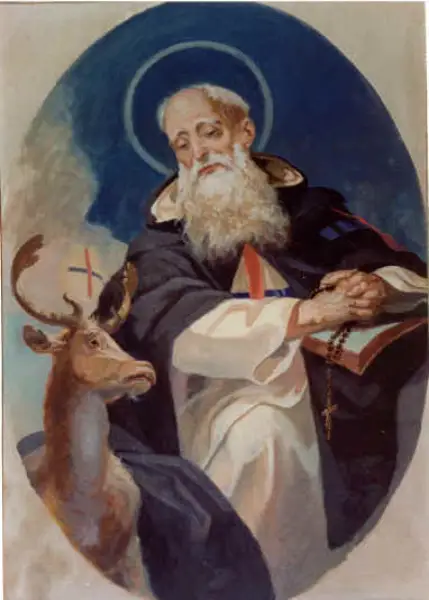
The Trinitarian order Felix co-founded endured for centuries as one of the Church's distinctive instruments of mercy, and his name traveled with European settlement to the far corners of the world. In the province of Quebec, the village of Saint-Felix-de-Valois preserves his memory in its very name. In Australia, St. Felix de Valois Parish serves the Catholic community of Bankstown. In the United States, St. Felix Church in Clifton Springs, New York, honors him; the present building dates from 1895, the year the pastor, Felix O'Hanlon, changed the parish's name from St. Agnes to St. Felix, and the church now forms part of Saint Peter's Roman Catholic Parish in the Diocese of Rochester. In sacred art his emblem is a white stag bearing a cross between its antlers, an image that gathers up the legend of a huntsman's vision associated with his withdrawal into the forest. His major shrine remains the Monastery of Cerfroid at Brumetz in the French department of Aisne, where he died and was buried. Nearly nine centuries after his birth, the hermit of Cerfroid is still honored on three continents.
§ Legacy
Timeline
- 16 Apr 1127
Born, according to Butler, in the province of Valois, France.
§ Life
- Jan 1198
Traveled to Rome with John of Matha, arriving at the start of Innocent III's pontificate.
§ The Trinitarians
- 17 Dec 1198
By a papal bull, Innocent III approved the new order devoted to ransoming captives, under the name of the Holy Trinity.
§ The Trinitarians
- 4 Nov 1212
Died at the Trinitarian motherhouse of Cerfroid, aged eighty-five.
§ Life
- 1215
His feast was already being kept in the Diocese of Meaux, according to Du Plessis.
§ Veneration
- 1 May 1262
By the tradition of his institute, canonized by Pope Urban IV in Rome.
§ Veneration
- 21 Oct 1666
Pope Alexander VII confirmed his sainthood on account of his immemorial cult.
§ Veneration
- 1679
Pope Innocent XI transferred his feast to November 20 and placed it in the General Roman Calendar.
§ Veneration
- 1969
His feast was restored to November 4, the day of his death.
§ Veneration
The Record
- Major works
- Co-founder of the Order of the Holy Trinity for the Redemption of Captives·Monastery of Cerfroid (Brumetz), motherhouse of the Trinitarians·Trinitarian house in Paris attached to the Church of Saint Maturinus
- Symbols
- White stag with a cross between his horns
- Canonization
- Tradition holds that Pope Urban IV canonized him in Rome on May 1, 1262; Pope Alexander VII confirmed his immemorial cult on October 21, 1666.
Prayer
Bibliography
Show 6 sources
- Husenbeth, Frederick Charles. Emblems of Saints: By which They are Distinguished in Works of Art, Longman, Green, Longman, and Roberts, 1860, p. 64
- Butler, Rev. Alban. "Saint Felix of Valois, Confessor", Lives of the Saints, Volume XI, 1886. Bartleby.com
- O'Kane, Michael. "St. Felix of Valois." The Catholic Encyclopedia. Vol. 6. New York: Robert Appleton Company, 1909. Newadvent.org
- Moeller, Charles. "Order of Trinitarians." The Catholic Encyclopedia. Vol. 15. New York: Robert Appleton Company, 1912. Newadvent.org
- Calendarium Romanum (Libreria Editrice Vaticana 1969), p. 146
- Martyrologium Romanum (Libreria Editrice Vaticana 2001, ISBN 88-209-7210-7)
Profile text adapted from the Wikipedia article, licensed CC BY-SA 4.0.
Pray with this saint every day
Save St. Felix of Valois to your favorites, read the full profile, and get feast-day reminders in the Saints app.
Get the Saints AppFree on the App Store for iPhone and iPad