
c. 1776 – 1864·Feast February 2 (Old Calendar); also July 5
St. Feodor Kuzmich
Siberian starets of mysterious royal origin
Overview
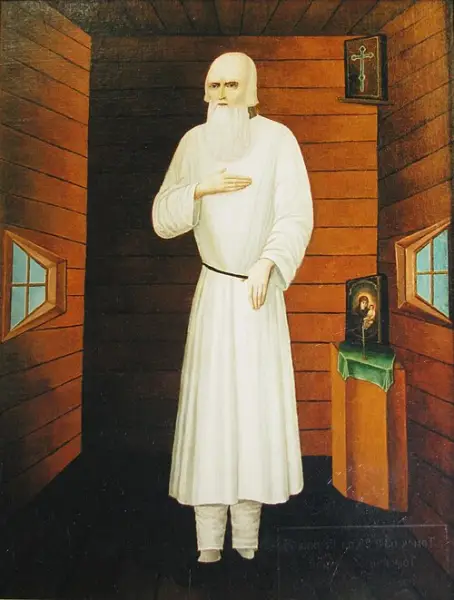
Feodor Kuzmich — honored as the Righteous Theodore of Tomsk, the Siberian elder — was a Russian Orthodox starets whose life begins, quite literally, with no past. Nothing is recorded of his early years. He appeared in September 1836 in Krasnoufimsk, in the Province of Perm, riding a snow-white horse and offering evasive answers to those who questioned him. A court sentenced the documentless stranger, who called himself Feodor Kuzmich Kozmin, to twenty whip blows and exile to Siberia as a tramp. From that punishment he carved one of the most remarkable lives in Russian sanctity. Exiled to the Tomsk region, his asceticism was severe: bare boards for a bed, plain garments for clothing, and he cared for the weak and sick so movingly during the prisoner convoy that he alone was not shackled. Miracles were attributed to him before and after his death, and his cell drew distinguished visitors, from Grand Duke Alexei Alexandrovich to Tsar Nicholas II. A persistent legend, never resolved by historians, holds that he was in fact Tsar Alexander I, who had faked his death at Taganrog in 1825 to expiate his father's murder as a hidden hermit. He died at Tomsk on February 1, 1864, and was canonized in 1984.
The Complete Life
A Stranger Without a Past
Feodor Kuzmich's story opens with an arrival and a mystery. On September 4, 1836, an old man rode into Krasnoufimsk in the Province of Perm on a snow-white horse harnessed to a cart. He carried no papers and could give no account of himself, and his strange behavior and evasive answers moved a local blacksmith to report him to the authorities. Detained as a tramp, he bore traces of whip blows on his back. When his case came before the court on September 10, he called himself Feodor Kuzmich Kozmin, a man of sixty, but could not or would not name his origins. As too old for military service and without documents, he was sentenced to twenty whip blows and exile to Siberia. He accepted the sentence with composure, asking the bourgeois Grigory Shpynyov to sign for him on the plea that he was illiterate — a claim that later facts would contradict, for the elder proved a man of unusual learning who knew French. On October 13, 1836, he was dispatched with the 43rd batch of exiles toward the Bogotolsky parish of the Mariinsky district in the province of Tomsk, beginning the Siberian path that would make him a saint.
§ Biography
Elder on the Exile Road
Even before he reached his place of exile, the old man was changing the people around him. On the long stages of the convict road through Siberia, Feodor Kuzmich drew prisoners and escorts alike to himself, showing particular care for the weak and the sick. The record of the Tomsk expedition preserves his description: a man of about five feet eight, with light blond hair and beard going gray, a round chin, and the marks of the whip still visible on his back. He was the only prisoner in the convoy who was not shackled. On March 26, 1837, the party reached Tomsk, and the elder was assigned to the village of Zertsaly but lodged at the Krasnorechensky distillery, remaining there five years and being spared forced labor on account of his age. The local Cossack Semyon Sidorov, seeing his longing for solitude, built him a cell-hut at Beloyarskaya. There, and in the places where he afterward lived, the elder spent the rest of his life in quiet service, and the people of the Tomsk country came to know him as a man of prayer whose counsel and presence drew visitors of every rank.
§ Biography
The Freedom of the Spirit
The asceticism of Feodor Kuzmich was unadorned and unyielding: he slept on a bare board and wore only simple clothes. When curious neighbors pressed him about his former life, since his manner suggested he had come from a very different station, he answered with a teaching on spiritual freedom that his biographers preserved. Why, he asked, did they imagine his situation had grown worse? He was now free, independent, and light of heart; before, his peace had depended on many conditions — on the happiness of loved ones, on friends who might deceive him. Now nothing remained to trouble him except the words of his God, the love of the Savior and of neighbor. He had no grief or disappointment, he said, because he depended on nothing earthly, nothing outside his own power. If they restored him to his former position and made him again guardian of perishable wealth, he would be an unhappy man. The more the body is pampered, the weaker the spirit becomes; every luxury relaxes the body and enfeebles the soul. Miracles were attributed to him before and after his death, and generations of Siberians treasured his memory as that of a genuine elder of the last times.
§ Biography
Death and an Unanswered Question
Feodor Kuzmich died at Tomsk on February 1, 1864, at about eighty-seven years of age, after twenty-seven years in Siberia. To the end he kept his secret. On his deathbed, the priest attending him reportedly asked whether he was in truth Alexander the Blessed — the tsar who had died so strangely at Taganrog in 1825. The elder answered only with words of wonder at God's works and a quiet assurance that no secret would remain forever unopened. He had long been the subject of rumors connecting him to the vanished emperor. He knew French; he spoke familiarly of Saint Petersburg and Moscow and of great men as if they had been his friends; he discussed Metropolitan Philaret in detail and recalled intimate particulars of the war of 1812. According to one account, he had dwelt in a simple dwelling with a garden, shielded in several ways by the Imperial Chancery, and had received a visit from Tsarevich Alexander in 1837. His grave became a place of pilgrimage: Tsarevich Nicholas is said to have visited it in 1893, and among those who honored it were Grand Duke Alexei Alexandrovich and Tsar Nicholas II himself. Historians continue to debate the question he would not answer.
§ The death of Feodor Kuzmich
A Saint of the Siberian Land
Veneration of the elder grew steadily in the century after his death. During the first years of the twentieth century a chapel rose above his tomb at Tomsk. In 1984 the Russian Orthodox Church raised him to the honors of the altar: Patriarch Pimen I added his name to the Russian Church Menologium as a righteous saint. The following year, on July 5, 1985, the relics were carried in procession to a new resting place, and a fresh chapel was raised over them. His liturgical memory is kept on several days: February 2 on the Old Calendar, marking the day of his death; July 5, commemorating the translation of his relics; June 10, among the Saints of Siberia; and, in the Diocese of Tomsk, June 22 for his translation, with January 20 observed in Siberia as the day of his repose. The Church's canonization quietly passed over the question that had surrounded him for a century: whether the starets had been Emperor Alexander I. Whatever the truth of his origins, the Church confirmed what the faithful of Tomsk had always known — that the nameless exile who slept on a bare board had been a righteous man and a wonderworker, worthy to be numbered among the saints of the Siberian land.
§ Canonization
The Legend of the Hidden Tsar
No Russian saint is wrapped in a more haunting legend. The claim that Feodor Kuzmich was Alexander I, who faked his death to become a hermit, circulated even while the elder lived and grew only stronger after his death; as Leo Tolstoy observed in his story 'Posthumous Notes of the Elder Feodor Kuzmich', not only common people believed it but many of the elite, including members of the royal family. Rumors that Alexander's tomb at Taganrog stood empty persisted from 1866 onward, and the tomb was reportedly opened four times — most recently in 1921, when Soviet authorities searched it for valuables — each time showing it empty or tampered with. Some suggested the tsar had feigned death out of guilt for his father Paul I's murder, abdicating to seek forgiveness. A president of the Russian Graphological Society, Svetlana Semyonova, concluded from an analysis of handwriting that Alexander's and the elder's scripts were identical. Tolstoy noted the circumstances that fed the legend: the emperor died suddenly, far from home, and those who saw him in the coffin said he had changed so much that it was quickly sealed. Prominent visitors to the elder — among them Innocent of Alaska, Father Peter Popov, and Bishop Athanasius of Irkutsk — added luster to a mystery historians have never closed.
§ Rumors of a previous life
Timeline
- 4 Sep 1836
Appeared in Krasnoufimsk, Province of Perm, riding a snow-white horse and giving evasive answers.
§ Biography
- 10 Sep 1836
Sentenced by the court as a tramp to twenty whip blows and exile to Siberia, calling himself Feodor Kuzmich Kozmin.
§ Biography
- 13 Oct 1836
Sent to Siberia with the 43rd batch of exiles, unshackled and caring for the weak and sick.
§ Biography
- 1837
According to one account, received a visit from Tsarevich Alexander, protected by the Imperial Chancery.
§ Rumors of a previous life
- 26 Mar 1837
Reached Tomsk with a party of exiles; spent the next five years lodged at the Krasnorechensky distillery.
§ Biography
- 1 Feb 1864
Died at Tomsk, aged about eighty-seven.
§ The death of Feodor Kuzmich
- 1893
By one account, Tsarevich Nicholas visited his grave during his eastern journey.
§ Rumors of a previous life
- 1984
Canonized as a righteous saint by Patriarch Pimen I and added to the Russian Church Menologium.
§ Canonization
- 5 Jul 1985
The saint's remains are moved, and a new chapel is raised over them.
§ Canonization
In Their Own Words
Your works are wonderful, Lord ... There is no secret, which is not opened.
Now I have no grief and disappointment, because I do not depend on anything earthly, nor on anything that is not in my power. You do not understand what happiness is in this freedom of the spirit, in this unearthly joy.
The Record
- Canonization
- Canonized in 1984 as a righteous saint by Patriarch Pimen I of the Russian Orthodox Church.
Prayer
Bibliography
Show 9 sources
- "Блаженная кончина и тайна старца | Житие Св. Феодора Томского". Богородице-Алексиевский монастырь (in Russian). Retrieved 31 March 2022
- Encyclopædia Britannica, 11th ed., vol. 1, p. 559
- "Праведный Фео́дор Кузьмич Томский, Сибирский, старец". Православный Церковный календарь (in Russian). Retrieved 31 March 2022
- "Феодор Томский – Древо". drevo-info.ru (in Russian). Retrieved 31 March 2022
- "Святой праведный старец Феодор Томский" (in Russian). Archived from the original on 24 October 2019
- Wacław Gąsiovowski, viscount de Busancy, Tragic Russia (Cassell, 1908), pp. 120–25
- Troubetzkoy 2002, pp. 205–210
- "Russian tsar 'lived secretly as monk in Siberia' for decades after history books say he died". siberiantimes.com. Retrieved 25 September 2018
- Yegorov, Oleg (23 August 2017). "Did tsar Alexander I leave his throne for a solitary life in Siberia?". Retrieved 25 September 2018
Profile text adapted from the Wikipedia article, licensed CC BY-SA 4.0.
Pray with this saint every day
Save St. Feodor Kuzmich to your favorites, read the full profile, and get feast-day reminders in the Saints app.
Get the Saints AppFree on the App Store for iPhone and iPad