
1632 – 1675·Feast December 1
St. Feodosia Morozova
Boyarynya and Old Believer martyr
Overview
Feodosia Prokopiyevna Morozova, born Sokovnina, was a Russian noblewoman who became one of the most famous witnesses of the Old Believer movement. Born on May 21, 1632 to the okolnichy Prokopy Feodorovich Sokovnin, she married at seventeen the boyar Gleb Morozov, brother of the tsar's tutor and one of the richest men in Russia, and after his death in 1662 she stood among the great ladies of the court of Tsar Alexis, administering a vast inheritance for her young son. When the church reforms of Patriarch Nikon split Russian Christianity, Morozova took the side of the old rites under the spiritual direction of Archpriest Avvakum, secretly receiving monastic vows under the name Theodora. She brought her sister Princess Evdokia Urusova and the noblewoman Maria Danilova into the movement. Arrested by order of the tsar in 1671, she was interrogated and tortured for years and refused every compromise, even those urged by Patriarch Pitirim. With her sister and Danilova she was imprisoned in an underground cellar of the St. Paphnutius Monastery at Borovsk and slowly starved to death; she died on December 1, 1675. Old Believers venerate her as a holy martyr, and her defiance, preserved in Avvakum's lament and an anonymous hagiography, became an enduring image of conscience in Russian culture.
The Complete Life
The Wealthiest Lady in Moscow
Feodosia Prokopiyevna Sokovnina was born on May 21, 1632, into the family of the okolnichy Prokopy Feodorovich Sokovnin, a household of the old service nobility of Muscovy. At seventeen she was married to the boyar Gleb Morozov, whose brother Boris had been tutor to the young tsar and whose family stood among the wealthiest in all Russia; through this marriage Feodosia became sister-in-law to Tsar Alexis himself. She bore Gleb one son, Ivan. When the boyar died in 1662, his widow inherited an immense fortune, which she administered on her son's behalf, and retained a prominent position at court as lady-in-waiting to Tsarina Maria. Few Russian women of her century possessed more — of rank, of money, of access to power. Yet the widow Morozova's thoughts were turning elsewhere. The spiritual earthquake of the Raskol, the great schism over Patriarch Nikon's revision of the liturgical books and rituals, was convulsing Russian Christianity, and the boyarynya found her conscience drawn to those who refused the innovations. She had already come under the direction of Archpriest Avvakum, the fiery leader of the Old Believers, and under his influence her life of privilege began its transformation into a life of witness.
§ Life
Daughter of the Old Rite
Following Archpriest Avvakum, Feodosia Morozova refused Nikon's reforms outright, holding that the patriarch possessed no right within the Church to overturn customs that had stood for ages, and she saw in his innovations the corruption of the faith worked by the antichrist. Secretly she received monastic vows, receiving the name Theodora — a hidden consecration that bound her more deeply to the persecuted old rite while she still moved through the splendor of the court. She did not keep her conviction to herself. She played a decisive role in convincing her own sister, Princess Evdokia Urusova, to join the Old Believers, and the two women were joined by the noblewoman Maria Danilova, forming a small community of aristocratic women bound together by loyalty to the ancient services, the ancient books, and the two-fingered sign of the cross that Nikon's reform had forbidden. To the modern eye their cause may seem a quarrel over ritual; to them it was the faith of their fathers against a state Church that had traded tradition for power. The boyarynya now held two faiths' worth of treasure: the wealth of the Morozovs, and a conscience that no decree could confiscate.
§ Life
Chains, Cellar, and Starvation
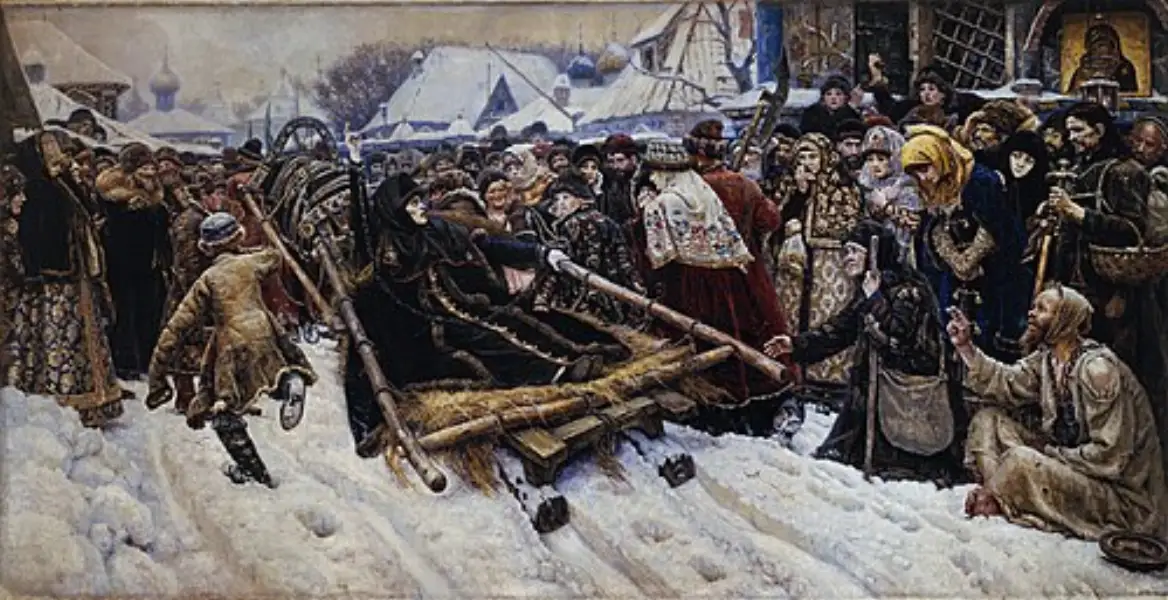
After many misfortunes, the three women were seized on the orders of Tsar Alexis in 1671. Morozova faced interrogation and torture across many months without ever renouncing her faith; the painting that later made her face famous shows her at the moment of arrest, lifting two fingers to bless herself in the ancient manner even as her captors laid hold of her by the Nikonites. The authorities hesitated before her rank and her steadfastness. Alexis is said to have contemplated burning her at the stake but was dissuaded; attempts at compromise, led personally by Patriarch Pitirim, were rejected. While she lay under arrest her son Ivan died, adding private grief to public trial. Once Ioakim succeeded to the patriarchate in 1674, the prisoners were stripped of every form of support, and the three women were confined in an underground cellar of the St. Paphnutius Monastery at Borovsk, where they endured considerable deprivations and were left to starve slowly. All three succumbed in 1675 — Feodosia dying on December 1, at forty-four years of age. The wealthiest lady in Moscow had ended her life in a hole in the ground, and the Old Believers never doubted what such a death meant.
§ Life
Martyr of the Old Belief
The Church from which Morozova had been torn never canonized her, but the Church she died to preserve counted her among its martyrs almost immediately. She was perceived as a martyr after her arrest and death in prison, and pamphlets praising her circulated shortly after her executioners had their victory. Avvakum himself, her confessor, wrote a 'Lament for the three martyrs' for Feodosia, Evdokia, and Maria. An unknown author composed the hagiographic Tale of Boiarynia Morozova, giving a full account of her life and passion as a martyr; copies of the narrative spread far and wide, and the Old Believers credited her intercession with wonders. To this day many Old Believer communities continue to venerate her as a holy martyr, one of the great witnesses of the Raskol and the most famous woman of the movement. Her feast falls on the day of her repose, December 1, and a chapel built in 2002 on the site of the Borovsk prison where she starved marks the place of her martyrdom. Whatever the judgments of historians about the disputes of the seventeenth century, the sanctity of the woman who would not recant has never been disputed among her own.
§ Reputation
From Sectarian Martyr to Symbol of Russia
For two centuries Morozova's reputation belonged mainly to the Old Believers, but in the nineteenth century she burst into the mainstream of Russian memory. Nationalist writers championed her as an emblem of Russian identity and tradition, and her name entered every household after celebrated authors discussed her life. Vasily Surikov fixed her image forever in his great painting Boyaryna Morozova, which depicts her 1671 arrest by the Nikonites: the defiant noblewoman in chains, two fingers raised in the old way of crossing herself. Revolutionary movements claimed her too — the People's Will promoted her as a heroine, and radical groups adopted her as an emblem of opposition to state power. Writers of the Soviet era, too,, though hostile to religion, found in her an irreducible figure of conscience: Anna Akhmatova, Varlam Shalamov, and Fazil Iskander praised her virtues and, as one historian puts it, enlisted her, symbolically, in their own struggles of resistance. Few figures in Russia's history have been claimed by so many contradictory parties — Old Believers, nationalists, revolutionaries, and dissident poets — and it is a measure of the woman that every one of them recognized in her the same unbreakable fidelity to what she believed.
§ Reputation
Timeline
- 21 May 1632
Born on May 21 into the family of the okolnichy Prokopy Feodorovich Sokovnin.
§ Life
- 1649
Married at seventeen the boyar Gleb Morozov, brother of the tsar's tutor Boris Morozov.
§ Life
- 1662
Widowed; inherited vast wealth and took up a prominent position as lady-in-waiting to Tsarina Maria.
§ Life
- 1671
Arrested by order of Tsar Alexis with her sister Evdokia Urusova and Maria Danilova; interrogated and tortured.
§ Life
- 1674
After Patriarch Ioakim's appointment, deprived of all support in the underground cellar of St. Paphnutius Monastery at Borovsk.
§ Life
- 2 Nov 1675
Died of starvation on November 2 in an underground cellar at Borovsk, together with her sister and Maria Danilova.
§ Life
- 2002
A chapel was constructed on the site of the prison where she died.
§ Reputation
The Record
- Symbols
- The two-fingered sign of the cross, made in the old way
- Canonization
- No formal canonization; venerated as a holy martyr by the Old Believers since her death in 1675.
Prayer
Bibliography
Show 8 sources
- Clements, Barbara Evans (June 29, 2012). A History of Women in Russia: From Earliest Times to the Present. Indiana University Press. pp. 51–52. ISBN 978-0-253-00104-7
- Daniil Ermokhin (October 22, 2018). "Boyarinya Morozova". www.rpsc.ru. Moscow: The Russian Orthodox Old Believer Church. The official website of the Moscow Metropolitanate
- "Boyarina Morozova", The state Tetyakov Gallery
- Nadieszda Kizenko (2004). "Review of Margaret Ziolkowski, ed. Tale of Boiarynia Morozova: A Seventeenth-Century Religious Life". www.h-net.org. H-Net: Humanities & Social Sciences Online
- Ziolkowski, Margaret (2000). Tale of Boiarynia Morozova: A Seventeenth-century Religious Life. Lanham, MD: Lexington Books. pp. 10–11. ISBN 978-0-7391-0177-3
- Ageeva, Е.А (2013). "Feodosia Prokopiyevna Morozova [Морозова Феодосия Прокопьевна]". Great Russian Encyclopedia (in Russian). Vol. 21. p. 141. ISBN 978-5-85270-355-2
- Kirill Kozhurin (2012). Boyar Morozova [Боярыня Морозова]. The Life of Wonderful People, Small Series, Issue 38 (in Russian). Moscow: Молодая гвардия. p. 382. ISBN 978-5-235-03559-1
- Mazunin A (1979). The Tale of Boyar Morozova [Повесть о боярыне Морозовой] (in Russian). Leningrad: Science [Наука]. p. 226. ISBN 978-5-235-03559-1
Profile text adapted from the Wikipedia article, licensed CC BY-SA 4.0.
Pray with this saint every day
Save St. Feodosia Morozova to your favorites, read the full profile, and get feast-day reminders in the Saints app.
Get the Saints AppFree on the App Store for iPhone and iPad