
1201 – 1252·Feast May 30
St. Ferdinand III of Castile
King and reconqueror called the Saint
Overview
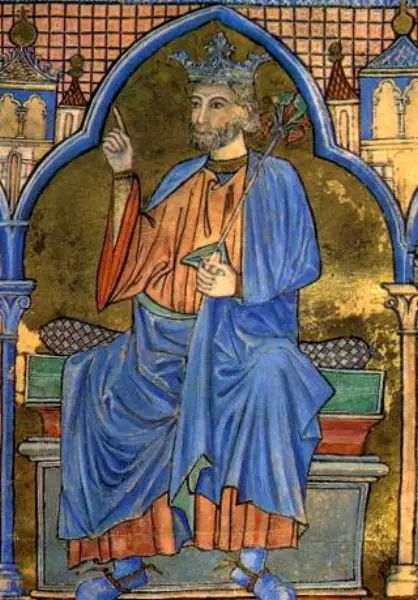
Ferdinand III, called the Saint, was King of Castile from 1217, of León from 1230, and of Galicia from 1231, and one of the most consequential monarchs of medieval Spain. Son of Alfonso IX of León and Berengaria of Castile, he began his reign as a contested young king at war with his own father, yet went on to accomplish the permanent union of the two crowns and to lead the most expansive southward campaign of the Reconquista. Exploiting the collapse of Almohad power after Las Navas de Tolosa, he took in twenty years the great cities of al-Andalus — Úbeda, Córdoba, Jaén, Murcia, and at last Seville, which he entered in triumph on December 22, 1248 — and set the borders within which the Castilian state would live for the next two hundred years. Gregory IX saluted him as Athleta Christi, Champion of Christ. At home he strengthened the University of Salamanca, built the Gothic Cathedral of Burgos, planted the mendicant orders throughout Andalusia, and was credited with sustaining the convivencia among Christians, Muslims, and Jews. A member of the Third Order of St. Francis, he feared the curse of a single poor woman more than an army of Saracens. He died at Seville on May 30, 1252, was canonized by Pope Clement X in 1671, and rests incorrupt in the cathedral of his conquered capital.
The Complete Life
Born of Two Crowns
Ferdinand's birth joined the two rival kingdoms of Christian Spain. He was born in the summer of 1201, by the dating of recent researchers, at the Monastery of Valparaíso near Peleas de Arriba in what is now the Province of Zamora, born to Alfonso IX of León by his second wife, Berengaria of Castile; through either parent he descended from Alfonso VII, whose empire had been divided between the two kingdoms at his death in 1157; his royal blood also flowed from Urraca of Portugal and from Eleanor of England, daughter of Henry II and Eleanor of Aquitaine. In 1204 Pope Innocent III annulled the marriage of Ferdinand's parents because the couple were too closely related, though the legitimacy of their children was upheld, and Berengaria carried the young Ferdinand to the court of her father, Alfonso VIII of Castile. There he was raised amid the generation that would win Las Navas de Tolosa. In 1217 his uncle Henry I died, and Berengaria, to whom the crown passed, at once crowned her son as co-ruler. Alfonso of León felt himself cheated, and the young king had to open his reign by fighting a war against his own father and a faction of Castilian nobles — a struggle in which the abilities of mother and son prevailed, and in which Berengaria remained the decisive influence, counseling her son in war and even in his choice of a bride.
§ Early life
Reuniting the Kingdoms
Ferdinand's kingly vocation was the restoration of a divided inheritance. When Alfonso IX died in 1230, his will bypassed Ferdinand and delivered León to the daughters of his first marriage, Sancha and Dulce. Ferdinand contested the disposition and pressed his own claim to the kingdom of his father. The crisis was resolved not by fresh bloodshed but by diplomacy of a rare kind: the treaty of Benavente was negotiated primarily between the two mothers, Berengaria of Castile and Teresa of Portugal, and signed on December 11, 1230. Ferdinand received the Kingdom of León, while his half-sisters were compensated with substantial cash and lands. For the first time since the death of Alfonso VII in 1157 a single sovereign ruled both crowns, and this union, unlike earlier arrangements, proved permanent — the founding act of the Castilian state that would dominate the peninsula for two centuries. Early in the reign Ferdinand also had to suppress a rebellion of the House of Lara, one of the great noble families. His reign as king of the united realms would be judged among the most successful in Castilian history, combining conquest abroad with careful institution-building at home, and his mother's guiding hand remained near him through the years in which the unified kingdom took shape.
§ Unification of Castile and León
The Twenty-Year Reconquest
Ferdinand's great mission was the conquest of al-Andalus in its hour of collapse. The death of Yusuf II in 1224 had plunged the Almohad Caliphate into succession crisis, and the claimant al-Adil shipped the bulk of Almohad arms to Morocco, leaving Spain undefended. Ferdinand intervened at once: in 1225 his army campaigned alongside the rebel al-Bayyasi through Jaén and the vega of Granada and installed him in Córdoba, receiving in payment the strongholds of Baños de la Encina, Salvatierra, and Capilla. When al-Bayyasi fell to a popular uprising, the Castilians kept his holdings at Andújar, Baeza, and Martos. In 1228 the new pretender Idris al-Ma'mun abandoned Spain entirely, and the Christian kings descended on a fragmented al-Andalus. Between 1228 and 1248 came the greatest single surge the reconquista ever knew: Úbeda in 1233 and Cazorla in 1231; Córdoba, once the Umayyads' own capital, in 1236; Huelva and Niebla in 1238; Lucena and Écija in 1240; Murcia, yielded by the pact of Alcaraz, in 1243; then Cartagena in 1245 and Jaén in 1246, and finally Seville, entered in conquest on December 22, 1248. Only the Emirate of Granada survived, and that as his tributary. Ferdinand annexed some conquests to the Crown, organized others as vassal states under Muslim governors, divided lands among knights, Church, and nobles through his council of partidores, and negotiated carefully with his fellow kings, as at Almizra in 1244, to keep the peace among the conquerors.
§ Reconquest of al-Andalus
The King Who Feared a Poor Woman
Ferdinand's sanctity lay less in cloister than in the governance of a kingdom. On the domestic front he gave new strength to the University of Salamanca and raised the present Gothic Cathedral of Burgos, and he proved an eager patron of the Church's newest movement, the mendicant friars. Where Benedictines, Cistercians, and Cluniacs had hitherto carried the religious weight of the Reconquista, Ferdinand founded houses for the Dominican, Franciscan, Trinitarian, and Mercedarian friars throughout Andalusia, fixing the future religious character of the region. Ferdinand belonged to the Third Order of St. Francis himself, and that Order still numbers him among its honored members. Historians have also credited him with keeping alive the convivencia — the long coexistence of Christians, Muslims, and Jews in the lands he conquered, and his administration of the new territories showed a ruler thinking of law and settlement as well as of victory: when he took Córdoba he directed the citizens to live under the Liber Iudiciorum and had that code put into Castilian, if imperfectly. Above all he watched over the burdens of his people. He was careful not to weigh his people down with taxes, fearing — so he said — a single poor woman's curse more deeply than the hostility of a whole Saracen host — a saying that captures the king whom his contemporaries would remember as a saint.
§ Domestic policy
Death in the Conquered Capital
Ferdinand had begun as a contested king of Castile; he ended as the deliverer of a vastly enlarged realm to his heir. In the winter of 1251 he contracted dropsy, and his strength declined through the spring. He died at Seville on May 30, 1252, aged about fifty. On his deathbed, his biographer Sister María del Carmen Fernández de Castro Cabeza records, he turned to his son and successor Alfonso X with words of blessing: that Alfonso would possess lands and loyal vassals in greater abundance than any Christian monarch of his day. The funeral took place on June 1 in the Cathedral of Seville, officiated by Remondo, Bishop of Segovia, before royal vassals, bishops, abbots, and the wealthy men of the kingdom gathered in lament. Alfonso X buried his father in the cathedral of the city his conquest had won. The tomb itself proclaimed the breadth of the dead king's world: its inscription ran in four tongues: Arabic, Hebrew, Latin, and a form of Castilian in its earliest stage. His biographer's testimony and the grief of the kingdom attest the esteem in which the warrior-king was held; within little more than a century of his death his cult was flourishing, and the path to his canonization was already prepared.
§ Death
Champion of Christ at the Altar
Recognition of Ferdinand's sanctity came first from his own century. Pope Gregory IX, following the conquest of Córdoba, hailed the king as Athleta Christi — Champion of Christ — and ordered the bishops of Castile and León to provide him with twenty thousand gold pieces a year for three years in support of his campaigns. More than four centuries after his death, the Church inscribed him formally among the saints: on February 4, 1671, Pope Clement X canonized him as Saint Ferdinand. His body, incorrupt according to the tradition of his shrine, may still be seen in the Cathedral of Seville, where he lies in a casket of gold and crystal fit for royalty, crowned with gold, and reclining beneath the image of the Virgin of the Kings. His feast is kept on May 30, the anniversary of his death. In the centuries since his canonization he has become one of the great royal saints of Christendom, venerated across the Spanish world from Seville to the Philippines to the Americas — the king whose earthly triumphs the Church came to read as service of a higher kingship, and whose poor man's curse he feared more than battle stands at the heart of his sanctity.
§ Death
A Name Across Two Worlds
Ferdinand's political achievement set the map of Spain for two hundred and fifty years: the boundaries of the Castilian state he established remained nearly unchanged until the late fifteenth century. His memory was carried even farther by the empire that grew from that state. Places named San Fernando were founded across the Spanish world in his honor — San Fernando in Pampanga and La Union in the Philippines, the San Fernando de Dilao Church in Paco, Manila, the San Fernando El Rey Church in Liloan, Cebu — and in the United States, the City of San Fernando and the San Fernando Valley in California, and the Cathedral of San Fernando in San Antonio, Texas. He is patron of Seville, Aranjuez, San Fernando de Henares, Maspalomas, and Pivijay, of the Spanish Army's Corps of Engineers and of engineers generally. Since 1819 he has been co-patron of the Diocese of San Cristóbal de La Laguna in the Canary Islands under a papal bull of Pius VII, and patron of its university, founded as the Literary University of Saint Ferdinand. The crest of Sevilla Fútbol Club bears his likeness enthroned with his sword and orb, and the symbol of his royal power, the sword Lobera, remains the emblem of a king whom Spain has never ceased to call simply the Saint.
§ Patronage
Timeline
- 1201
Born in the summer at the Monastery of Valparaíso in the Kingdom of León, son of Alfonso IX and Berengaria of Castile.
§ Early life
- 31 Aug 1217
Succeeded his uncle Henry I on the Castilian throne and was crowned co-ruler by his mother Berengaria on August 31.
§ Early life
- 1219
Married Elisabeth of Swabia, later called Beatrice, daughter of Philip, Duke of Swabia.
§ Family
- 1225
Sent Castilian troops to back al-Bayyasi, who seized Córdoba before year's end, ceding him Baños de la Encina, Salvatierra and Capilla.
§ Reconquest of al-Andalus
- 11 Dec 1230
By the treaty of Benavente, signed December 11, received the Kingdom of León from his dying father's heirs.
§ Unification of Castile and León
- 1231
Took Cazorla by his own effort during the great advance through al-Andalus.
§ Reconquest of al-Andalus
- 1233
Took Úbeda in the sweeping advance across the south.
§ Reconquest of al-Andalus
- 1236
Took Córdoba, the old Umayyad capital, bringing a royal army to capture the Medina after the Ajarquía had fallen.
§ Reconquest of al-Andalus
- 1238
Gained Niebla and Huelva, and imposed a tributary arrangement on the Emirate of Granada.
§ Reconquest of al-Andalus
- 1240
Took Écija and Lucena.
§ Reconquest of al-Andalus
- 10 Mar 1241
Marked out the frontier of the province of Córdoba with seven new outposts.
§ Reconquest of al-Andalus
- 1243
Received Orihuela and Murcia by the famous pact of Alcaraz.
§ Reconquest of al-Andalus
- 26 Mar 1244
Signed the treaty of Almizra with James I of Aragon on March 26, fixing the Murcian boundary.
§ Reconquest of al-Andalus
- 1245
Took Cartagena.
§ Reconquest of al-Andalus
- 1246
Took Jaén from Muhammad ibn al-Ahmar, who became his vassal.
§ Reconquest of al-Andalus
- 1248
Took Alicante shortly before his triumphant entry into Seville.
§ Reconquest of al-Andalus
- 22 Dec 1248
Entered Seville as conqueror on December 22, the greatest of the Andalusian cities.
§ Reconquest of al-Andalus
- 30 May 1252
Died on May 30 at Seville of dropsy contracted the previous winter; buried in the cathedral by his son Alfonso X.
§ Death
- 1 Jun 1252
His funeral was celebrated in the cathedral of Seville by Remondo, Bishop of Segovia.
§ Death
- 4 Feb 1671
Canonized by Pope Clement X on February 4.
§ Death
In Their Own Words
you will be rich in land and in many good vassals, more than any other king in Christendom.
the curse of one poor woman more than a whole army of Saracens
The Record
- Major works
- Permanent union of the crowns of Castile and León·The current Gothic Cathedral of Burgos·Strengthening of the University of Salamanca·Houses for the Dominican, Franciscan, Trinitarian, and Mercedarian orders in Andalusia·Adoption of the Liber Iudiciorum in Córdoba, rendered into Castilian
- Patron of
- Seville, Aranjuez, San Fernando de Henares, Maspalomas, Pivijay·Spanish Army's Corps of Engineers and engineers generally·Co-patron of the Diocese of San Cristóbal de La Laguna and its cathedral·Patron of the University of La Laguna
- Symbols
- The sword Lobera·Crown, enthronement, sword, and orb (as on the crest of Sevilla Fútbol Club)
- Canonization
- Canonized on 4 February 1671 by Pope Clement X.
Prayer
Bibliography
Show 9 sources
- O'Callaghan, Joseph F. (2004). Reconquest and Crusade in Medieval Spain. University of Pennsylvania Press
- Fernández de Castro Cabeza, María del Carmen (1988). The Life of the Very Noble King of Castile and León, Saint Ferdinand III. Mount Kisco, N.Y.: The Foundation for a Christian Civilization, Inc. ISBN 978-1877905094
- Heckmann, Ferdinand (1909). "St. Ferdinand III". In Herbermann, Charles (ed.). Catholic Encyclopedia. Vol. 6. New York: Robert Appleton Company
- Bianchini, Janna (2012). The Queen's Hand: Power and Authority in the Reign of Berenguela of Castile. University of Pennsylvania Press. ISBN 978-0-8122-0626-5
- Shadis, Miriam (2010). Berenguela of Castile (1180–1246) and Political Women in the High Middle Ages. Palgrave Macmillan. ISBN 978-0-312-23473-7
- Menocal, Maria Rosa (2009). The Ornament of the World: How Muslims, Jews, and Christians Created a Culture of Tolerance in Medieval Spain. Boston: Little, Brown. ISBN 978-0-316-09279-1
- Edwards, John (2001). Christian Córdoba: The City and Its Region in the Late Middle Ages. University of Central Arkansas
- Chisholm, Hugh, ed. (1911). "Ferdinand III. of Castile". Encyclopædia Britannica. Vol. 10 (11th ed.). Cambridge University Press. p. 266
- Lorenzo Lima, J. (2013). Patrimonio e historia de la antigua Catedral de La Laguna (in Spanish). Diocesis of San Cristóbal de la Laguna, Government of the Canary Islands. ISBN 978-84-7947-625-0
Profile text adapted from the Wikipedia article, licensed CC BY-SA 4.0.
Pray with this saint every day
Save St. Ferdinand III of Castile to your favorites, read the full profile, and get feast-day reminders in the Saints app.
Get the Saints AppFree on the App Store for iPhone and iPad