
died c. 730·Feast September 8 (Ireland); November 18 (Scotland)
St. Fergus
Pictish bishop and missionary to Alba
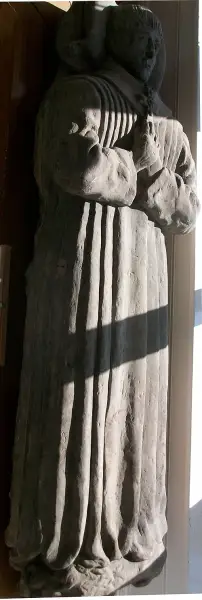
Overview
Fergus, also called Fergustian, was a bishop who worked as a missionary in what is now Scotland and died there about the year 730. Ten saints of this name are listed in the martyrology of Donegal, and the present Fergus is distinguished in the Irish martyrologies as Fergus Cruithneach, Fergus the Pict. His birth date and place remain unknown; the name is of Pictish origin, and since he is recorded as a Pictish bishop he is generally thought to have come from the north-east of Scotland, though his training is placed in Ireland, the south of Scotland, or possibly both. The Aberdeen Breviary, which calls him Fergustian, says that he busied himself with the conversion of the barbarous peoples. It records that he had long exercised the episcopal office in Ireland before crossing on mission to Alba with hand-picked priests and other clerics. His first settlement was near Strageath in Upper Strathearn, and he raised churches in that district, evangelized Caithness, and built a church at Glamis. He died around 730 and found burial at Glamis in Angus, where his well may still be visited.
The Complete Life
A Pict among the Saints of Two Lands
Neither the date nor the place of Fergus's birth is known, and even his identity required care in early records, for the martyrology of Donegal alone records ten saints who bore this name. The name itself is of Pictish origin, and because the saint is recorded simply as Fergus, a Pictish bishop, it is generally held that he came from Scotland's north-east as the country is mapped today. In the Irish martyrologies he is known as St. Fergus Cruithneach, meaning the Pict, a title that preserves his distinction from the many other holy men who shared his name. His lifetime overlapped those of St. Drostan and St. Donevaldus, placing his years firmly in the seventh and early eighth centuries. The Aberdeen Breviary calls him Fergustian and relates that he busied himself with the conversion of the barbarous peoples. Where he was formed for that work is uncertain: his training is placed in Ireland, in the south of Scotland, or in both, a pattern that would suit the crossing of peoples and traditions that marked his later mission. A saint of two lands, he belongs to the Irish records by name and to the Pictish church by reputation.
§ Life
Missionary Bishop in Strathearn and Caithness
The Breviary of Aberdeen relates that Fergus had exercised the episcopate for many years in Ireland before crossing on mission to Alba, taking with him hand-picked priests and other clerics. His first settlement was near Strageath in Upper Strathearn, in what is now Perthshire, and there he raised three churches in that district, Strageath, Blackford, and Dolpatrick, all dedicated to Saint Patrick, an indication of the Irish devotional tradition he carried with him. From Strathearn the mission pushed north, for Fergus next evangelized Caithness and established in that far province the churches of Wick and Halkirk, bringing the faith to communities on the northern edge of the Pictish world. His work reached also into Angus, where the church he built at Glamis would have followed the Celtic manner of construction in mud and wattle, standing not far from the present kirk. The map of his foundations, from Strathearn through Caithness to Glamis, traces a missionary career of unusual range for a single bishop of his era. Each foundation carried his name into local memory, and several of the sites remain identifiable in the parishes of present-day Scotland.
§ Life
Death and Burial at Glamis
Fergus died about the year 730, and his body was buried at Glamis in Angus, the place of his last foundation. His grave became a centre of remembrance: the recently restored Saint Fergus' Well at Glamis can be visited to this day, and the village church of Eassie bears his dedication, the noted Pictish Eassie Stone having been moved into that church for safekeeping. One puzzle of his later memory concerns his possible appearance further south. It has been suggested that he might be the Fergustus Pictus who travelled to Rome in 721, yet such an identification rests only on the likeness of a shared name, and the sources leave the question open. What stands firm is the picture of an aged bishop ending his days among the people of his last mission field, his resting place at Glamis honoured by well, church, and stone. The sanctity that had drawn him across the Irish Sea in youth kept his memory green in the Angus glades long after his death. Death found him among his own people, in the church he had built for their service.
§ Life
Shrines, Feasts, and Patronage
Fergus's cult flourished in medieval Scotland. During the time of King James IV the Abbot of Scone removed the saint's head to the church of Scone and built an expensive shrine to house it, while Aberdeen secured an arm of the saint for its own veneration, a division of relics that testifies to the esteem in which he was held. He remains the patron saint both of Glamis, where he laboured and lies buried, and of Wick, one of the Caithness churches he founded. His feast is celebrated on September 8 in Ireland, a date the Martyrology of Tallaght records for his festival, while in Scotland the observance was previously kept on November 18. The two dates reflect his double inheritance: formed in the Irish tradition yet remembered above all as a Pictish bishop of the northern kingdom. His story is preserved in the Aberdeen Breviary, the Irish martyrologies, and the landscape itself, in wells, parish churches, and Pictish stones from Strathearn to Caithness. In Scotland his day was long kept with solemnity, and the division of his relics between Scone and Aberdeen shows how widely his cult had spread.
§ Veneration
Timeline
- 721
May possibly be identified with Fergustus Pictus, who went to Rome in this year, though the case rests only on the similarity of a common name.
§ Life
- 730
Died at about this date and was buried at Glamis in Angus, where Saint Fergus' Well can still be visited.
§ Life
In Their Own Words
he occupied himself in converting the barbarous people
The Record
- Major works
- Churches of Strageath, Blackford, and Dolpatrick in Strathearn·Churches of Wick and Halkirk in Caithness·Church at Glamis in Angus
- Patron of
- Patron saint of Glamis·Patron saint of Wick
- Canonization
- Pre-congregation; venerated in the Catholic, Eastern Orthodox, and Anglican churches.
Prayer
Bibliography
Show 6 sources
- Mulcahy, Cornelius. "Sts. Fergus." The Catholic Encyclopedia, Vol. 6. New York: Robert Appleton Company, 1909.
- "St. Fergus Cruithneach", Glamis Inverarity Kinnettles Kirk.
- "Wick St. Fergus", Church of Scotland.
- Hogan, C. Michael. "Eassie Stone", The Megalithic Portal, ed. Andy Burnham, 7 October 2007.
- Ross, Andrew. The Lyons of Cossins and Wester Ogil, Cadets of Glamis. Glasgow: G. Waterston & Sons, 1901.
- Hutchison-Hall, John (2017). "Fergus – Eighth Century". Orthodox Saints of the British Isles, Vol. 4, p. 189.
Profile text adapted from the Wikipedia article, licensed CC BY-SA 4.0.
Pray with this saint every day
Save St. Fergus to your favorites, read the full profile, and get feast-day reminders in the Saints app.
Get the Saints AppFree on the App Store for iPhone and iPad