
c. 250 – 303·Feast September 25
St. Fermin
Bishop of Amiens and Martyr of Navarre
Overview
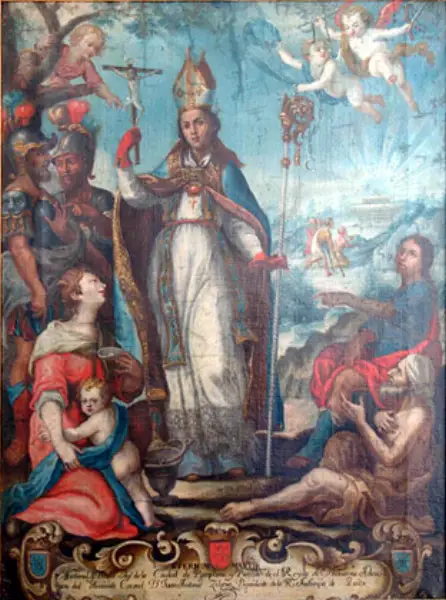
Fermin, whose Latin name Firminus also appears as Firmin and Spanish Fermín, is honored as a martyr and as co-patron of Navarre. Tradition places his birth at Pamplona in the middle of the third century, the son of Firmo, a Roman of senatorial rank, and his wife Eugenia. He is said to have received baptism from Saturninus, first bishop of Toulouse, and to have been trained in the faith by Honestus, a disciple of that bishop. At about the age of thirty-one he traveled to Toulouse, where Honoratus, successor of Saturninus, consecrated him a bishop. He then returned to Pamplona, which remembers him as its first bishop, before carrying his preaching through Aquitania, Auvernia, and Anjou and at last settling at Amiens, where he was named bishop. There the local authorities arrested him and put him to death by beheading on September 25, 303, a date that would place his martyrdom amid the era of imperial persecution. Written testimony about him is late, and historians treat the narrative with reserve, yet his cult took deep root: his relics were uncovered at Amiens around the year 600, and the feast kept in his name at Pamplona grew into the world-famous Sanfermines festival with its running of the bulls.
The Complete Life
A Senator's Son at Pamplona
The story the tradition tells begins in Pamplona, the old capital of Navarre, in the third century. There Firmo, a Roman holding senatorial rank, lived with his wife Eugenia, and their son Fermin was born into a household of the colonial elite in a city still close to its pagan past. The turning of the family toward Christ came through missionaries moving north from the Christian communities of southern Gaul. Honestus, a disciple of Saturninus, first bishop of Toulouse, brought the faith to Firmo, and the senator's conversion was so notable that Saturninus himself was persuaded to make the journey to Pamplona. There, the legend relates, the bishop preached to immense crowds and administered baptism to some forty thousand people across three days, Firmo among them. His young son was placed under Honestus for instruction in the Christian life, and Fermin too received baptism from Saturninus at a spring in Pamplona that pilgrims still point out today as the Small Well of San Cernin, opposite the church that now covers the foundations of the pagan temple where the rite is said to have taken place.
§ Legend
Consecrated at Toulouse
Educated in the faith by Honestus, Fermin grew toward the clerical state in the shadow of the Toulouse mission. According to the local account, he was ordained a priest at Toulouse, and at about the age of thirty-one he presented himself to Honoratus, who had succeeded the martyred Saturninus in that see. Honoratus consecrated him a bishop, and the young prelate turned his face toward his native Pamplona. The church of Navarre counts him as its first bishop, the man who organized the scattered Christians of the city into a settled community. His ministry there, however, was not to be confined to one see. The missionary current that had carried Saturninus and Honestus northward carried Fermin outward as well, and after some years among his own people he left Pamplona for the wide field of Gaul. If the details of this career rest on pious tradition rather than early records, its shape is the classic one of the apostolic age of Gaul: a convert of the Toulouse mission, consecrated in that city, sent back to evangelize his own province, and then drawn onward to new territories until his work ended in martyrdom.
§ Legend
The Gospel Through Gaul
From Pamplona, tradition sends Fermin north to preach through Aquitania, the Auvergne, and Anjou, the long stretch of country between the Pyrenees and the Loire. His path ended at Amiens in the north, where he settled and where the church named him its bishop. The city would remain forever his. There, according to the account, the gospel he proclaimed brought him into conflict with the local authorities, who arrested him and held him in prison before condemning him to death. He was beheaded on September 25, 303, a date remembered as falling within the great persecution that was then beginning to rage against the church. The manner of his witness became the center of his cult, and Amiens preserved the memory of his preaching, his baptism of converts, his arrest, and his execution in a celebrated sequence of images, including the reliefs that the early sixteenth-century chapter head Adrien de Henencourt caused to be carved in the cathedral, which show the whole course of the saint's life and the subsequent history of his body. The cathedral city kept his memory in stone as well as in rite: the funeral monument of Adrien de Henencourt, who led the cathedral chapter in the early sixteenth century, dedicates a whole sequence of polychrome reliefs and statuary to the course of his life, showing him entering Amiens, proclaiming the gospel, baptizing converts, standing at his arrest, and bowing his head beneath the sword.
§ Legend
Martyrdom and the Finding of the Relics
Fermin's death in 303 closed his earthly course, but the tradition watches his body still. For nearly three centuries the place of his burial at Amiens was said to be forgotten, until the episcopate of Salvius, around the year 600. The Golden Legend recounts that the site of the grave was then made known, and that a sweet fragrance rose from it, melting ice and snow, drawing flowers into bloom, curing the sick, and bending the trees toward the saint in homage. Salvius arranged for the body to be carried to the cathedral of Amiens, where the greater part of the relics remained. In 1085 the abbey of Saint-Acheul was founded on the spot identified as his tomb, and beneath its choir a vault marks the place where the body is said to have been found. The discovery and translation of the relics became one of the founding stories of medieval Amiens, depicted alongside the martyrdom itself in the cathedral's monuments, and the veneration of the saint brought the city both spiritual prestige and material prosperity through the Middle Ages and beyond.
§ Veneration
The Saint of the Sanfermines
Whatever the historian may say of the third-century missionary, the Fermin of living devotion is unmistakable. When Pamplona received relics of the saint once more in 1196, the townsfolk determined to mark the event with a yearly celebration, and over the centuries the saint's festival merged with an ancient fair and with the running of the bulls and the bullfights that followed it. The result is the Sanfermines, held every year from the sixth to the fourteenth of July, internationally famous for the bulls driven through the old quarter to the arena by crowds of runners. The religious core of the feast has receded in recent generations, yet it remains a festival in honor of the co-patron of Navarre. He is honored beyond the capital as well, at Lesaka with the Regata del Bidasoa, and at the basilica of San Fermín de Aldapa, where his martyrdom is still commemorated on September 25 with days of celebration around the cathedral quarter of Pamplona, opened by a firework rocket and closed with the ceremony called Pobre de mí. His cult crossed the channel as well: a puzzling well bearing the name of a Saint Farmin recorded nowhere else still exists at Bowes in Yorkshire, a monastery named for a Saint Firmin appears in the Domesday Book at North Crawley with its holy well, the church at Thurlby in Lincolnshire is dedicated to St Firmin, and scattered English dedications point toward a veneration of Firmin in Anglo-Saxon England that has otherwise left no trace.
§ Veneration
Timeline
- 25 Sep 303
Beheaded at Amiens after imprisonment by the local authorities, his death traditionally linked to the Diocletianic Persecution.
§ Legend
- 600
Relics were discovered and translated in triumph to Amiens Cathedral in the time of Bishop Salvius, amid reported miracles.
§ Veneration
- 1085
The Abbey of Saint-Acheul was founded at Amiens over the site believed to hold his tomb.
§ Veneration
- 1196
Certain relics were brought back to Pamplona, and the city instituted an annual commemoration in his honor.
§ Veneration
The Record
- Major works
- Foundation of the church of Pamplona as its first bishop, according to tradition
- Patron of
- Co-patron of Navarre, Spain·Amiens, France·Lesaka, Spain
- Symbols
- Bishop's mitre and crozier·Decapitation sword·Depiction entering Amiens proclaiming the gospel
- Canonization
- Pre-congregation canonization; honored as a martyr from antiquity, with the earliest surviving written accounts dating from the ninth century.
Prayer
Bibliography
Show 8 sources
- Collins, Roger. The Basques. Blackwell, 1986, p. 61
- Wightman, Edith Mary. Gallia Belgica. University of California Press, 1985, p. 286
- "History of... The saint-Saint San Fermin festival- Sanfermines-tourist information on Navarre." Government of Navarre. Archived from the original on 2009-08-18
- Dégert, Antoine. "St. Saturninus." The Catholic Encyclopedia Vol. 13. New York: Robert Appleton Company, 1912
- Amadó, Ramón Ruiz. "Diocese of Pamplona." The Catholic Encyclopedia Vol. 11. New York: Robert Appleton Company, 1911
- Nash, Susie. Between France and Flanders: Manuscript Illumination in Amiens. University of Toronto Press, 1999, p. 61. ISBN 978-0-8020-4114-2
- Salmon, Charles. Histoire de saint Firmin, martyr, premier évêque d'Amiens, patron de la Navarre et des diocèses d'Amiens et de Pampelune. Arras: Rousseau-Leroy, 1861
- Thacker, Alan, and Richard Sharpe. Local Saints and Local Churches in the Early Medieval West, "A Handlist of Anglo-Saxon Saints", p. 535
Profile text adapted from the Wikipedia article, licensed CC BY-SA 4.0.
Pray with this saint every day
Save St. Fermin to your favorites, read the full profile, and get feast-day reminders in the Saints app.
Get the Saints AppFree on the App Store for iPhone and iPad