
c. 600 – 670·Feast August 30
St. Fiacre
Hermit and patron saint of gardeners
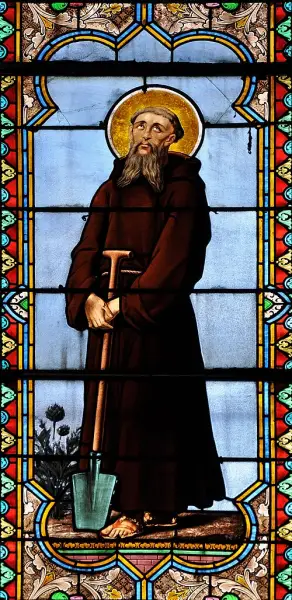
Overview
Fiacre, in Irish Fiachra and in Latin Fiacrius, is the most famous of three Irish saints who bore the name. Born in Ireland around the year 600, he was raised in a monastery, became a monk, and learned the herbal medicine for which he would be remembered. Ordained a priest and raised to the rank of abbot, he kept a hermitage in his native land, probably near the well at Cill Fiachra in County Kilkenny, but crowds drawn by his holiness and cures drove him to seek greater solitude abroad. He arrived at Meaux in France in 628, where Bishop Faro granted him ground at Brogillum — the Breuil — in the province of Brie. There he built a hermitage, a garden of vegetables and healing herbs, an oratory honouring the Blessed Virgin Mary, and a hospice for travellers, living a life of prayer, fasting, vigils, and manual labour. His fame for miracles was widespread, and he cured the sick by laying on of hands. He died on 18 August 670 and was buried at the site of his hermitage, which grew into the village of Saint-Fiacre. He is the patron of gardeners and of many sufferers.
The Complete Life
An Irish Monk Called to the Garden
Fiacre was born on Irish soil in the closing years of the sixth century, around the year 600. His Irish name, Fiachra, is ancient and pre-Christian, interpreted either as battle king or as deriving from fiach, the raven, and it echoes through old Irish story such as the tale of the Children of Lir. Though not named in the earlier Irish calendars, his upbringing took place within a monastery; there he professed as monk and drank in the knowledge of herbal medicine that marked his whole later life. He received priest's orders at some stage and was advanced to abbatial rank. In time he had a hermitage of his own, and perhaps a small monastery, possibly near Saint Fiachra's Well at Cill Fiachra, Kilferagh, in the barony of Shillelogher near Bennetsbridge in County Kilkenny. As crowds thronged to him, drawn by his reputation for holiness and cures, the solitude he sought eluded him, and he resolved to sail to France in search of a quieter field. The name he carried would in time be given to villages, churches, gardens, and even carriages far from the land of his birth.
§ Life
The Gift of Brogillum
Fiacre arrived at Meaux in France in the year 628 and approached Bishop Faro with a manifestation of his wish to pursue a solitary existence within the forest. Faro was well disposed to him, owing to favours that he and his father's house had received at the hands of the Irish missionary Columbanus, and he granted the hermit a site at Brogillum, the Breuil, in the province of Brie, on land now forming the commune of Saint-Fiacre in the department of Seine-et-Marne. Legend embellished the gift: Faro promised Fiacre as much ground as he could enclose within a single day's furrow, and the saint turned the soil with the tip of his staff, felling trees and tearing out briers and weeds. A suspicious woman hurried to warn Faro that he was being deceived and that sorcery was at work, but the bishop recognized in it the handiwork of God. It is said that from then on Fiacre barred women, threatening grave bodily affliction, from entering the precincts of his hermitage, a prohibition that shaped much of his later cult. The miracle set the seal on the settlement, and the story was told for centuries at Breuil.
§ Legends
Hermitage, Garden, Oratory, and Hospice
On the land granted at Breuil Fiacre raised the fourfold establishment that defined his vocation. He built a hermitage for his own dwelling, a vegetable and herb garden that joined his healing art to the labour of his hands, an oratory dedicated to the Blessed Virgin Mary, and a hospice where he received and cared for travellers. The complex gave his epithet to the place, for the medieval record calls the site Monasterium quod dicitur Breilum, three miles distant from the city of Meaux, and the commune that grew from it took the name Saint-Fiacre in his honour. His fame for miracles was widespread, and it was said that he cured all manner of diseases by the laying on of his hands. His family shared his calling: his sister Syra left Ireland to follow him to France and embraced the nun's life. Though she was blind, an inspiration granted through her brother's merits led her to the resting place of Saint Savinien, where, prostrate in prayer and refusing to rise, she recovered her sight. The hermitage thus became a school of sanctity for others as well as for its founder.
§ Legends
Prayer, Fasting, and the Labour of Hands
The rule of Fiacre's life was one of great mortification: devoted to prayer, fasting, and the keeping of vigils, he joined to these the manual cultivation of his garden. In the tradition of Irish monasticism, physical labour was not a distraction from contemplation but its companion, and the beds of vegetables and medicinal herbs that Fiacre tended were at once a discipline of humility, a pharmacy for the sick, and a provision for the guests of his hospice. His skill with plants made him a healer of the body as well as a shepherd of souls, and the sick sought him out for the laying on of hands. The rigour of his enclosure, from which women were excluded by his own ordinance, expressed a single-minded custody of solitude rather than contempt; his sister Syra's place in his story shows the tenderness beneath the severity. When the reputation of his cures drew crowds even across the sea, he did not capitalize on his fame but sought deeper silence, asking only a corner of forest in which to pray, work, and welcome the stranger in the name of the Virgin and her Son.
§ Life
Death and the First Shrine
Fiacre died on 18 August 670, at the age of seventy, likely at Saint-Fiacre in Seine-et-Marne, the place of his long retreat. His body was laid to rest in the local church standing on the ground of his hermitage, and that church became his first shrine. The settlement that gathered around his grave and his garden developed in time into a village that afterwards took the name Saint-Fiacre in his honour and remains in the department of Seine-et-Marne to the present day. Thus the man who had crossed the Irish Sea for solitude became, after death, the centre of a living community of devotion, his tomb drawing the pilgrims whom his solitude had once escaped. The garden he planted and the hospice he kept passed into the care of others, and the memory of the gardener saint took root in French soil as firmly as any herb he had sown. His death in the odour of sanctity closed a life whose outward events were few but whose influence would reach into gardens, guilds, and cities across Europe. The humble church became a place of pilgrimage, and the hermit's grave the seed of a lasting shrine.
§ Life
An Ancient Cult at Meaux
Fiacre was never formally canonized, for he belongs to the ages before the process existed; his canonization is recorded simply as Pre-Congregation. His relics remained in their first shrine, the local church raised on the ground of his hermitage with its garden, oratory, and hospice, but in 1568, for fear that fanatical Calvinists would endanger them, they were transferred to their present shrine in Meaux Cathedral, near Saint-Fiacre in the same department. The Roman Martyrology commemorates him on 30 August, though certain Catholic writers instead give 1 September. Meaux stayed a great focus of his devotion, above all during the seventeenth and eighteenth centuries, and the roll of pilgrims to his shrine included Anne of Austria, Bishop Jacques-Bénigne Bossuet, John of Matha, Louis XIII, and Vincent de Paul. His reputation for healing haemorrhoids, which were known in the Middle Ages as Saint Fiacre's figs, brought Cardinal Richelieu to venerate his relics in hope of relief. Wooden devotional figures of the saint survive from as early as the fifteenth century, witnesses to a cult that centuries of veneration never exhausted. The pilgrims' road to Meaux kept his memory vivid long before any formal process could have confirmed it.
§ Veneration
The Saint of Gardens and of Fiacres
Few saints command so varied a patronage. Fiacre is patron of the commune of Saint-Fiacre in Seine-et-Marne, of growers of vegetables and medicinal plants, of gardeners in general including ploughboys, and of herbalists and florists. The aversion to women ascribed to him is thought to explain why those stricken by venereal disease invoke him; he is further patron of sufferers from haemorrhoids and fistulas and from infertility, of taxi drivers, box makers, hosiers, pewterers, tilemakers, and florists, and is commonly invoked for the healing of many infirmities. From about 1650 a business called the Hôtel de Saint Fiacre, situated in the rue Saint-Martin of Paris, hired out carriages, and these came to be known as fiacres, a general word for horse-drawn vehicles kept for hire; though taxi drivers sometimes claim him, the Catholic Church does not formally recognize him as their patron. In his native land his memory revived in 1999, when Saint Fiachra's Garden opened at the Irish National Stud and Gardens at Tully, County Kildare, and villages such as Graiguenamanagh in County Kilkenny still recall his founding hand.
§ Patronage
Timeline
- 600
Born in Ireland near the close of the sixth century and raised within a monastery, where he took the monk's habit and learned herbal medicine.
§ Life
- 628
Arrived at Meaux in France, where Bishop Faro granted him ground at Brogillum — the Breuil — in the province of Brie.
§ Life
- 18 Aug 670
Died at the age of seventy and was interred in the local church at the site of his hermitage complex.
§ Life
- 1568
His relics were transferred from the original shrine at Saint-Fiacre to Meaux Cathedral for fear of fanatical Calvinists.
§ Veneration
- 1650
The Hôtel de Saint Fiacre in Paris began hiring out carriages that came to be known as fiacres, a generic term for hired transport.
§ Fiacre cabs
- 1999
Saint Fiachra's Garden was opened at the Irish National Stud and Gardens at Tully, County Kildare, to celebrate the Second Millennium.
§ Veneration
In Their Own Words
His fame for miracles was widespread. He cured all manner of diseases by laying on his hands
Through his merits, St. Fiacre had an inspiration, that his sister should recover her sight, while to her in like manner was revealed the spot where the body of St. Savinien lay.
The Record
- Major works
- Hermitage at Breuil (later Saint-Fiacre), Seine-et-Marne·Vegetable and herb garden at Breuil·Oratory in honour of the Blessed Virgin Mary·Hospice for travellers at Breuil
- Patron of
- Patron of gardeners, growers of vegetables and medicinal plants, and ploughboys·Patron of herbalists and florists·Patron of victims of venereal disease·Patron of victims of haemorrhoids and fistulas·Patron of those suffering from infertility·Patron of box makers, hosiers, pewterers, and tilemakers·Patron of the commune of Saint-Fiacre, Seine-et-Marne, France
- Symbols
- spade·basket of vegetables
- Canonization
- Pre-Congregation; popular cult of immemorial standing, commemorated in the Roman Martyrology on 30 August.
Prayer
Bibliography
Show 7 sources
- "St. Fiacre". Catholic Encyclopedia. Retrieved 6 December 2007.
- Stracke, Richard (20 October 2015). "Saint Fiacre". Christian Iconography.
- Ó Corráin, Donnchadh; Maguire, Fidelma (1981). Gaelic Personal Names. Dublin: The Academy Press.
- Farmer, David Hugh (1997). The Oxford Dictionary of Saints, 4th ed. Oxford University Press, p. 183.
- O'Hanlon, John (1875). Lives of the Irish Saints, vol. 4. Dublin: James Duffy, p. 247.
- Delehaye, Hippolyte (1911). "Fiacre, Saint". Encyclopædia Britannica, Vol. 10 (11th ed.), p. 309.
- Marius, Richard. "Vita – Saint Fiacre", Harvard Magazine (1998).
Profile text adapted from the Wikipedia article, licensed CC BY-SA 4.0.
Pray with this saint every day
Save St. Fiacre to your favorites, read the full profile, and get feast-day reminders in the Saints app.
Get the Saints AppFree on the App Store for iPhone and iPad