
died c. 304·Feast October 28
St. Fidelis of Como
Soldier-Martyr of Lake Como
Overview
Fidelis of Como, who died around 304, is honored as an Italian military martyr, though the traditions about his life differ. His cult is bound up with the soldier-saints Carpophorus and Exanthus, and variations of their legend are told of him. In one account, he and his two companions were Roman soldiers of the legendary Theban Legion who deserted when the persecution under Maximian broke out; at Como the three separated, Carpophorus and Exanthus seeking hiding places in the countryside while Fidelis boarded a boat and made for Samolaco over the water, and all were eventually captured and beheaded. A second account makes him an army officer at Milan who, while guarding Christian prisoners, among them Alexander of Bergamo, managed to free five of them; with Carpophorus and Exanthus and the freed men he set out for the Alps but was executed at Como. Modern judgment prefers a simpler story: that he was a missionary dispatched by Maternus, bishop of Milan, to evangelize the country around Lake Como, where paganism still held, and that he met his death there. What is certain is the antiquity of his cult: Magnus Felix Ennodius describes his tomb at Como in the early sixth century, and reports of miracles spread his fame.
The Complete Life
A Saint of Shifting Stories
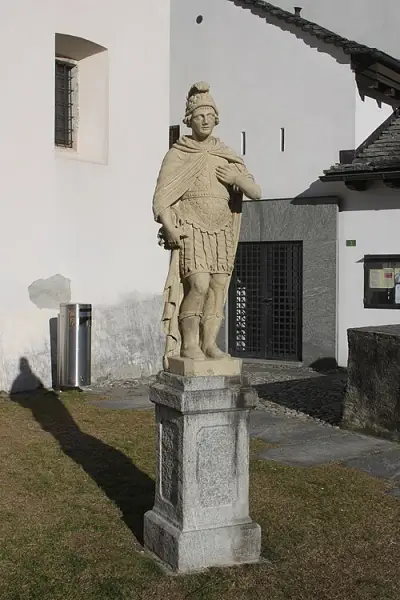
Nothing certain is recorded of Fidelis's origin; what the tradition offers instead is a pair of legends, both shared with his companions Carpophorus and Exanthus. In the first, the three are Roman soldiers, members of the fabled Theban Legion, the all-Christian unit whose massacre in the Alps became one of the great martyr narratives of the early church. During the persecution of Christians under Maximian they deserted rather than take part in it, and their flight carried them to the shores of Lake Como. There the company divided: Carpophorus and Exanthus sought hiding places in the countryside while Fidelis boarded a boat and made for Samolaco over the water. Their hunters in time overtook them all, and each was beheaded. The story gives Fidelis to the company of military saints, and his images keep the memory, representing him in military attire. Whether the story is history is another matter; these are variations of legend applied to Fidelis, traditions that grew around a cult whose true origins were already old when they were written down. The Samolaco tradition fixes the geography of the story on the northern arm of the lake, where a boat could carry a fugitive beyond the reach of his pursuers and where the oldest traces of his cult remain. Even in its legendary form, the account explains the details the later cult preserved: the military dress of his images, the companionship of Carpophorus and Exanthus in feast and relic, and the devotion of the lake towns that claimed the martyr for their own.
§ Legends
The Officer and the Prisoners
The second legend gives Fidelis a different part in the same persecution. In this version he was an officer in the army, stationed at Milan, where he was set to guard Christians held as prisoners, among them Alexander of Bergamo, who would be remembered as a martyr in his own right. The duty became the turning point of the officer's life: contact with the prisoners brought him over to their faith, and he used his position to procure the escape of five of them. With Carpophorus and Exanthus at his side and the five freed men under his protection, he attempted to lead the party to safety in the Alps. The flight ended at Como, where the whole group was caught and executed. In this telling Fidelis is not merely a soldier of the legion but a man who betrayed his uniform to save the church, a convert who won his crown within weeks or days of his conversion. The two legends cannot both be literal history, but they agree in the essentials that mattered to his votaries: a soldier's fidelity transformed into Christian fidelity, and death by beheading in the lake country.
§ Legends
The Missionary of the Lake
Modern students of the cult have preferred a third and plainer account, judged the most likely of the three. In it Fidelis was no soldier at all but a Christian missionary, sent out by Maternus, bishop of Milan, to carry the gospel to the country around Lake Como, which remained pagan. Maternus, remembered as one of the great early bishops of the Milanese church, was traditionally credited with evangelizing the districts of the Lombard lake country, and a missionary of his sending would fit precisely the geography of Fidelis's cult, which runs along the northern shores of the lake from Como to Samolaco. The mission cost the evangelist his life: in this account, too, he met his death in the region where the later churches honored him. The historical judgment behind this reading is sober — legends accrete around old cults, and a martyr's tale was fleshed out with the stock figures of the Theban Legion — but the plain conclusion stands that a man named Fidelis died for the faith by Lake Como around the year 304 and was venerated there from the earliest times of which any record speaks.
§ Legends
Death and Burial
All three traditions converge on Fidelis's death in the region of Lake Como around the year 304, in the age of the Diocletianic persecutions that the church of northern Italy remembered as its founding trial. The place of his martyrdom was remembered on the north side of the lake, and there his cult took root first. His body, or at least relics taken from it, rested at Como, where Magnus Felix Ennodius, writing in the early sixth century, could describe the tomb that held the martyr's remains; his testimony is the earliest solid evidence both for the shrine and for the antiquity of the veneration. Reports of miracles worked at the tomb spread the saint's reputation and fed the growth of his cult through the following centuries. In 964 an account records the relics were carried in procession from the place of his death to Como itself itself, an act that established the city's particular claim upon him, though it would not go uncontested by Milan and Arona in the centuries that followed. Between the death and the first written witness to the tomb lie two centuries that the tradition fills with a chapel rather than documents: a simple fourth-century building, first dedicated to Saint Euphemia, already marked the spot where the martyr was honored. The translation of 964 gave that devotion its durable civic form, carrying the relics from the quiet shore where he died into the cathedral city that would keep them.
§ Veneration
Three Cities and Two Forearms
Fidelis's relics made the history of his cult after his death. Milan, Como, and Arona all claim them. A church on the lake shore, Sanfedelino, rose before the year 1000 on the site of a simple chapel from around the fourth century that had first been dedicated to Saint Euphemia. During a war between Milan and Como, relics of the saint found their way to Arona on Lake Maggiore, where documents of 1259 and 1321 attest the presence of his remains together with those of Carpophorus. The most celebrated episode came in 1576, when Charles Borromeo, the great archbishop of Milan, transferred the relics of Carpophorus and Fidelis to his own city. The people of Arona, for whom the saints' veneration had grown into civic pride, rose in protest; Borromeo compromised by returning to them the two left forearms of the saints on March 13. The city council decreed an annual festival for that day, later extended to embrace the martyrs Felinus and Gratian, and the feast has grown in splendor through the centuries. At Milan, Borromeo had already commissioned from Pellegrino Tibaldi in 1559 the church of San Fedele, which still bears the saint's name.
§ Veneration
Timeline
- 304
Put to death, according to tradition, in the region north of Lake Como during the era of the persecutions.
§ Legends
- 964
According to an account of this year, the relics were translated from the place of his death to the city of Como.
§ Veneration
- 1000
By this time the church of Sanfedelino, dedicated in his honor, had been built on the site of the older chapel.
§ Veneration
- 1259
Documents attest the presence of his relics, with those of Carpophorus, at Arona, where they had come during war between Milan and Como.
§ Veneration
- 1559
Charles Borromeo commissioned the church of San Fedele in Milan from the architect Pellegrino Tibaldi.
§ Veneration
- 1576
Charles Borromeo transferred the relics of Carpophorus and Fidelis to Milan, provoking protests at Arona.
§ Veneration
- 13 Mar 1576
As a compromise, Borromeo returned the saints' left forearms to Arona, whose council decreed an annual festival.
§ Veneration
The Record
- Major works
- Mission to the pagan communities around Lake Como, according to the most probable account
- Patron of
- City of Como·Arona, whose March 13 festival honors him with Carpophorus, Felinus, and Gratian
- Symbols
- Military attire·Palm of martyrdom·Boat crossing Lake Como, from the Samolaco tradition
- Canonization
- Pre-congregation canonization; his cult at Como is ancient and was already flourishing in the early sixth century.
Prayer
Bibliography
Show 5 sources
- Monks of Ramsgate. "Fidelis of Como". Book of Saints, 1921. CatholicSaints.Info, 28 April 2013
- "Santi Graziano e Felino, Carpoforo e Fedele su santiebeati.it". Santiebeati.it
- Butler, Alban, and Peter Doyle. Butler's Lives of the Saints. Liturgical Press, 1996, pp. 196–197
- Watkins, Basil. The Book of Saints: A Comprehensive Biographical Dictionary. Bloomsbury Publishing, 2015, p. 243. ISBN 9780567664150
- Odden, Per Einar. "Den hellige Fidelis av Como (d. ~303)", Den katolske kirke, August 16, 2008
Profile text adapted from the Wikipedia article, licensed CC BY-SA 4.0.
Pray with this saint every day
Save St. Fidelis of Como to your favorites, read the full profile, and get feast-day reminders in the Saints app.
Get the Saints AppFree on the App Store for iPhone and iPad