
1577 – 1622·Feast April 24
St. Fidelis of Sigmaringen
Capuchin Lawyer-Turned-Friar and Martyr
Overview
Fidelis of Sigmaringen, born Mark Roy or Rey in 1577, was a German Capuchin friar of the Catholic Counter-Reformation who was put to death by his enemies at Seewis im Prättigau in present-day Switzerland. The son of Johannes Rey, burgomaster of Sigmaringen and a man of Flemish ancestry, he studied law and philosophy at the University of Freiburg, taught philosophy there, and took the degree of Doctor of Law. Known in student days for modesty, meekness, and chastity, he refrained from wine and wore a hair-shirt. In 1604 he set out as preceptor to three young Swabian noblemen on six years of European travel, filling the journey with Mass, visits to hospitals and churches, long hours before the Blessed Sacrament, and alms that sometimes cost him the clothes he wore. He then practiced law at Colmar in Alsace, earning the name 'poor man's lawyer' for his scrupulous fairness, before disillusionment with the profession drove him to the Capuchins, following his brother George. Taking the religious name Fidelis, 'faithful one', he was ordained in 1612, served as guardian of the friary of Weltkirchen at Feldkirch, and was commissioned to preach in Graubünden, where on 24 April 1622 he was killed by Calvinist soldiers on the road from Seewis to Grüsch.
The Complete Life
The Burgomaster's Son
The man the church would come to call Fidelis was born in 1577 at Sigmaringen, a town on the Danube then belonging to the Principality of Hohenzollern-Sigmaringen and part of Germany today. He was named Mark Roy, or Rey, and his family stood at the head of the town's civic life: his father, Johannes Rey, a man of Flemish ancestry, served as burgomaster. The boy was sent to the University of Freiburg, where he studied law and philosophy, later taught philosophy in the same university, and in time completed the doctorate in law. His student years already showed the ascetic temper that marked his whole life: he refused to drink wine and wore a hair-shirt against his skin, and his companions knew him for modesty, meekness, and chastity. In 1604, having finished his studies, he took charge as preceptor of three young Swabian gentlemen, whom he accompanied through the principal regions of Europe over six years. The journey became a hidden school of holiness; in every town of their route he sought out the hospitals and the churches, spent hours on his knees before the Blessed Sacrament, and relieved the poor with such generosity that he sometimes stripped the very clothing from his back to give it away.
§ Early life
The Poor Man's Lawyer
Returning from his European travels, Rey took up the practice of law as counselor and advocate at Colmar in Alsace. He made his name there as the 'poor man's lawyer', and the title rested on more than charity: he would allow himself no invective, no detraction, no device of any kind that might damage the reputation of an adversary, conduct almost unheard of at the bar of his day. Yet the profession disillusioned him. The evils he saw practiced around the courts, which his own conscience refused to share, convinced him that God was calling him to a different tribunal, and he resolved to join the Capuchin friars, in which his brother George already served. At his reception he took from the guardian the name Fidelis — Latin for 'faithful one' — an echo of the promise made in the Book of Revelation of a crown of life for the one who continues faithful to the end. He completed his novitiate, studied for the priesthood, and was ordained, his first Mass being said at the Friary in Freiburg on 4 October 1612, which that year kept the memory of St. Francis of Assisi, father of the Capuchins' order.
§ Life as a friar
Preacher in the Grisons
Once his theological course was finished, Fidelis was put at once to the two works for which the Capuchins were famed: preaching and the hearing of confessions. He was made guardian of the friary the Capuchins kept at Weltkirchen near Feldkirch, in present-day Austria, and when a severe epidemic struck a city in his care he tended the sick soldiers, curing many of them. His zealous ministry reformed the townsfolk of the neighborhood and brought several Calvinists back to the Catholic communion. His abilities drew the attention of Roman authorities: the Congregation of the Doctrine of the Faith commissioned him to preach in Graubünden, the region of eastern Switzerland where the Reformed faith had taken deep root, and eight other Capuchin friars were assigned as his assistants, laboring in the mission under his direction. The success of the enterprise made him enemies as fast as it made converts; the Calvinists of the territory, incensed at seeing their brethren won back, threatened his life openly. Fidelis received the threats as a summons, preparing himself for martyrdom. Among his converts in those years were Ralph de Salis and another Calvinist gentleman, won over by his missionary preaching.
§ Life as a friar
Faithful Unto Blood
The spirituality that carried Fidelis from the law courts to the mountains was formed early and never changed. From his university days came the practices he never abandoned: the hair-shirt worn against the skin, the refusal of wine, and hours passed in adoration before the Blessed Sacrament, a devotion renewed daily on his six years of European travels. His charity was direct and bodily, given in clothes taken from his own back and in nursing at the bedside of soldiers whom the epidemic had struck. As a friar he joined to these the Franciscan works of preaching and confession, and his sermons were remembered for their zeal. When death threatened, he did not withdraw from the field but made ready, and his friends observed the change: after foretelling his own end in the clearest terms, he began signing his letters 'Father Fidelis, in days ahead to become food for worms', and on the morning of his last day, as he traveled from Grüsch to Seewis, his companions remarked that he was particularly cheerful. The account of his martyrdom records that in the pulpit at Grüsch he fell suddenly silent, his eyes fixed upon heaven in ecstasy, before rising to preach with more than ordinary force.
§ Life as a friar
The Road from Seewis
On 24 April 1622, in a campaign organized by the Habsburgs for the reconversion of the region, Fidelis preached in the church at Seewis under the protection of Austrian imperial soldiers. During the sermon, Calvinist agitators outside called the listeners to arms; some of the congregation went out to face the troops. The remaining Catholics begged him to flee at once with the Austrian soldiers, and he did so, but set out alone on the road back to Grüsch. There twenty Calvinist soldiers met him and demanded that he renounce the Catholic faith; he refused, and they killed him. The local account adds detail: a shot had been fired at him in the church at Seewis, and he had answered those who begged him to leave that dying would be his profit and his delight, and that he stood prepared to surrender his life for God's cause. Confronted on the road and urged to embrace the Reformed sect, he replied that he was sent to confute, not to embrace, their heresy, that the Catholic religion was the faith of all ages, and that he did not fear death. Beaten down by a backsword stroke, he raised himself onto his knees, spreading his arms wide in the shape of a cross, and begged heaven's pardon for his enemies; a second stroke clove his skull, and the soldiers wounded his body in many places with their long knives and severed his left leg, claiming this as payment for the repeated preaching journeys he had made among them.
§ Death
Incorrupt and Raised to the Altars
A Catholic woman lay hidden near the place of the killing, and when the soldiers had gone she came out and found the martyr's eyes open, fixed upon the heavens. Catholics buried him the next day. The events that followed were read as his own prophecy fulfilled: the rebels were soon defeated by the imperial troops, just as he had foretold, and the Protestant minister who had taken part in his martyrdom was won over by that circumstance, abjured Calvinism openly, and was reconciled to the Catholic communion. Six months after the death the body was found incorrupt, though the head and left arm had been separated from it. The relics were divided between two reliquaries: one, at the bishop's request, was laid beneath the High Altar of the cathedral of Coire; the second went to the Capuchins' church at Weltkirchen near Feldkirch. The cause then moved slowly through the century that followed. On 24 March 1729 Pope Benedict XIII beatified him, and on 29 June 1746 Pope Benedict XIV canonized him in Rome, in the same ceremony that raised Camillus de Lellis, Peter Regalati, Joseph of Leonissa, and Catherine Ricci to the altars.
§ Veneration
The Martyr of the Prättigau
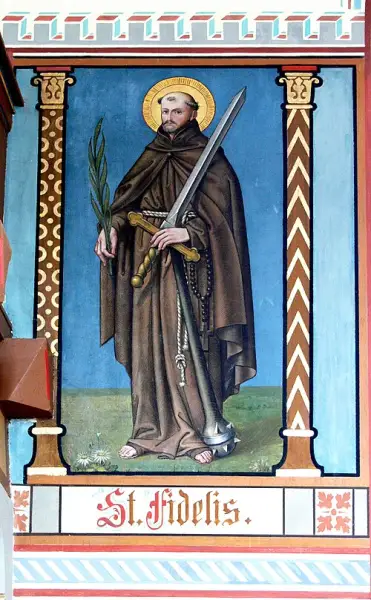
Fidelis of Sigmaringen holds his place in memory as a martyr of the confessional age in the Alps, killed at the height of the struggles that followed the Reformation. His feast is kept in the Catholic Church on 24 April, the day of his death. His images gather the emblems of his story: the sword that killed him and the palm that crowned him, the morning star of his falling, and the figure of the saint trampling the word 'heresy', beside the club set with spikes and the whirlbat of his tormentors, while an angel carries the palm of martyrdom and the painter Tiepolo set him in company with St. Joseph of Leonessa. His chief shrine remains the Capuchin friary of Weltkirchen at Feldkirch, where one of the reliquaries rests, the other lying in Coire Cathedral under the high altar. The report which the Bishop of Coire forwarded before the Congregation charged with the propagation of the faith kept the story of his mission alive for the processes that made him a saint. In Sigmaringen and Feldkirch, in Graubünden and beyond, he is remembered as the lawyer who laid down his brief, took up the cross, and proved his name by remaining faithful to the end.
§ Veneration
Timeline
- 1577
Born Mark Roy (Rey) at Sigmaringen, son of the burgomaster Johannes Rey.
§ Early life
- 1604
Set out as teacher-mentor to three young Swabian gentlemen on six years of travel through Europe.
§ Early life
- 1610
Returned from his travels and took up the practice of law as an advocate at Colmar in Alsace.
§ Early life
- 1611
Entered the Capuchin order, receiving the religious name Fidelis, and followed his brother George into the friars.
§ Life as a friar
- 4 Oct 1612
Ordained a priest; said his first Mass on 4 October 1612 at the Capuchin house in Freiburg, keeping the feast of St. Francis of Assisi.
§ Life as a friar
- 6 Jan 1622
On the Feast of the Epiphany, 6 January, entered the Prättigau district of Graubünden with his companions on the mission.
§ Life as a friar
- 24 Apr 1622
On 24 April, after preaching at Grüsch and Seewis, was murdered on the road back to Grüsch by twenty Calvinist soldiers after refusing to renounce the Catholic faith.
§ Death
- 1622
Six months after his death, the body was found incorrupt; head and left arm were placed in reliquaries sent to Coire Cathedral and Weltkirchen.
§ Veneration
- 24 Mar 1729
Beatified by Pope Benedict XIII on 24 March.
§ Veneration
- 29 Jun 1746
Canonized by Pope Benedict XIV in Rome on 29 June.
§ Veneration
In Their Own Words
I am sent to you to confute, not to embrace your heresy. The Catholic religion is the faith of all ages, I fear not death.
Pardon my enemies, O Lord: blinded by passion they know not what they do. Lord Jesus, have mercy on me … succor me!
P. Fidelis, prope diem esca vermium
The Record
- Major works
- Counter-Reformation mission in Graubünden with eight Capuchin assistants under his direction
- Symbols
- Sword·Palm of martyrdom·Morning star·Trampling on the word 'heresy'·Club set with spikes·Whirlbat·Angel carrying a palm of martyrdom·Depicted with Saint Joseph of Leonessa
- Canonization
- Beatified 24 March 1729 by Pope Benedict XIII; canonized 29 June 1746 in Rome by Pope Benedict XIV.
Prayer
Bibliography
Show 5 sources
- "Proper of Saints: 24 April". Liturgy of the Hours. Vol. II. New York: Catholic Book Publishing Co.
- Herbermann, Charles, ed. (1913). "St. Fidelis of Sigmaringen". Catholic Encyclopedia. New York: Robert Appleton Company
- "Saint Fidelis of Sigmaringen". Franciscan Media. 2016-04-24
- Butler, Alban. Vol. IV of "The Lives or the Fathers, Martyrs and Other Principal Saints". 1864 edition published by D. & J. Sadlier, & Company
- Acts of the canonization of SS. Fidelis of Sigmarengen, Camillus de Lellis, Peter Regalati, Joseph of Leonissa and Catherine Ricci, by Pope Benedict XIV, printed in 1749, folio. On St. Fidelis, pp. 101, 179, and the bull for his canonization, p. 516
Profile text adapted from the Wikipedia article, licensed CC BY-SA 4.0.
Pray with this saint every day
Save St. Fidelis of Sigmaringen to your favorites, read the full profile, and get feast-day reminders in the Saints app.
Get the Saints AppFree on the App Store for iPhone and iPad