
c. 1020 – 1070·Feast April 8
St. Filarete of Calabria
Calabrian monk and gardener of Mount Aulinas
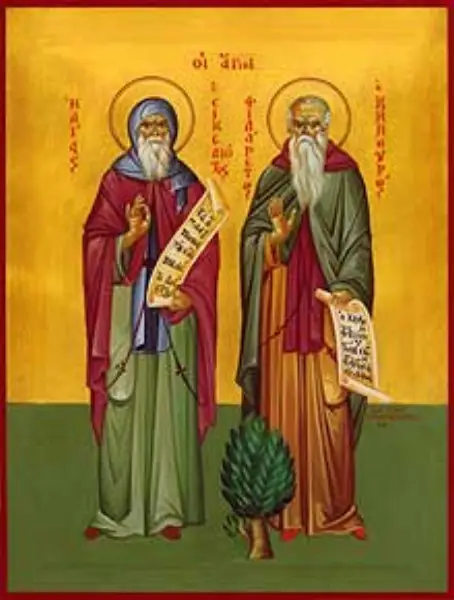
Overview
Filarete of Calabria, remembered also simply as "the gardener," was an Italo-Greek monk of the eleventh century whose life joined Sicily and Calabria at a moment when both lands were emerging from centuries of Muslim domination. He was born at Palermo around 1020 into a family of Calabrian descent that had been carried off to Sicily by Saracen raiders and afterwards set free. When the family was able to return to the mainland in 1040, Filarete settled first at Reggio Calabria, where his monastic vocation took shape. He soon attached himself to the monastery of St. Elias on Mount Aulinas near Palmi, left for a time to live at Sinopoli, and then went back to Mount Aulinas, placing himself under the guidance of the elder Orestes. There he passed the final twenty-five years of his life in prayer, obedience, and humble labor, the gardening that gave him his affectionate byname. He died around 1070, and his memory has been honored on 8 April by Catholics and Orthodox alike.
The Complete Life
A Family Carried Off and Set Free
Filarete was born at Palermo around the year 1020, into a household whose history bore the marks of the turbulent age in which Sicily then lived. His family was of Calabrian origin, but it had been deported to Sicily by the Saracens, the Muslim forces who for centuries raided and settled the island and carried mainland Christians into captivity. At some point the family was subsequently released, an unexpected mercy that preserved them and their faith. It was in this setting of exile and homecoming that the boy grew up, a Christian of mainland descent raised in a Palermo still touched by Islamic rule. The experience of a people uprooted and then allowed to return shaped the world he inherited: his family's identity remained fixed on Calabria, the land of their fathers, even while they lived in Sicily. When at last the opportunity came, in 1040, they went back to the mainland, and the young Filarete went with them, leaving the island of his birth for the region his family had never ceased to call home. His early life thus spans the two shores of the strait, and his story belongs to that Italo-Greek monastic world in which Sicilian captivity and Calabrian sanctuary were woven together.
§ Introduction
The Call to Mount Aulinas
After the family's return to the mainland in 1040, Filarete settled at Reggio Calabria, the principal city of the Calabrian coast, and it was there that his religious vocation matured. He did not remain long in the city. Drawn to the eremitical and cenobitical tradition that flourished in southern Italy, he moved to the monastery of St. Elias, which stood on Mount Aulinas at Palmi, a house named for the great prophet and father of Calabrian monasticism. The choice placed him in the line of the Basilian monks who had made the mountains of Calabria a refuge of prayer. His path was not a straight one: at a later stage he also lived at Sinopoli, another center of the region's monastic life, before returning once more to Monte Aulinas. This final return was of a different character, for he now placed himself under the guidance of Orestes, an elder of the community, submitting his discipline and daily conduct to a spiritual father. In that stability he found the form of life to which he would be faithful for the rest of his days, embracing the obedience, simplicity, and manual labor that would come to define his memory among the people of Calabria.
§ Introduction
Twenty-Five Years in the Garden
The closing chapter of Filarete's life was also its longest and most fruitful. Under the direction of Orestes on Mount Aulinas, he spent the final twenty-five years of his life in the monastery's service, and it is from this period that his affectionate byname, "the gardener," derives. The title suggests a man whose sanctity was expressed not in writings or spectacular penances but in the steady, unglamorous work of cultivating the ground and feeding the brethren, done day after day in humility. Such labor, in the monastic tradition of Calabria, was itself a form of prayer, and Filarete's memory shows how deeply he united the two. He died around the year 1070, having lived long enough to see the Norman conquest transform the south of Italy, yet remaining to the end a figure of the older Italo-Greek world of monastic observance. He was buried in the region of his adopted mountain, and the holiness recognized in his ordinary, patient fidelity passed quickly into the collective memory of the local church, which preserved his name and assigned his feast to the eighth of April.
§ Introduction
Veneration Across the Traditions
Filarete was never subjected to a formal process of canonization, for he died in an age when the holiness of a monk was affirmed by the devotion of the people and the judgment of the local church rather than by papal decree. He is accordingly honored as a pre-congregation saint, one whose cult is older than the machinery of formal canonization. Remarkably, his memory was not confined to a single communion: he is venerated in the Catholic Church, in the Eastern Orthodox churches, and in the Oriental Orthodox churches, a breadth of remembrance that reflects the shared Greco-Latin heritage of Calabrian monasticism, which stood close to both Constantinople and Rome. His feast is kept on the eighth of April, the day on which the two calendars alike commemorate him. In the town of Palmi, at the foot of Monte Aulinas, his cult has remained particularly alive, joined with that of St. Elias, the prophet-monk whose name the monastery on the mountain bore and whose patronage shaped the whole character of Filarete's religious life.
§ Introduction
Timeline
- 1020
Born at Palermo into a family of Calabrian origin that had been deported to Sicily by the Saracens and later released
§ Introduction
- 1040
Returned to Calabria and lived at Reggio Calabria
§ Introduction
- 1070
Died at Palmi after a quarter century of monastic life on Mount Aulinas
§ Introduction
The Record
- Major works
- Monastic community of St. Elias on Mount Aulinas at Palmi, where his example of humble gardening and obedience shaped the house under Orestes
- Patron of
- Gardeners
- Symbols
- Gardener's spade·Monastic habit
- Canonization
- Pre-congregation saint, venerated since antiquity in the Catholic, Eastern Orthodox, and Oriental Orthodox churches
Prayer
Bibliography
Show 1 sources
- Filarète di Calabria, santo, Enciclopedia Treccani (in Italian)
Profile text adapted from the Wikipedia article, licensed CC BY-SA 4.0.
Pray with this saint every day
Save St. Filarete of Calabria to your favorites, read the full profile, and get feast-day reminders in the Saints app.
Get the Saints AppFree on the App Store for iPhone and iPad