
1848 – 1923·Feast June 4
St. Filippo Smaldone
Apostle of the deaf and founder
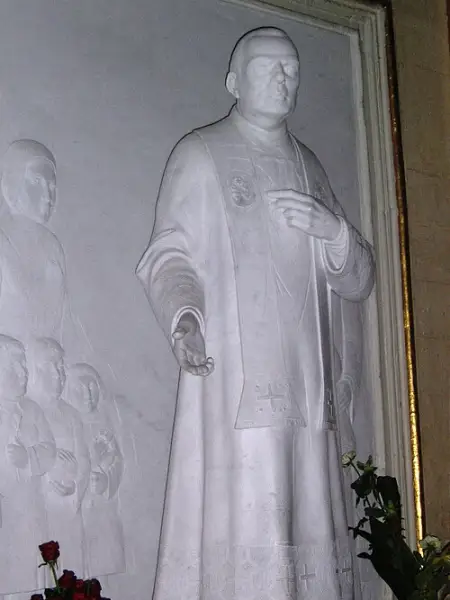
Overview
Filippo Smaldone was an Italian Roman Catholic priest who devoted his ministry to those whom his age largely overlooked: the deaf and the mute. Born in Naples in 1848, the eldest of seven children, he was ordained a priest in 1871 and soon began teaching and caring for deaf children in his native city. Though at one point discouragement drove him to ask for assignment to the foreign missions, his spiritual director persuaded him that his true field lay before him in Naples. The year 1885 saw him establish at Lecce an institute serving deaf and mute students, and out of that work grew the congregation of the Salesian Sisters of the Sacred Hearts, which received papal approval after his death and spread as far as Rwanda and Moldova. He also promoted Eucharistic devotion through leagues of priestly and lay adorers, served briefly as superior of the Missionaries of Saint Francis de Sales, and was honored with a canonry at Lecce Cathedral. He died at Lecce on 4 June 1923 from complications of diabetes and heart disease. His cause moved swiftly after its opening in 1964: John Paul II declared him Venerable in 1995 and beatified him in 1996, and Benedict XVI canonized him in Saint Peter's Square on 15 October 2006.
The Complete Life
The Eldest of Seven in Naples
Filippo Smaldone entered the world in Naples on 27 July 1848, at a time of revolution and upheaval across the Italian peninsula, in what was then the Kingdom of the Two Sicilies. He was the first of seven children born to Antonio Smaldone and Maria Concetta De Luca, and the responsibilities of an eldest son in a large household marked him from the beginning. His religious formation proceeded through the ordinary milestones of Catholic childhood: he made his First Communion in 1858, at about the age of ten, and received Confirmation four years later, in 1862. These years fell within the period in which the Kingdom of the Two Sicilies was absorbed into the new Kingdom of Italy, so that the Naples of his boyhood was a city negotiating profound political change. Amid those transformations, the boy's path turned steadily toward the Church. As a young man he undertook studies for the priesthood, a path that took him for a time to the far southern Archdiocese of Rossano-Cariati for part of his formation. His formation was not effortless: when he presented himself for the examination for minor orders, he came close to failing, because he would not abandon his apostolic work with the poor and the sick in order to devote himself to study. That tension between learning and service, present so early, would characterize the whole of his priestly life.
§ Life
Ordination and the Turn Toward the Deaf
Smaldone's progress toward the priesthood resumed in earnest when Cardinal Archbishop Sisto Riario Sforza of Naples granted him permission to return to his native city in 1876, completing a period of education that had taken him to Rossano-Cariati. Holy orders followed one another in quick rhythm: on 31 July 1870 he became a subdeacon, on 27 March 1871 a deacon, and on 23 September of that same year a priest, as the new Kingdom of Italy was consolidating around the papal capital. Even before his ordination was complete, the direction of his ministry was becoming clear. During his studies he had begun efforts to help the deaf of Naples, a population for whom systematic religious instruction and schooling barely existed in nineteenth-century Italy, and he had also devoted himself to work among the sick. The combination was demanding. At one stage the burden told on him severely: frustrated over his mute students and depressed by the difficulty of the work, he asked to give up teaching altogether and to go instead to the foreign missions. His spiritual director intervened, convincing him to remain at his post and continue what he had begun. That act of obedience, the refusal of a dramatic mission in favor of an unpromising local one, proved decisive, for the work he nearly abandoned became the cause of his life.
§ Life
Founding a Work for the Deaf
The institutional fruit of Smaldone's perseverance came at Lecce, in the far south of Apulia: it was there, on 25 March 1885, that he opened an institute for deaf and mute children. He did not act alone: Lorenzo Apicella assisted him, and several nuns whom he had under his care joined the enterprise, forming the nucleus of what would become the Salesian Sisters of the Sacred Hearts. His competence in the field was recognized beyond his own institutions; in 1880 he had traveled to Milan to serve as an expert at a national conference of educators of the deaf. The work spread: in 1897 he opened branches in both Rome and Bari, extending his method from the deep south to the capital. His peril during the cholera epidemic of 1884, when he almost died and credited his survival to the Madonna, only deepened his commitment. Formal recognition followed in stages: on 18 December 1912 his congregation was aggregated to the Order of Friars Minor; on 30 November 1915 it received the decree of praise from Pope Benedict XV; and on 21 June 1925, two years after the founder's death, Pope Pius XI granted it full papal approval. By 2005 the order counted forty houses and 398 religious, working in nations as distant as Rwanda and Moldova.
§ Life
The Eucharist at the Center
Smaldone's interior life was anchored in the Eucharist. Beyond his educational foundations, he established two devotional associations, the Eucharistic League of Priest Adorers and the Eucharistic League of Women Adorers, both designed to promote adoration of the Blessed Sacrament among clergy and laity respectively. This Eucharistic emphasis was not separate from his work with the deaf but its source: he believed that catechesis done properly could bring even those cut off from hearing into living contact with Christ in the sacrament. Contemporaries knew him as a gifted preacher, and his commitment to sound catechesis was matched by concrete care for orphans and for the mute, a combination that earned him the recognition of civic authorities as well as religious ones. His devotion to the Madonna was personal and intense; when cholera nearly took his life in 1884, he attributed his recovery to her intercession. His administrative gifts were also placed at the Church's service beyond his own congregation, for he served for a brief period as superior of the Missionaries of Saint Francis de Sales. The ecclesial esteem he won found its symbolic expression in his appointment as a canon of the Lecce Cathedral, an honor that bound the founder of a work for the voiceless to the liturgical heart of his adopted city.
§ Life
Death at Lecce
Smaldone's final years were spent at Lecce, the city of his great foundation, where he continued to guide the congregation he had raised from the institution for the deaf. His health, never robust after the cholera of 1884, declined under the burden of diabetes complicated by heart difficulties. He died at Lecce on 4 June 1923, at nine o'clock in the evening, at the age of seventy-four, having devoted half a century of priestly life to those who could not hear the Gospel preached in the ordinary way. The congregation he left behind was still in its juridical infancy, awaiting the full papal approval that Pius XI would grant on 21 June 1925, but it was already firmly established in its mission. His body was not allowed to remain long in its first resting place: in 1942 his remains were relocated to the motherhouse of the Salesian Sisters of the Sacred Hearts, so that the religious of his foundation could keep vigil over their founder. There his tomb became a center of recollection and intercession for the congregation as it grew, and the memory of the priest who had nearly abandoned his deaf students in despair became the patrimony of a religious family spanning continents.
§ Life
From Servant of God to the Altar
The movement toward Smaldone's canonization began four decades after his death, when an informative process opened in 1964 under Pope Paul VI; its introduction gave him the title of Servant of God. The Congregation for the Causes of Saints validated the cause in Rome on 23 May 1989 and took up the Positio within that same year, with theologians approving it on 3 February 1995 and the congregation itself on 16 May 1995. On 11 July 1995 Pope John Paul II declared him Venerable, recognizing that his Christian discipleship had reached heroic virtue. The miracle sought for his beatification underwent investigation, was validated on 7 May 1993, and won the approval of a medical board on 1 June 1995; theologians assented on 27 October 1995 and the congregation on 12 December 1995. John Paul II formally recognized the healing as miraculous through Smaldone's intercession on 12 January 1996 and beatified him that May. The second miracle, processed from 2000 to 2002 and validated on 4 April 2003, passed the medical board on 3 February 2005, the theologians on 17 May 2005, and the congregation on 17 January 2006. Pope Benedict XVI approved it on 28 April 2006 and canonized Filippo Smaldone in Saint Peter's Square on 15 October 2006.
§ Sainthood
A Patron of the Silent
Smaldone's enduring legacy rests on two pillars: the congregation he founded and the cause he championed. The Salesian Sisters of the Sacred Hearts carried his method of educating the deaf and mute far beyond Lecce, and by 2005 the order maintained forty houses with 398 religious in countries that included Rwanda and Moldova, making a nineteenth-century Neapolitan's work a global undertaking. Within the Church he came to be honored as patron of deaf people and mute people, a recognition that his canonization made universal, and his own congregation of sisters holds him in particular patronage. His life also stands as a quiet vindication of perseverance in unglamorous work: the man who asked to leave his frustrating classroom for the missions was instead made, by his fidelity to that classroom, a saint of the universal Church. Civic and religious authorities had commended him during his lifetime, and the ecclesiastical honors he received, including his canonry at Lecce Cathedral, testified to the esteem in which his combination of preaching, catechesis, and care for orphans was held. At his canonization in 2006, Benedict XVI presented him to the Church as a model of priestly charity, particularly for those who serve persons with disabilities, and his feast is kept each year on the anniversary of his death, 4 June.
§ Life
Timeline
- 27 Jul 1848
Born in Naples, Kingdom of the Two Sicilies, first of the seven children of Antonio Smaldone and Maria Concetta De Luca
§ Life
- 1858
Made his First Communion in Naples
§ Life
- 1862
Received the sacrament of Confirmation
§ Life
- 31 Jul 1870
Ordained a subdeacon, having nearly failed the minor orders examination because he would not abandon his apostolate
§ Life
- 27 Mar 1871
Ordained a deacon
§ Life
- 23 Sep 1871
Ordained to the priesthood, while already beginning efforts to help the deaf of Naples
§ Life
- 1876
Returned to Naples with permission of Cardinal Archbishop Sisto Riario Sforza after studies in the Archdiocese of Rossano-Cariati
§ Life
- 1880
Travels to Milan to serve as an expert adviser at a national gathering of educators of the deaf
§ Life
- 1884
Nearly died of cholera during the epidemic that struck the area, crediting his survival to the Madonna
§ Life
- 25 Mar 1885
Founds an institution for the deaf and mute at Lecce, aided by Lorenzo Apicella and nuns under his care
§ Life
- 1897
Opened new branches of his congregation in both Rome and Bari
§ Life
- 18 Dec 1912
Saw his order aggregated to the Order of Friars Minor
§ Life
- 30 Nov 1915
His congregation received the decree of praise from Pope Benedict XV
§ Life
- 4 Jun 1923
Dies at Lecce at nine in the evening of diabetes compounded by heart trouble
§ Life
- 21 Jun 1925
His congregation received full papal approval from Pope Pius XI, two years after his death
§ Life
- 1942
His remains were relocated to the motherhouse of his order
§ Life
- 1964
The informative process of his canonization cause opened under Pope Paul VI, titling him Servant of God
§ Sainthood
- 23 May 1989
The Congregation for the Causes of Saints validated his cause in Rome and received the Positio
§ Sainthood
- 11 Jul 1995
Declared Venerable by Pope John Paul II upon confirmation of his heroic virtue
§ Sainthood
- 12 May 1996
Beatified by Pope John Paul II in Saint Peter's Square, Vatican City
§ Sainthood
- 15 Oct 2006
Canonized by Pope Benedict XVI in Saint Peter's Square, Vatican City
§ Sainthood
The Record
- Major works
- Salesian Sisters of the Sacred Hearts (founded from his institution for the deaf at Lecce)·Institution for the deaf and mute at Lecce (1885)·Eucharistic League of Priest Adorers·Eucharistic League of Women Adorers
- Patron of
- Deaf people·Mute people·Salesian Sisters of the Sacred Hearts
- Symbols
- Cassock
- Canonization
- Canonized 15 October 2006 by Pope Benedict XVI in Saint Peter's Square, Vatican City
Prayer
Bibliography
Show 4 sources
- "Biographies of New Blesseds - 1996". EWTN. Retrieved 12 October 2016.
- "Filippo Smaldone (1848-1923)". Holy See. Retrieved 12 October 2016.
- "Saint Filippo Smaldone". Saints SQPN. 29 May 2015. Retrieved 12 October 2016.
- "Saint Filippo Smaldone". Santi e Beati. Retrieved 12 October 2016.
Profile text adapted from the Wikipedia article, licensed CC BY-SA 4.0.
Pray with this saint every day
Save St. Filippo Smaldone to your favorites, read the full profile, and get feast-day reminders in the Saints app.
Get the Saints AppFree on the App Store for iPhone and iPad