
8th century·Feast February 3
St. Fillan
Munster monk and abbot of Strath Fillan
Overview
Fillan, whose name in old Irish means "little wolf," was an eighth-century monk from Munster who became one of the most beloved saints of Perthshire in Scotland. Of royal blood, the son of Feriach and grandson of Cellach Cualann, King of Leinster, he received the monastic habit at the abbey of Fintán of Taghmon in Wexford. In 717 he left Ireland for Scotland as a hermit, traveling with his mother, St. Kentigerna, and his uncle, St. Comgan; the family settled at Loch Duich. After a period with his uncle at Lochalsh, Fillan gave himself to the evangelization of the Perthshire district that still bears his name, Strath Fillan; he led a monastery in Fife as its abbot before withdrawing to Glen Dochart and Strathfillan by Tyndrum. Medieval legend remembered him for miraculous powers of healing, for a luminous glow from his left arm by which he copied Scripture in the dark, and for the tale of the wolf that was forced to take an ox's place at his plough. His relics became famous in Scottish history: his arm-bone was credited with helping Robert the Bruce win the Battle of Bannockburn in 1314. His cult, attested from the 8th or 9th century, embraces Catholics and Orthodox, and he is patron of the mentally ill.
The Complete Life
A Prince's Son of Leinster
Fillan was born in Munster in the eighth century into the highest rank of Irish society. His father was Feriach, and his grandfather was Cellach Cualann, King of Leinster, so the boy who would become a hermit in the Scottish highlands began life in the orbit of royal courts. The very name he bore carried meaning: Fillan, in its Irish forms Fáelán or Faolán, probably means "little wolf," formed from a diminutive of faol, the old Irish term for the creature, and spoken as 'Fway-lawn' in Irish. The name would prove prophetic, for legend would one day bind the saint to a living wolf in the fields near Killin. His formation in the faith came through the great monastic network of early Ireland: he received the monastic habit at the abbey of Fintán of Taghmon in County Wexford, one of the venerable houses of the Irish church. From Munster, through Wexford, his life was shaped by the austere, missionary spirituality of seventh- and eighth-century Irish monasticism, which sent its sons across the sea in search of solitude for God. That searching spirit would soon carry him, together with his own royal family, across the North Channel to the mountains and lochs of western Scotland.
§ Life
Hermits of Loch Duich
Fillan's monastic profession at Taghmon Abbey was the beginning of a vocation that would unite his family in an extraordinary common enterprise of sanctity. In the year 717 he crossed from Ireland to Scotland as a hermit, and he did not travel alone: his mother, the Irish princess St. Kentigerna, and his uncle, the Irish prince St. Comgan, went with him. That a king's daughter and a prince should abandon royal rank for eremitical life in a foreign land is itself a striking witness to the missionary fervor of the age. The little company settled at Loch Duich on the west coast, where Comgan's memory is preserved at Lochalsh, in the places named Killilan and Kilfillan. Fillan spent time with his uncle there, learning under his direction before his own independent work began. The household thus formed a small monastic colony, mother, uncle, and son, transplanting Irish observance onto Scottish soil. From this base in the northwest highlands, Fillan's calling would widen from the contemplative silence of the hermitage to the active labor of evangelizing an entire district, though he would always return to solitude, retiring in his later years to the remote glens where his memory remains strongest to this day.
§ Life
Evangelist of Strath Fillan
Departing from his uncle's household, Fillan gave himself to converting the stretch of Perthshire around Strath Fillan, the valley that took its very name from him and in which he came to be profoundly venerated. His ministry ranged widely across the heart of Scotland. He led a monastery in Fife, governing monastic life on the east coast, before withdrawing at length to Glen Dochart and Strathfillan by Tyndrum in Perthshire. At Killin, the village most closely associated with him, tradition remembers that he established both a mill and a market, binding the material welfare of the community to its Christian life. The miracles recounted of him in this period belong to the world of highland legend: while ploughing the fields near Killin, the story runs, a wolf killed his ox, and a geis was laid upon the wolf obliging it to take the ox's place and draw the plough itself. The tale, more parable than history, was understood to explain the origin of his wolfish name. He was credited with the healing of the sick, and with a luminous glow from his left arm by which he studied and copied Sacred Scripture even in darkness, a wonder that made him a figure of light in the literal sense.
§ Life
Retirement to Glen Dochart
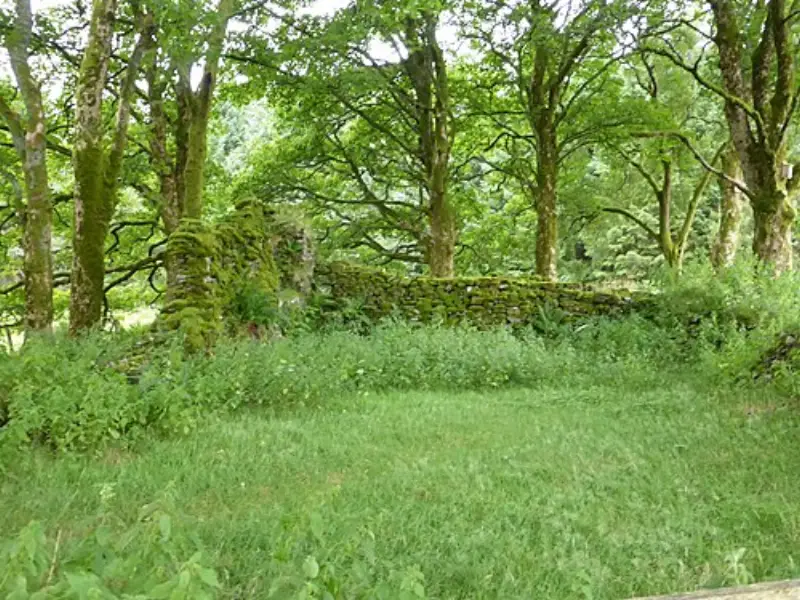
Fillan's last years were spent in retirement at Glen Dochart and Strathfillan near Tyndrum, withdrawing from the governance he had exercised in Fife to the valley that would forever bear his name. Yet even this retirement became a permanent foundation, for a monastery in his honor stood at Strath Fillan already by the 8th or 9th century, among the old religious houses of Scotland that, like most houses of that early age, was afterwards secularized. Near the ruins of Saint Fillan's chapel at Strathfillan lies the Holy Pool, into which the mentally ill were bathed even into the nineteenth century in hope of a cure through the saint's intercession, a custom that made him the patron saint of the mentally ill and that Sir Walter Scott referred to in Marmion. At the Augustinian priory at Kirkton Farm along the West Highland Way, the lay abbot presiding over it under William the Lion ranked highly in the Scottish kingdom, and the house was restored in the reign of Robert I, becoming a cell of the canons regular of Inchaffray Abbey. The original chapel of the saint stood upriver, beside a deep pool that came to be known as St. Fillan's Pool.
§ St. Fillan's Priory
An Ancient and Ecumenical Cult
Fillan belongs to the company of saints canonized not by decree but by the devotion of the people, a pre-congregation saint whose cult flourished within a century or two of his death. His veneration had taken hold already by the 8th or 9th century: at Strathfillan in Perthshire an old monastery stood in his honor, and the cult took root on both sides of the Irish Sea. He was honored in a special way at the villages of Houston and Kilellan in Renfrewshire in Scotland, as well as at Cluain Mavscua in County Westmeath in Ireland. The Roman Catholic Church keeps his memory on 3 February, and he is venerated as a saint in the Eastern Orthodox Church as well, whose calendar likewise marks his feast. The durability of his cult is visible in the institutions that bore his name through the centuries: the parish of Killallan in Renfrewshire, originally Kilfillan, the Church of Fillan; the Catholic parish church of St. Fillan established at Houston in 1841; the Scottish Episcopal church named for him at Kilmacolm; and the chapel at Doune Castle dedicated to the saint. Few early saints of either kingdom can claim so continuous and so geographically widespread a memory.
§ Feast
Relics, Bells, and Bannockburn
No part of Fillan's memory is more famous than his relics. The Mayne, his arm-bone, enclosed in a silver reliquary, was credited with the Scots' victory at Bannockburn: on the eve of the battle, Robert the Bruce knelt in prayer with the Abbot of Inchaffray and the hereditary keeper of the relic when a sound came from the reliquary, its door swung open, and the bone dropped to the floor; the king took the victory the next day and founded a monastery in thanksgiving, and the custodians, fearing English capture, had left the bone behind, bringing only the casket. The Quigrich, his crosier, counted among the sacred battle-ensigns of Scotland, remained in the keeping of the hereditary Dewar guardians, whose right James III formally recognized in 1487; its silver-gilt head now rests in the National Museum of Scotland. The Bernane, his cast bronze bell, was set over the heads of sufferers in healing rituals, was said to fly to the saint when called, was used at the coronation of James IV at Scone on 24 June 1488, and after its theft by an English tourist was recovered in 1869 by Bishop Forbes of Brechin and placed in the Scottish National Museum. At the Killin woollen mill, river stones believed endowed with healing power by the saint are still kept, each curing a specific part of the body.
§ Relics
Timeline
- 717
Left Ireland for Scotland as a hermit together with his mother Kentigerna and his uncle Comgan, settling at Loch Duich
§ Life
- 800
By the eighth or ninth century an ancient monastery dedicated to him stood at Strathfillan in Perthshire
§ Veneration
- 1123
Earliest surviving fabric of St Fillan's parish church at Aberdour in Fife belongs to this period or later
§ Legacy
- 1314
The Abbot of Inchaffray carried the saint's arm-bone relic onto the Bannockburn field, later credited for Robert the Bruce's triumph
§ Relics
- 1390
St Fillan's parish church at Aberdour, Fife, first appears in records as linked to the saint
§ Legacy
- 1428
The Dewar family of hereditary keepers held the Quigrich, the saint's crosier, in their custody
§ Relics
- 1487
King James III formally confirmed the Dewars' hereditary right to guard the crosier
§ Relics
- 24 Jun 1488
The Bernane bronze bell took part in the coronation of King James IV at Scone
§ Relics
- 1841
Catholic parish church of St. Fillan was founded at Houston in Renfrewshire
§ Legacy
- 1869
Bishop Forbes of Brechin recovered the stolen Bernane bell and placed it in the National Museum in Edinburgh
§ Relics
The Record
- Major works
- Monastery at Strath Fillan, Perthshire·Mill and market at Killin, Perthshire·Strath Fillan Priory, later a cell of Inchaffray Abbey
- Patron of
- Patron of the mentally ill
- Symbols
- The Quigrich (his crosier)·The Bernane (his bronze bell)·The Mayne (his arm-bone relic)·River-stones of Killin·Luminous left arm
- Canonization
- Pre-congregation saint, venerated since the 8th or 9th century in the Roman Catholic and Eastern Orthodox churches
Prayer
Bibliography
Show 5 sources
- Monks of Ramsgate. "Foelan". Book of Saints, 1921. CatholicSaints.Info, 4 May 2013.
- Barrett, OSB, Michael. "Saint Fillan or Faolan, Abbot (8th century)". The Calendar of Scottish Saints, 1919. CatholicSaints Info, 6 November 2010.
- "Saint Fillan's Celtic Apostolic Church: Our Saint". Archived from the original on 27 September 2007. Retrieved 31 August 2007.
- Sharp, Mick. The Way and the Light. Aurum Press Ltd, 2000. ISBN 1-85410-722-4.
- Chisholm, Hugh, ed. (1911). "Fillan, Saint". Encyclopædia Britannica. Vol. 10 (11th ed.). Cambridge University Press. p. 344.
Profile text adapted from the Wikipedia article, licensed CC BY-SA 4.0.
Pray with this saint every day
Save St. Fillan to your favorites, read the full profile, and get feast-day reminders in the Saints app.
Get the Saints AppFree on the App Store for iPhone and iPad