
1238 – 1253·Feast March 12
St. Fina
Virgin and patroness of San Gimignano
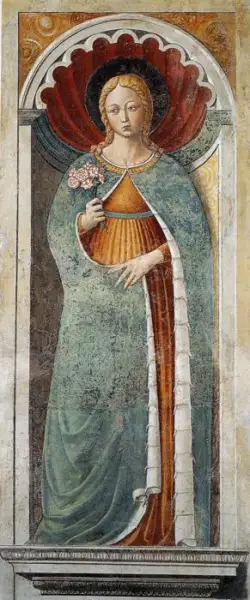
Overview
Fina, also called Serafina, was born in San Gimignano in 1238 and died there on 12 March 1253 at the age of fifteen. The daughter of Cambio and Imperiera Ciardi of a declined noble family, she lived quietly in the historic centre of the city of beautiful towers, learning to sew and spin and going out chiefly to hear Mass. In 1248 she contracted a serious illness that progressively left her paralysed, and she chose to lie not on a bed but on a wooden pallet, developing painful sores yet never complaining and keeping a joyful countenance in thanksgiving to God. During her sickness her father died, and afterwards her mother was killed in a fall. Her devotion to Saint Gregory the Great was marked: on 4 March 1253, after five years of suffering, she experienced a vision of the saint foretelling her death, and she died as foretold. Legends tell that at the moment of her passing all the bells of San Gimignano rang untouched, and that white violets bloomed from the wood of her pallet. Her cult was approved by papal authority in 1481, and she remains a patroness and protector of San Gimignano.
The Complete Life
A Humble House in the City of Towers
Fina dei Ciardi first saw the light at San Gimignano in 1238, daughter of Cambio and Imperiera Ciardi, a family of nobility in decline. The house in which she lived stood in the old quarter of that celebrated city of beautiful towers, on a small road that today bears her own name. Of her first decade of life little record remains, and the information that survives comes largely from the legends narrated after her death. What the traditions preserve is a picture of quiet industry and piety: she learned to sew and to spin, passing nearly all her days indoors, and some accounts note her strong devotion to the Virgin Mary, noting that Mass was the only outing that drew her from the house. In an age when noble birth still expected splendour, the fallen fortunes of the Ciardi seem to have sheltered rather than embittered their daughter, forming in her a spirit of recollection and simplicity. The child of the Tuscan hill town gave no outward sign of the fame to come; she was simply a girl who prayed, worked with her needle and spindle, and kept close to the sacraments of the church.
§ Life
The Bed of Suffering
In 1248, when she was ten years old, Fina fell gravely ill, and the disease by degrees deprived her of the use of her limbs. Refusing a proper bed, she lay instead on a plank of wood, and in time she developed painful pressure sores, a suffering she accepted as her portion. Her trials deepened: while her sickness ran its course her father died, and afterwards her mother was killed in a fall, leaving the paralysed girl bereft of both parents. Yet those who watched her swore that she uttered no complaint, wore a cheerful face, and blessed God continually. Her resignation drew the citizens of San Gimignano to her side, and visitors marvelled to hear comfort flow from a girl so cruelly afflicted, so thoroughly was she resigned to the will of God. She had a particular devotion to Saint Gregory the Great, the pope whose intercession would mark the close of her life. The legends that grew around her, of the pitcher of Smeralda made whole and full, and of the bells that rang untouched at her death, all confirm the single trait her neighbours remembered: a child whose suffering was transformed into gentleness for others.
§ Life
The Vision of Saint Gregory and a Holy Death
On 4 March 1253, in the fifth year of her sickness and torment, Fina experienced a vision of Saint Gregory the Great, in which the saint foretold her death. She died as predicted on 12 March 1253, at the age of fifteen. The legends record wonders at her passing: at the exact moment she died, every bell of San Gimignano rang out untouched by human hands, and when her body was removed from the pallet that had been her deathbed, onlookers watched white violets burst from the plank's grain and smelt a fresh floral fragrance through the house. Violets flourish upon the walls of San Gimignano to this day, and the townspeople call them the Saint Fina violets. For several days pilgrims came to the Pieve to see her remains, and during that time a number of cures were reported, among them the healing of the hand of her nurse Beldia. One last story belongs to the years after: a neighbour, Cambio di Rustico, who cut wood on the anniversary of her death in disregard of the town's holiday, hurt his leg and was healed when he asked the saint's pardon. Many who visited her grave in the following years reported cures.
§ Legends
An Approved Cult in San Gimignano
Miracles attributed to Fina are recorded in stories, paintings, poems, and notary documents, and her veneration received formal standing from the popes. A papal bull issued by Pope Sixtus IV in October 1481, confirmed by Pope Paul III in 1538, permitted the public cult and veneration of the saint. Her feast on 12 March, the anniversary of her death, has been a statutory holiday in San Gimignano since 1481, and a second feast is kept on the first Sunday of August, commemorating her reputed deliverance of the town from the two plagues that laid it waste in the years 1479 and 1631. On each of these days the relics are borne in procession to bless the town. Her remains rest in a chapel in the Collegiata of San Gimignano, and a hospital in the town was formerly named in her honour. Alongside Saint Gimignano himself, she stands honoured as a patroness and protectress of the town, its advocate in sickness and calamity. Paintings of her life by Ghirlandaio, Gozzoli, Pollaiuolo, and others have made her cult visible to every visitor to the Tuscan hilltop city.
§ Veneration
Hospital, Chapel, and the Artists of Her Story
The town's gratitude to Fina took lasting forms. In 1255, two years after her death, a hospital rose through alms left at her grave, and received her name; in the century that followed it ranked among the finest in Tuscany, sheltering the aged, the poor, and pilgrims, and it kept serving until the closing years of the twentieth century. In its chapel the original slab of oak on which the saint lay for five years is preserved. The chapel within the Collegiata, planned by Giuliano da Maiano in 1468 and consecrated in 1488, holds her relics in an altar by his brother Benedetto da Maiano, and its walls carry Domenico Ghirlandaio's frescoes of the vision of Saint Gregory and of her funeral, with the violets in blossom and the self-portrait of the painter beside his kinsman by marriage Mainardi, who frescoed the ceiling. Lorenzo di Niccolò's tabernacle of 1402 in the Civic Museum shows her holding a model of San Gimignano amid scenes of her life, and the earliest hagiography, by Fra Giovanni del Coppo in the fourteenth century, was translated into the vernacular by Jacopo Manducci in 1575.
§ Iconography and biographies
Timeline
- 1238
Born in San Gimignano in the Florentine Republic, daughter of Cambio and Imperiera Ciardi.
§ Life
- 1248
Contracted a serious illness that progressively left her paralysed, and took to lying on a wooden pallet.
§ Life
- 4 Mar 1253
Experienced a vision of Saint Gregory the Great, who foretold her death after five years of sickness.
§ Life
- 12 Mar 1253
Died in San Gimignano at the age of fifteen, as the vision had foretold.
§ Life
- 1255
A hospital named in her honour was built from donations given at her tomb; it became one of the best in Tuscany.
§ Legacy
- 1468
Her chapel in the Collegiata of San Gimignano was designed by Giuliano da Maiano.
§ Iconography and biographies
- Oct 1481
Pope Sixtus IV issued a papal bull permitting the public cult and veneration of Saint Fina.
§ Veneration
- 1488
The chapel in the Collegiata designed by Giuliano da Maiano was consecrated.
§ Iconography and biographies
- 1538
Pope Paul III confirmed the earlier papal bull permitting her public veneration.
§ Veneration
The Record
- Major works
- Hospital of Saint Fina in San Gimignano, founded 1255
- Patron of
- Patroness and protector of San Gimignano, together with Saint Gimignano
- Symbols
- violets·with Saint Gregory the Great·lying on her wooden board
- Canonization
- Public cult permitted by papal bull of Pope Sixtus IV in 1481, confirmed by Pope Paul III in 1538.
Prayer
Bibliography
Show 6 sources
- "St. Seraphina", FaithND.
- Stevens, Clifford. The One Year Book of Saints. Huntington, Indiana: OSV Publishing.
- Ghezzi, Bert. Voices of the Saints. Loyola Press.
- "Festa di Santa Fina", Fondazione Sistema Toscana.
- Mansfield, Mildred (1908) [1598]. Fra Giovanni Coppo — The Legend of the Holy Fina, Virgin of Santo Gemignano. New York: Duffield & Co.
- Vichi, Iole Imberciadori. Fina dei Ciardi (1979).
Profile text adapted from the Wikipedia article, licensed CC BY-SA 4.0.
Pray with this saint every day
Save St. Fina to your favorites, read the full profile, and get feast-day reminders in the Saints app.
Get the Saints AppFree on the App Store for iPhone and iPad