
early 6th century – d. c. 650·Feast April 7
St. Finan Cam
Early Kerry abbot of Kinnitty
Overview
Finan Cam, also called Fionan or Finian, was an early Irish saint, Abbot of Kinnitty, associated above all with County Kerry, who belonged to the sixth century and whose death probably fell in the first half of the seventh. To distinguish him from the many other Irish saints of the same name he received the appellation Cam, "crooked" — a nickname owed, some said, to a stooped frame, and to others to a squint. He was born in the wild Atlantic promontory of Corcodhuibhne, most likely the barony of Corkaguiny, into an old Kerry family descended from the kings of Ireland through the race of Cairbre Musc. As a child he was said to cure his playmates of illness and to possess the gift of prophecy. St. Brendan was his first tutor, and he spent seven years with Brendan learning to read and to understand monastic discipline. With Brendan's blessing he founded a monastery at Kinnitty in County Offaly, perhaps as early as 557, though he soon returned to Kerry, where nearly all the recorded events of his life took place. He lived for a time at or near the Lakes of Killarney, and one biography places him at Lough Leane near Aghadoe. Many miracles are attributed to him. His feast day is 7 April.
The Complete Life
Son of the Corcu Duibne
Finan Cam was born early in the sixth century in Corcodhuibhne, most probably the barony of Corkaguiny in County Kerry, a wild promontory stretching into the Atlantic that formed the ancient territory of the O'Falvys. His lineage was illustrious on both sides. According to the hagiographer O'Hanlon, the family of Conaire Cóem, King of Ireland, was his own: a line ran from his father Kennedy, son of Maenag, down through generations to Cairbre Musc, son of King Conaire, of the posterity of Érimón; he thus belonged to the Corcu Duibne, the race of Cairbre Musc. The O'Clerys record that his mother was Becnat, daughter of Cian. Another tradition, preserved in the Life of St. Brendan, names his father as Mac Airde, a man of considerable wealth who shortly after Brendan's birth gave the saint thirty cows. The two accounts of his father may reflect variant genealogical traditions, but either way, Finan was born into the old stock of Kerry, and it is as a Kerry saint that he is chiefly remembered. His very nickname, Cam or "crooked," given to set him apart from the many other saints named Finan, was said to derive either from a stooped frame or from a squint, a homely detail that has kept his memory distinct across twelve centuries.
§ Origins
The Pupil of Brendan
Holiness announced itself in Finan's childhood: even as a small boy he could, it was said, heal his playmates' sicknesses, and the gift of prophecy was likewise credited to him, signs that marked him out for the religious life in a society that read such things carefully. His education was entrusted to the greatest of Kerry's saints. Brendan was Finan's first tutor, and the boy passed seven years under him, acquiring letters and the discipline of monastic life. This training most likely happened early in the sixth century, while Brendan still made his home in Kerry itself, before the voyages and the later foundations that made his name famous; John Healy, who places the tutelage in this early period, found the earlier date more plausible than O'Hanlon's suggestion that Finan's birth fell around or after the middle of the century. Between master and pupil the bond was likely one of blood as well as spirit, for it is considered probable that Brendan and Finan were relatives. Seven years under so formidable a master formed the young Kerryman in the essentials of Irish monasticism, literacy in the sacred sciences, obedience, ascetic discipline, and readiness for mission, and prepared him for the work of founding which, with Brendan's blessing, would carry him across half of Ireland.
§ Life
Founder at Kinnitty
Brendan judged it wasteful for master and disciple alike to stay put in one spot, and Finan consented to go. He made his way to a place called Kenetich, later known as Kinnitty, in County Offaly within the ancient kingdom of Leinster; there, perhaps already in the year 557, his monastery was founded — though O'Hanlon judged that he likely settled there only near the close of the sixth century, finding the earlier date hard to credit. Butler, citing Colgan, tells how, with Brendan's blessing, he established the monastery of Cean-e-thich along the border where Munster meets Meath, with certain other houses afterwards; the site lay where Éile bordered Fearaceall. Kinnitty's parish church is thought to stand on the ground of Finan's old monastery. Yet his tenure as abbot there appears to have been brief: he seems to have stayed at Kinnity only a short time before returning to Kerry, the county where almost all the events recorded of him took place. For some time he lived at or near the Lakes of Killarney, and one biography places him at Lough Leane, near Aghadoe, whose church ruins were already old when the Annals of Inisfallen were written. It may well be, as some have argued, that the oratory on Skellig Michael had its first founder in none other than Finan.
§ Life
Old Age Among the Kerry Saints
The closing period of Finan's life is fixed only by the company he kept. He was a contemporary of St. Mochelloc, and the two were old men at the same time, for Mochelloc died about the year 655; from this synchronism it follows that Finan's own death probably came in the first half of the seventh century, when he was an old man of the generation that had received the faith of Kerry from Brendan himself. Many miracles are attributed to him in his biographies, though the sources, which O'Hanlon described as a very confused narrative preserved among the Franciscan Convent Records in Dublin, preserve few details of his last years. His memory remained anchored in the landscape of western Kerry. Around 1750 the remains of his church and cell were still visible on the biggest of three small islands in Lough Currane, and local people kept his festival on 16 March — the date generally given for Finan the Leper, likely through a confusion of names, since there is no record of the Leper ever traveling so far to the southwest. Derrynane, south of the lake, preserves his name as Diare Fionain, the oak grove of Finan, though the old abbey on the shore there is medieval.
§ Life
A Name on the Kerry Coast
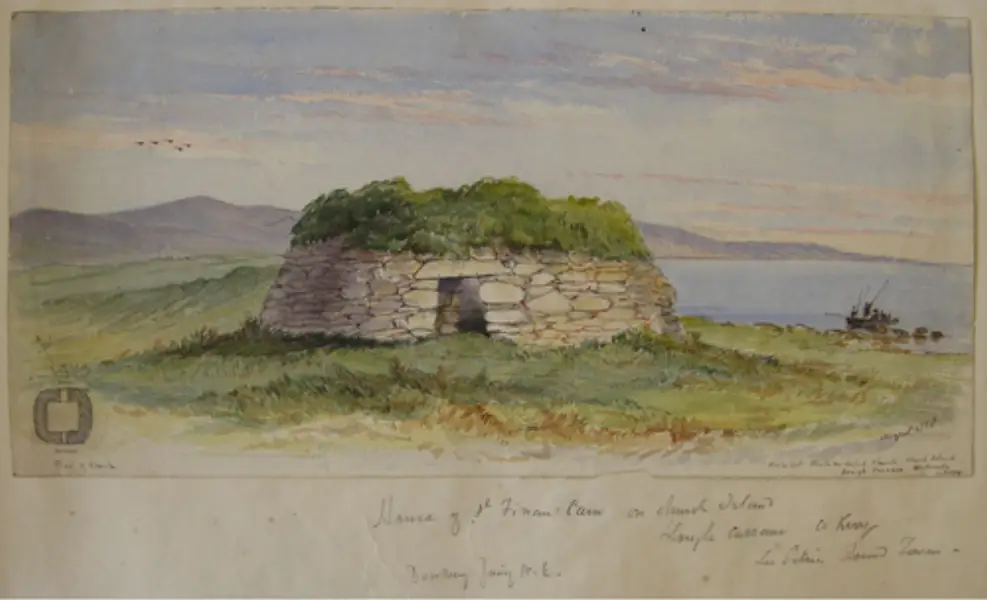
Finan Cam's legacy is written most durably into Kerry's geography, in the many spots that carry his name. St. Finian's Bay, a wind-beaten reach of Atlantic shore north of Bolus Head, keeps his memory, and directly opposite it rises Skellig Michael, whose first oratory he may well have founded; during the Viking Age, when Danish raiders harried the coast, the monastery there withdrew to the mainland, where its dilapidated walls could still be made out in 1890 in the sheltered corner at the bay's head. At Lough Currane, the house of Finan Cam on Church Island was recorded in an 1817-1869 drawing by George Victor Du Noyer, and the remains of his church and cell were visible around 1750. Scholarly debate has also kept his name alive: writing in 1890, John Healy challenged the received opinion that Finian Lobhar, Finan the Leper, had founded the church and abbey on Innisfallen island, set in Lough Leane, holding such a foundation improbable, and the island named in the Leper's biographies more likely Ireland's Eye off County Dublin. For Finan Cam, born of an old Kerry family and spent almost entirely in west Kerry, that attribution fitted far better. His feast day remains 7 April, distinct from the Leper's March date.
§ Places
Timeline
- 500
Born early in the sixth century at Corcodhuibhne, most likely the barony of Corkaguiny in County Kerry.
§ Life
- 510
Passed seven years under St. Brendan, his first tutor, learning to read and to keep monastic discipline.
§ Life
- 557
Founded his monastery at Kenetich, afterwards Kinnitty in County Offaly, perhaps as early as this year.
§ Life
- 650
Died probably in the first half of the seventh century; he was a contemporary of St. Mochelloc, who died about 655.
§ Life
- 1750
Remains of his church and cell could still be seen about this time on the largest of three islets in Lough Currane.
§ Places
The Record
- Major works
- Monastery of Kinnitty (Kenetich), County Offaly·Church and cell on Church Island, Lough Currane
- Patron of
- Diocese of Kerry places bearing his name, including St. Finian's Bay and Derrynane
- Canonization
- Pre-congregation saint of the early Irish church, venerated since antiquity
Prayer
Bibliography
Show 3 sources
- Butler, Alban (1798). The lives of the primitive fathers, martyrs, and other principal saints... J. Moir.
- Healy, John (1890). Insula Sanctorum Et Doctorum. BoD – Books on Demand. ISBN 978-3-7523-3423-4.
- O'Hanlon, John (1875). Lives of the Irish saints.
Profile text adapted from the Wikipedia article, licensed CC BY-SA 4.0.
Pray with this saint every day
Save St. Finan Cam to your favorites, read the full profile, and get feast-day reminders in the Saints app.
Get the Saints AppFree on the App Store for iPhone and iPad