
c. 550 – 25 September 623·Feast September 25
St. Finbar of Cork
Bishop of Cork and School of Munster
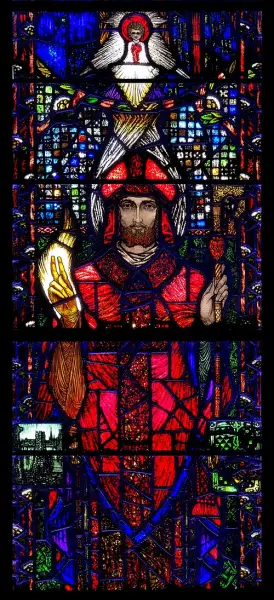
Overview
Finbar, in Irish Fionnbharra and often shortened to Barra, was the sixth-century bishop and abbot whose monastery on the marshes of the River Lee grew into the city of Cork, of which he is patron saint. Born around 550 at Templemartin near Bandon, the son of Amergin of Maigh Seóla, a craftsman from Galway, he bore the name Lóchán until his tonsure, when a presiding cleric's remark, fair is the crest of Loan, gave him the name Fionnbharra, fair-head. He studied in Ossory, went on pilgrimage to Rome with fellow monks, and called on St. David in Wales on the journey home. Back in his native country he lived as a hermit on an island in Loch Irce, now Gougane Barra, and raised churches across the region, including one at Ballineadig. For the last seventeen years of his life he settled at Corcach Mór na Mumhan, the Great Marsh of Munster, now Cork city, gathering monks and scholars into a famous school. His church and monastery of 606 stood above the Lee, where Saint Fin Barre's Cathedral rises today. He died in 623 at Cellnaclona, returning from a visit to Gougane Barra.
The Complete Life
Lóchán of Templemartin
The boy who became Finbar was born around 550 at Templemartin, north of Bandon in County Cork, and was originally named Lóchán, the modern form of which survives as Loan. His father was Amergin of Maigh Seóla, a skilled craftsman who had come from Galway, so that the saint's line joined the old families of two Irish provinces. For his education he was sent to Ossory, the kingdom corresponding roughly to today's County Kilkenny. The turning point of his young life came at his tonsure. As the rite was performed, the presiding cleric looked at the newly shorn head and remarked in the Irish of the time, Is fionn barr Lócháin: fair is the crest of Loan. The phrase fixed itself, and from it the young monk took the religious name Findbarr or Fionnbharra, fair-head, the name by which all Munster would know him, and from which comes the everyday Barra. Some scholars have even theorized that this Cork saint was identical with Finnian of Moville, the teacher of Colm Cille, so wide was his early reputation. Between the craft of his Galway father and the scholarship of Ossory, the boy who would be called fair-head grew up with tools in one inheritance and books in the other, a combination that later showed itself in the practical founding of churches and the intellectual fame of his school.
§ Life
Pilgrimage to Rome and the Call of David
Finbar's formation did not end in Ireland. When his studies were complete he went with a company of monks on pilgrimage to Rome, the great act of devotion open to an Irish churchman of his age, crossing the seas to pray at the tombs of the apostles. The homeward road held a detour of lasting consequence: he sat with St. David in Wales, the austere abbot-bishop whose monastery at Mynyw was the chief school of the Celtic west. Such encounters bound the Irish and Welsh churches together in learning and discipline, and brought home to Cork a training shaped by the strictest of the British fathers. When at last he returned to his own country he did not settle in the family home at Templemartin, but sought the eremitical life on an island in a small lake then called Loch Irce. There, among rock fissures and dark water beneath the mountains, he found the solitude his soul demanded; the island bears his name to this day as Gougane Barra, the little rock-fissure of Finnbarr, and remains the major shrine of his cult.
§ Life
Churches Across the Lee Valley
From his island retreat Finbar went out to build. He is reputed to have raised small churches in many places across the region, the most noted standing at Ballineadig in County Cork, called Cell na Cluaine, anglicized Cellnaclona and often confused with the name Cloyne, a title that has caused endless confusion with the true Cloyne, Cluain Uamha, in east Cork. The decisive foundation came in 606, when he raised his church and monastery on a limestone cliff over the River Lee, in the district the Irish called Corcach Mór na Mumhan, Munster's Great Marsh. Around this house he gathered monks and students until it became one of the great centers of learning in the south of Ireland, celebrated in the phrase Ionad Bairre Sgoil na Mumhan, Finbarr's foundation, the School of Munster. The site, later called Gill Abbey after a twelfth-century Bishop of Cork, Giolla Aedha Ó Muidhin, remained continuously the seat of the city's cathedral, and the present Church of Ireland cathedral on the spot bears his name as Saint Fin Barre's. The choice of so unpromising a site, a marsh between the river and the cliffs, proved characteristic of the monk who had first made his home on a rock fissure in a mountain lake: the Church of his age took root wherever prayer could be sustained, and cities grew afterwards around the praying.
§ Life
Seventeen Years in the Great Marsh
Through roughly his seventeen closing years Finbar dwelt in the marsh settlement he had founded, directing a school whose fame drew students from every quarter of Munster. From the limestone cliff above the Lee he governed monks, taught scholars, and served the scattered churches of the valley, from Gougane Barra in the mountains to Cellnaclona in the low country. He died on 25 September 623 at Cell na Cluaine, struck down, as tradition relates, while returning from a visit to his old hermitage at Gougane Barra, a pilgrimage homeward from the solitude where his religious life had matured. His body was carried back to the city of his labors and laid to rest in his church's cemetery, where his grave became the center of the city's devotion. The people of the city have never forgotten him: the Catholic church in Dunbar Street in the South Parish, dedicated to him and known familiarly as the South Chapel, stands near the Anglican Saint Fin Barre's Cathedral, while the Catholic cathedral of Saint Mary and Saint Anne, the North Cathedral, serves the diocese that claims him as founder.
§ Life
Patron of Cork
Finbar belongs to the pre-congregation age, when the reverence of a local church made its founder a saint without formal process. He is venerated in both the Roman Catholic Church and the Eastern Orthodox Church, and his principal shrines are Gougane Barra, the island hermitage of his youth, and Saint Fin Barre's Cathedral in Cork. His feast is kept on 25 September, the anniversary of his death, throughout the Diocese of Cork, of which he is patron together with the city itself. Of the five Irish saints who bore the name Finnbarr, he is by far the most renowned, and tradition even identifies the Finnbarr honored on the Gaelic island of Barra in Scotland, where the ruined church of Cille Bharra stands, with the bishop of Cork, though some have argued for a separate Scottish saint, and hold that devotion reached the Hebrides through his disciples. Whatever the truth of the Scottish identification, the devotion carried across the Irish Sea by his disciples shows how far the fame of the Cork bishop reached within a few generations of his death.
§ Other Saint Finbars
Where Finbar Taught, Let Munster Learn
Finbar's most enduring monument is intellectual. The school he founded in the Great Marsh became so celebrated that its Irish title, Ionad Bairre Sgoil na Mumhan, is today the motto of University College Cork, inscribed above an entrance gateway of the university; its English rendering, Where Finbar taught let Munster learn, is not a translation of the Irish, which means Finbarr's foundation, the School of Munster, but it carries the same claim across the centuries: that the city's learning began with the bishop's monastery. His name has traveled wherever the Irish went. Schools dedicated to St. Finbar stand in England and across Australia, at Ashgrove, Byron Bay, Invermay in Tasmania, Sans Souci, East Brighton, Quilpie and Glenbrook in the Blue Mountains, with a St. Finbarr's school in Lagos, Nigeria, and a St. Finn Barr church and school in San Francisco, together with a parish and school in Burbank, California. The first cathedral of Charleston, South Carolina, honored him, likely because its first bishop, John England, a Cork man, was consecrated in Saint Fin Barre's Church before sailing for America; the building stood until the Great Fire of Charleston in the Civil War.
§ Legacy
Timeline
- 550
Born at Templemartin north of Bandon and originally named Lóchán, son of the craftsman Amergin of Maigh Seóla
§ Introduction
- 606
Founds his church and monastery on a limestone cliff above the River Lee, at the site later called Gill Abbey
§ Saint Fin Barre's Cathedral
- 25 Sep 623
Dies at Cellnaclona while returning from Gougane Barra and is buried in the cemetery of his church in Cork
§ Saint Fin Barre's Cathedral
The Record
- Major works
- Monastery and school at Cork (Ionad Bairre Sgoil na Mumhan)·Church and monastery of 606 above the River Lee (Gill Abbey site)·Church at Ballineadig (Cellnaclona)·Hermitage at Gougane Barra
- Patron of
- City of Cork·Roman Catholic Diocese of Cork and Ross
- Symbols
- Bishop's crozier·Church on the limestone cliff above the Lee
- Canonization
- Pre-congregation; venerated from antiquity by Catholics and the Eastern Orthodox Church
Prayer
Bibliography
Show 9 sources
- MacErlean, Andrew, "St. Finbar", The Catholic Encyclopedia, Vol. 6, New York: Robert Appleton Company, 1909, retrieved 19 July 2013
- Herbermann, Charles, ed. (1913), "School of Cork", Catholic Encyclopedia, New York: Robert Appleton Company
- P. Cahalane, "Saint Finnbarr, Founder of the Diocese of Cork", in The Fold, July and August 1953
- "About Saint Finbarr", Saint Finbarr Roman Catholic Church, Naples, Florida
- Patrick Duffy, "St Finbarr (560-610) patron of the diocese of Cork"
- "St Finn Barr's Catholic Church Mass Times - San Francisco, California", catholicmasstime.org, retrieved 22 July 2022
- "St. Finn Barr Catholic School", retrieved 28 June 2021
- Clark, W.H.; McDaniel, M.B. (2017), Growing Up in Burbank: Boomer Memories from The Akron to Zodys, History Press, p. 184, ISBN 978-1-4396-6380-6
- "Our History", Roman Catholic Diocese of Charleston, retrieved 28 June 2021
Profile text adapted from the Wikipedia article, licensed CC BY-SA 4.0.
Pray with this saint every day
Save St. Finbar of Cork to your favorites, read the full profile, and get feast-day reminders in the Saints app.
Get the Saints AppFree on the App Store for iPhone and iPad