
c. 470 – 549·Feast December 12
St. Finnian of Clonard
Abbot of Clonard and Teacher of Ireland's Saints
Overview
Finnian of Clonard stands among the founding figures of Irish monasticism. Born in Leinster around 470, a son of Findlog, he was baptized by Abban and entrusted as a child to Bishop Fortchern of Trim before seeking a wider education abroad. Tradition places him first at the monastic centre associated with Martin of Tours, then for years at the school of Cadoc the Wise at Llancarfan in Wales, where he gave himself to prayer and to the copying of Rome's classics and Jerome's Vulgate. Returning to Ireland after a Welsh sojourn that the Codex Salmanticensis puts at thirty years — a length scholars doubt — he received a site at Aghowle, is credited with a foundation on Skellig Michael, and visited Kildare before being led, so the story goes, by an angel to Clonard on the River Boyne around 520. There he raised a modest cell and a wattle-and-clay church and opened a school famous for strict discipline and scriptural learning. As many as three thousand pupils are said to have studied there at once, among them Ciarán of Clonmacnoise and Columcille of Iona, the men remembered as the Twelve Apostles of Ireland. Finnian died of plague in 549 and was buried in his own church at Clonard.
The Complete Life
A Leinster Boy of the Ulaid
Finnian was born around 470 at Myshall in the Kingdom of Leinster, a son of Findlog, and his birthplace is generally placed near what is now the town of New Ross. He belonged to Clanna Rudhraighe, a kindred of the Ulaid, a detail that links the great Leinster teacher to the peoples of the north. The infant was baptized by Abban, and while still a child he was handed over to Bishop Fortchern of Trim for his earliest formation. Such arrangements marked out a boy destined for the church from the beginning. Nothing in the record suggests an ordinary upbringing; instead the sources present a student sent early to ecclesiastical guardians and then abroad for the schooling Ireland could not yet provide. Later Irish tradition would remember him above all as a master, and the habits of a lifetime — painstaking copying, long years of study, reverence for teachers — were evidently formed young. By the time he left Ireland for Gaul and Wales he was already practising the disciplines of prayer and learning that would make Clonard, decades later, the most celebrated school in the island. His sister Regnach, remembered as abbess of Kilreynagh near Banagher, shared the family's monastic vocation.
§ Early life
From Tours to Llancarfan
Two foreign schools shaped Finnian's mind. The first was the monastic centre associated with Martin of Tours in Gaul, a foundation noted above all for its austerity; there the young Irishman is said to have studied for a time. From Gaul he crossed to Wales and settled at the school of Cadoc the Wise at Llancarfan in Glamorgan, a place whose very name — the Llan of the stags — spoke of a landscape given over to God. Here he remained for years, absorbed in prayer and study, and here he laboured as a scribe, making copies of the classics of Rome and of Jerome's Vulgate. The Codex Salmanticensis would later claim that this Welsh sojourn lasted thirty years before he returned to his native land, though the modern scholar Elizabeth Hickey observed that three decades away seems too long given what Finnian achieved after coming home. Whatever the true length, the direction of his formation is clear: Tours gave him ascetic severity, Llancarfan gave him scriptural learning, and Wales gave him the model of monastic schoolmanship he would one day transplant to the banks of the Boyne.
§ Early life
The Founding of Clonard
Finnian's return to Ireland launched a series of foundations. His first halt was Aghowle in present-day County Wicklow, under Sliabh Condala, on ground that Oengus, Leinster's king, made over to him. Tradition also connects him with a monastic community on Skellig Michael, the bare rock off the Kerry coast, although historians doubt this attribution. From there he made his way to the monastery of Brigid at Kildare. Around 520, according to his legend, an angel finally led him to Cluain Eraird — Clonard in County Meath — on the River Boyne, telling him that this would be the place of his resurrection. There Finnian raised his little cell and a church of wattle and clay, and gave himself to study, mortification, and prayer. His reputation for learning and holiness spread quickly, and scholars of every age came flocking to the monastic retreat on the Boyne. In ordering his monastery he took the Welsh houses for his model, building on the heritage of the Desert Fathers and on constant scriptural reading. The pupils who left to found monasteries of their own are described departing with a book or a crozier in hand — evidence that a working scriptorium and craft workshops stood at Clonard from an early date.
§ Foundations
A Strict Rule and a Penitential
Clonard's rule was famed for its severity and its ascetic demands, and Finnian's own teaching survives in the Penitential of Finnian, a document of wide learning that draws on the instruction of John Cassian about overcoming the eight evil tendencies — pride, vainglory, accidie, dejection, anger, covetousness, fornication, and gluttony — the theme of Books 5 through 12 of the Institutes. Finnian's penances were designed not merely to punish sin but to correct the sinful tendency itself and to cultivate the contrary virtue, a therapeutic and formative understanding of discipline that Irish monasticism would carry forward for centuries. The same severity governed daily life at Clonard, which the tradition describes as a place of study, mortification, and prayer. Finnian excelled above all in the exposition of the Sacred Scriptures, and it was to his teaching of the biblical text that his school owed its extraordinary popularity. His gift for teaching, joined to an absolute dedication to the ascetic ideal, formed a whole generation: the men who studied under him carried his methods and his standards into every province of Ireland and across the sea to Iona and beyond, making a small monastery on the Boyne the nursery of a civilization.
§ Foundations
Master of Three Thousand Scholars
The Office of St. Finnian records that no fewer than three thousand pupils received instruction at one time in the school that grew up in the green fields of Clonard. Students arrived from various parts of Europe, drawn by the fame of a master who excelled in expounding the Scriptures and who modelled in his own person the ascetic ideal he taught. Among those who trained at Clonard were Ciarán of Clonmacnoise and Columcille of Iona; with their companions they took the seeds of knowledge gathered in Finnian's monastery and planted them abroad with remarkable success, so that Clonard's true harvest was reaped far beyond Meath. Finnian died in 549, a victim of the plague that swept Ireland in that year. His biographer credited him with a fabulous age of one hundred and forty years, but Elizabeth Hickey, weighing his actual achievements, judged that he was perhaps sixty or sixty-five when he died. He was buried in his own church at Clonard, the place he had been promised would be his resurrection, and there his memory remained fixed even after the school itself had passed away.
§ Later life and death
An Ancient and Widespread Cult
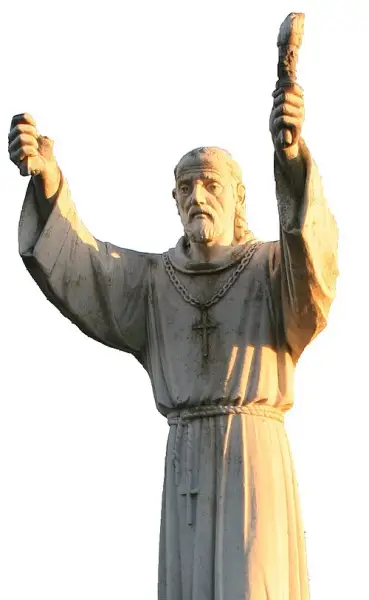
No formal act of canonization raised Finnian to the altars; he belongs to the earliest company of Irish saints, honoured by the church as soon as he was buried. His cult was already established far enough west to appear in a Spanish martyrology of the ninth century, which gives his feast as 12 December, the date still kept by Catholics and, as the commemoration of the Venerable Finnian, Abbot of Clonard, by Orthodox Christians on 12 December (25 December on the new calendar). He is venerated in both the Catholic Church and the Eastern Orthodox Church, a rare breadth for a saint of early Ireland. The tangible focus of his cult was the shrine of his relics at Clonard, which stood until 887, when it was destroyed. The loss of the relics did not end the veneration: the parish church at Clonard still bears his name, the statue of the saint still watches over the town, and the Diocese of Meath continues to honour him as its patron. His feast has outlived the abbey, the school, and the see that succeeded him.
§ Veneration
The Glory That Departed
Clonard became an important school chiefly because of its alumni: for centuries after Finnian's death it remained renowned as a seat of scriptural learning, and the monasteries founded by his pupils carried his influence into every corner of Ireland. In its later years the monastery passed under Uí Néill control and came to share its abbot with Kildare or with Clonmacnoise. During the eleventh century the Danes worked the school harm, and worse harm came from two Irishmen, O'Rorke of Breifney and Dermod McMurrough. The end came in 1206, when the Norman bishop of Rochfort transferred the See of Meath from Clonard to Trim, and the old glory of the place departed for good. Yet Finnian's personal reputation has never faded. Together with Enda of Aran he is honoured as a father of Irish monasticism; as teacher of the Twelve Apostles of Ireland he stands behind the entire golden age of Irish saints; and as author of the Penitential he helped shape the private-penance tradition that would eventually transform the whole Western church.
§ Veneration
Timeline
- 470
Born in Leinster, son of Findlog; baptized by Abban and entrusted as a boy to Bishop Fortchern of Trim.
§ Early life
- 520
Guided, it is said, by an angel, he settled at Clonard on the River Boyne and built a cell and clay-and-wattle church.
§ Foundations
- 12 Dec 549
Died of plague at Clonard and was buried in his own church there.
§ Later life and death
- 887
His relics, enshrined at Clonard up to this year, lost their shrine when it was destroyed.
§ Veneration
- 1206
The Norman Bishop of Rochfort moved the See of Meath from Clonard to Trim, ending the school's glory.
§ Veneration
The Record
- Major works
- Penitential of Finnian·Clonard Abbey (foundation)
- Patron of
- Diocese of Meath
- Symbols
- book·crozier
- Canonization
- Pre-congregation; venerated since antiquity in the Catholic and Eastern Orthodox Churches
Prayer
Bibliography
Show 5 sources
- MacKillop, Charles James (1998), A Dictionary of Celtic Mythology, Oxford.
- Hughes, Kathleen. "The Cult of St Finnian of Clonard from the Eighth to the Eleventh Century". Irish Historical Studies 9.33 (1954). pp. 13–27.
- Hickey, Elizabeth (1996). The Irish Life of Saint Finnian of Clonard: Master of the Saints in Ireland with a Commentary for the general reader. Meath: Meath Archaeological and Historical Society. ISBN 9780950033273.
- Farmer, David Hugh (1997). The Oxford Dictionary of Saints (4th ed.). Oxford: Oxford University Press. ISBN 0-19-280058-2.
- De Paor, Liam (1955). "A Survey of Sceilg Mhichíl". The Journal of the Royal Society of Antiquaries of Ireland. 85 (2): 174–187.
Profile text adapted from the Wikipedia article, licensed CC BY-SA 4.0.
Pray with this saint every day
Save St. Finnian of Clonard to your favorites, read the full profile, and get feast-day reminders in the Saints app.
Get the Saints AppFree on the App Store for iPhone and iPad