
c. 495 – c. 589·Feast September 10
St. Finnian of Movilla
Missionary Founder of Movilla Abbey in Ulster
Overview
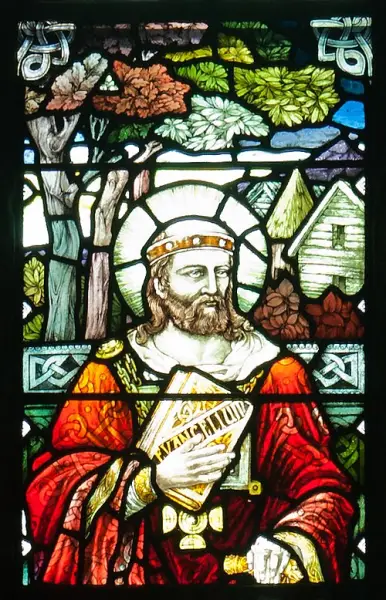
Finnian of Movilla, sometimes called Finbarr — 'the white head', a nod to his fair hair — was an Irish Christian missionary of the sixth century, remembered especially as the founder of Movilla Abbey near Strangford Lough in County Down. Traditional scholarship made him a descendant of Fiatach the Fair, born in Ulster, though the Celticist Thomas Owen Clancy has questioned this lineage. He is said to have studied under Colman of Dromore and Mochaoi of Nendrum, then at Candida Casa (Whithorn), and afterwards to have completed his education in Rome, where he spent seven years and was ordained a priest. Coming home with a copy of Jerome's Vulgate, at a time when books were scarce, he founded his own monastery at Maigh Bhile in 540 and won prestige for it through the treasured text. Movilla grew into a community of real consequence for worship, learning, mission, and trade, and it was remembered in the Book of Armagh as a place rich in miracles. Finnian's most famous pupil was Columba, whose disputed copying of a psalter is linked to his exile on Iona. Finnian died late in the sixth century, leaving a monastery that endured until the Dissolution.
The Complete Life
Origins in Question
Finnian's origins are less secure than his fame. Traditional scholarship describes him as a descendant of Fiatach the Fair, born in Ulster, but his lineage has recently been challenged by the American-based Celticist Thomas Owen Clancy, who argued in 2001 that Finnian and St Ninian were in fact one and the same person, separated by nothing more than an eighth-century scribal spelling error. Older sources sometimes give his name as Uinniau, and Alban Butler calls him 'Saint Finian, or Winin'. Whatever his parentage, his formation is described with some consistency: he apparently studied under Colman of Dromore and under Mochaoi of Nendrum, and subsequently at Candida Casa — Whithorn — the great British centre of mission. One legend from his Whithorn days has him playing a prank, of unknown nature, on Princess Drustice, daughter of a Pictish king, who was lodged in the women's quarters of the monastery; had he been less well connected, the tale runs, his clerical career might have collapsed entirely. Leaving Whithorn, he went on to Rome for the finishing of his education, and after seven years in the city he was raised to the priesthood.
§ Origins and life
A Book for a Poor Country
Ordained a priest after seven years in Rome, Finnian returned to Ireland carrying a copy of Jerome's Vulgate — and in an island where books were rare, that single volume conferred honour and prestige on whatever establishment possessed it. Home again, the missionary set about founding a monastery to house his treasure, and the book became both the practical heart and the emblem of the enterprise: a school built around the scriptures, at a moment when the Irish church was hungry for exactly such resources. He is also remembered under the name Finbarr, 'the white head', a reference to his fair hair, and he must be distinguished both from his great namesake Finnian of Clonard and from the County Donegal town of Moville, which is often confused with Movilla in County Down. The choice of site was telling: Maigh Bhile, the plain of the ancient tree, had been a sacred place venerated in pagan times, and the new foundation took over an old holiness for a new faith. Here the Roman-trained priest set about building an Irish monastery with an international library at its core.
§ Origins and life
Movilla on the Plain of the Ancient Tree
In 540 Finnian founded his new monastery at Movilla — Maigh Bhile, the plain of the ancient tree, a spot held sacred in pagan times — roughly a mile inland from Strangford Lough's northern shore; their fifteenth-century remains still stand at Newtownards. The enterprise was sponsored in its building and upkeep by the king of the Dál Fiatach, and it grew into a monastic community of great significance for Ulster and for Ireland as a whole, a hub of Celtic Christian prayer, scholarship, missionary outreach, and trade. At about the same time Finnian established the famous school of Druim Fionn. Legend attaches to Movilla one of the strangest encounters in Irish letters: his attempt to convert Tuan mac Cairill, the mythical last survivor of the Partholonian race, in the course of which the tale called Scéal Tuáin maic Cairell was recounted to him — a narrative of the takings of Ireland that fed the great compilation known as the Lebor Gabála Érenn. The Book of Armagh kept the founder's memory alive in its own words, picturing a life venerable in God's sight and a resting place in Movilla crowded with miracles.
§ Movilla Abbey
Rule and Penitential
Finnian wrote a rule for his monks and, in addition, a penitential code — two documents that place him squarely in the mainstream of sixth-century Irish monasticism, where each community lived under a written discipline and each confessor worked from a graduated tariff of penances. Though only the fact of these writings survives rather than their contents, their significance is clear: a rule ordered the common life of prayer and work at Movilla, while the penitential extended the abbot's care for souls into a systematic discipline of confession and amendment. Finnian thus belongs to the company of Irish abbots whose legislation shaped not only their own monasteries but the whole penitential culture of the early medieval church. The same pedagogical impulse shows itself in his schools — Movilla itself and the school of Druim Fionn — where scripture, and especially the Vulgate he had carried back from Rome, stood at the centre of study. In an age when books were rare and copied by hand, the possession and transmission of a biblical text was itself a spiritual work, and Finnian's reputation for learning and holiness grew from that conjunction of the scribe's desk and the altar.
§ Rule and code
Teacher of Columba
Finnian's most distinguished pupil at Movilla was Columba, and from that discipleship came one of the most famous stories in Irish history. Tradition tells that the psalter Columba copied without leave became, in the end, the cause of his banishment to Iona; the book that survives is kept in Dublin's Royal Irish Academy, its casket in the National Museum of Ireland. The relic, known as the Cathach — the Battler — was customarily carried into battle by the O'Donnells; the inner shrine was Cathbar O'Donnell's work of 1084, while the outer casing belongs to the fourteenth century. Adomnán of Iona adds that Finnian, judged a bishop in his telling, numbered Columba among his deacons, and preserves a story of the young deacon's first miracle: when the wine ran out at a Mass Finnian was celebrating, Columba drew water from a well, called on the name of Christ, and blessed it, whereupon it became wine and was brought to the altar. Finnian himself died late in the sixth century — the date is given variously as 589 or 579 — by which date Movilla already ranked among the great monastic houses, and the abbey kept on as a Christian witness for a millennium more, until the Dissolution of 1542.
§ Teacher of Columba
Timeline
- 495
Born c. 495, possibly in Ulster; traditional scholarship makes him a descendant of Fiatach the Fair.
§ Origins and life
- 540
Founded Movilla Abbey at Maigh Bhile near Strangford Lough, and about this time the school of Druim Fionn.
§ Movilla Abbey
- 579
Died this year, with Movilla by then celebrated as a major monastic centre of Ulster.
§ Movilla Abbey
- 1084
Cathbar O'Donnell crafted the inner case of the Cathach, the psalter casket tied to Finnian's pupil Columba.
§ Teacher of Columba
- 1542
After more than a millennium of worship there, the abbey was suppressed when England's monasteries were dissolved.
§ Movilla Abbey
The Record
- Major works
- Rule for his monks·Penitential code·Movilla Abbey (foundation)
- Patron of
- Ulster
- Symbols
- book·psalter
- Canonization
- Pre-congregation; venerated in the Catholic, Orthodox, Church of Ireland, and Anglican traditions
Prayer
Bibliography
Show 7 sources
- Challoner, Richard. A Memorial of Ancient British Piety: or, a British Martyrology, p. 128. W. Needham, 1761.
- Butler, Alban (1799). The Lives of the Primitive Fathers, Martyrs, and Other Principal Saints. J. Moir, p. 114.
- Hammond, David. "St. Finnian's Cregagh".
- McCavery, Trevor. Newtown: A History of Newtownards. White Row Publications, 2013.
- Grattan-Flood, William. "St. Finnian of Moville". The Catholic Encyclopedia, Vol. 6. New York: Robert Appleton Company, 1909.
- Clancy, T. O. "The real St Ninian", in Innes Review, 52 (2001), pp. 1–28.
- MacKillop, James. A Dictionary of Celtic Mythology. Oxford, 1998.
Profile text adapted from the Wikipedia article, licensed CC BY-SA 4.0.
Pray with this saint every day
Save St. Finnian of Movilla to your favorites, read the full profile, and get feast-day reminders in the Saints app.
Get the Saints AppFree on the App Store for iPhone and iPad