
c. 526 – 603·Feast February 17
St. Fintan of Clonenagh
Father of the Irish Monks of Clonenagh
Overview
Fintan of Clonenagh, born around 526 to the Christian couple Gabhren and Findlath, was an Irish hermit, monk, and abbot whose severity became proverbial. He received his formation under Abbot Colum, the founder-saint associated with Terryglass, and was shaped above all by his master's penitential practices and the harshness of his Rule; under that direction the pupil earned a name for austerity of his own. At Clonenagh, in what is now County Laois, Fintan established a monastery whose discipline astonished even contemporaries accustomed to Irish rigour: his monks were forbidden all animal products, and the community kept not a single cow, so that neither milk nor butter ever crossed the refectory. When the brothers protested that they could not labour on so meagre a diet, a delegation of local clergy led by Canice of Aghaboe came to plead for relief; Fintan consented for their sake but kept the strict regime for himself, reportedly living on little more than barley bread and water. His disciples included Colmán of Oughaval and Comgall of Bangor, and the Irish annalists compared him to St Benedict, styling him 'Father of the Irish Monks'. He is one of the three patron saints of County Laois and died in 603.
The Complete Life
A Christian Household
Fintan came into the world around 526, the child of Gabhren and Findlath, a Christian couple — a detail worth pausing over, for it places his childhood in one of the families already converted within a generation or two of Patrick's mission. He grew up in an Ireland where monasticism was becoming the dominant form of religious life, and where the great founders of the sixth century were still living and teaching. Into that world he came as a natural recruit: a boy of believing parents, formed young in the faith, and drawn to the severest expression of it. Little is recorded of his youth, but the pattern of his later life was set by the master under whom he placed himself as a young man. Under Abbot Colum he received his religious formation, and what he absorbed there was not merely routine but an ethos: the penitential practices of his teacher and the severity of his Rule passed into the disciple and became, in him, even more pronounced. By the time he left Colum's direction he had already acquired the reputation for austerity that would define the rest of his life.
§ Life
Apprentice to Colum
Fintan's vocation was formed in the school of Colum, the abbot whom the tradition links with Terryglass, and the relationship between the two men belongs to the classic pattern of early Irish monasticism: founder and disciple, master and heir. The monastery at Clonenagh, founded in the sixth century, passed into Fintan's keeping when Colum departed for Terryglass around 548; out of that handing-on Fintan emerged as head of the community. His apprenticeship had taught him two things above all — the value of penance as a way of life, and the conviction that a Rule's severity was not cruelty but precision, a means of cutting away whatever dulled the soul's appetite for God. He carried both convictions to Clonenagh and applied them without softening. Yet the same apprenticeship had also taught him obedience and deference to the wisdom of the church: when the clergy of the district later came to him seeking mercy for his monks, he listened, and his concession shows a humility equal to his rigour. The disciple of a severe master proved capable of gentleness toward those in his care.
§ Life
Barley Bread and Clayey Water
The discipline of Clonenagh centred on the table. Fintan gave his monks rules of great strictness forbidding the consumption of any animal products; the community kept not even one cow, and so knew neither milk nor butter. Baring-Gould sums up the table: no meat, no butter, no milk — vegetables only. The brothers protested that such scant fare left them unfit for heavy labour, and their protest reached the ears of the local clergy: a deputation headed by Canice of Aghaboe came to urge the abbot to improve the fare. Fintan agreed — for his monks. For himself he elected to keep the strict diet, and for his own part he was said to keep to a sustenance the old sources describe as coarse barley bread and muddy water. Here is asceticism of a distinctly Irish kind, praised by the annalists, who compared Fintan to St Benedict himself and styled him 'Father of the Irish Monks'. The comparison is telling: like Benedict, Fintan understood that a community is formed by its habits, and that the abbot who asks everything of others must first ask it of himself.
§ Life
Father of the Irish Monks
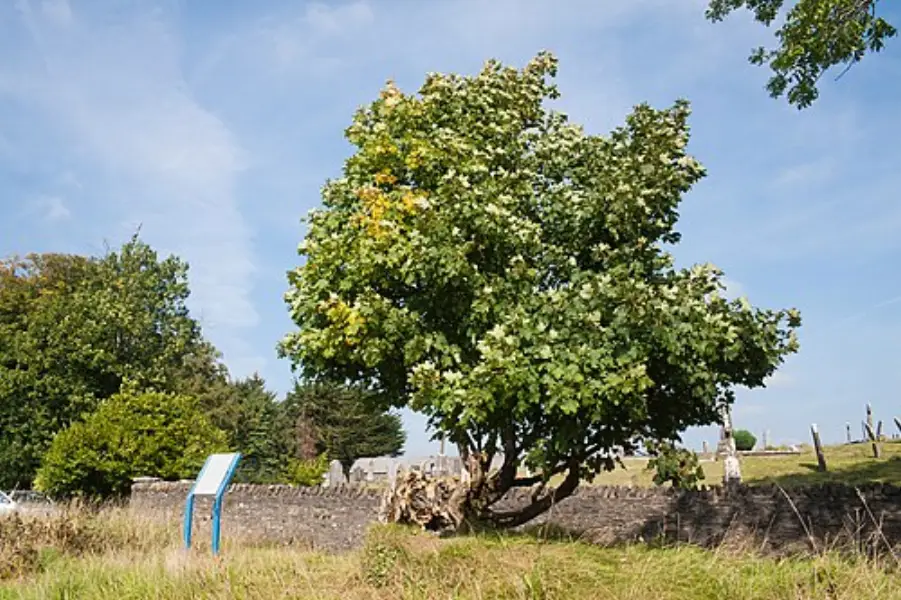
Fintan's influence reached far beyond his own enclosure through the disciples he formed. Among them were Colmán of Oughaval and, most significantly, Comgall of Bangor, whose abbey would become one of the greatest monastic schools in Europe and send missionaries across the continent. The Irish annalists ranked Fintan with St Benedict and gave him the title 'Father of the Irish Monks', a judgement on two generations of monastic life rather than on one man's asceticism alone. Within his own region his cult remained vivid: he is regarded as one of the three patron saints of County Laois, alongside Colman Mac ua Laoise and Mochua of Timahoe, and he is sometimes confused with the later Fintán, or Munnu, abbot of Taghmon, though the two are distinct saints. Even the landscape at Clonenagh kept his memory: a sycamore maple planted in the late eighteenth or early nineteenth century at the site of the early Christian monastery became known as St. Fintan's Tree, and the custom grew of pressing coins into its trunk — a practice that so injured the tree that it was believed dead until it put out new shoots, before it was finally blown down in a storm in 1994. He died in 603; his feast is kept on 17 February.
§ St. Fintan's Tree
Timeline
- 526
Born in Ireland, the son of the Christians Gabhren and Findlath.
§ Life
- 548
Around this year Colum moves on to Terryglass; Fintan becomes head of the monastery at Clonenagh.
§ Life
- 603
Dies; the annalists rank him with St Benedict as 'Father of the Irish Monks'.
§ Life
- 1994
St. Fintan's Tree at Clonenagh, a sycamore-maple dedicated to the saint, is blown down in a storm.
§ St. Fintan's Tree
The Record
- Major works
- Clonenagh monastery (foundation)
- Patron of
- one of the three patron saints of County Laois
- Symbols
- barley bread·monastic cell
- Canonization
- Pre-congregation
Prayer
Bibliography
Show 7 sources
- Berry, Albert. "Saint Fionntan". Lives of Irish Saints. CatholicSaints.Info, 27 February 2014.
- Lanigan, John (1829). An Ecclesiastical History of Ireland, From the First Introduction of Christianity to the Beginning of the Thirteenth Century. Printed for J. Cumming. p. 227.
- Baring-Gould, Sabine (1914). The Lives of the Saints, Volume 2. Edinburgh: John Grant. p. 324.
- Jones, Kathleen (2002). Who are the Celtic Saints? Canterbury Press. p. 38. ISBN 978-1853114939.
- Grattan-Flood, William (1909). "Sts. Fintan". In Herbermann, Charles (ed.). Catholic Encyclopedia. Vol. 6. New York: Robert Appleton Company.
- Millar, Seamus. "St Fintan of Clonenagh". Carloviana: Journal of the Old Carlow Society 1:22 (1973): 10-12.
- Sperber, Ingrid. "'Late and not of special distinction'? The misunderstood Life of St Fintan of Clonenagh". In Ossory, Laois and Leinster 1 (2004): pp. 28–49.
Profile text adapted from the Wikipedia article, licensed CC BY-SA 4.0.
Pray with this saint every day
Save St. Fintan of Clonenagh to your favorites, read the full profile, and get feast-day reminders in the Saints app.
Get the Saints AppFree on the App Store for iPhone and iPad