
died 3rd century·Feast November 24
St. Firmina
Roman Virgin Martyr of Amelia and Civitavecchia
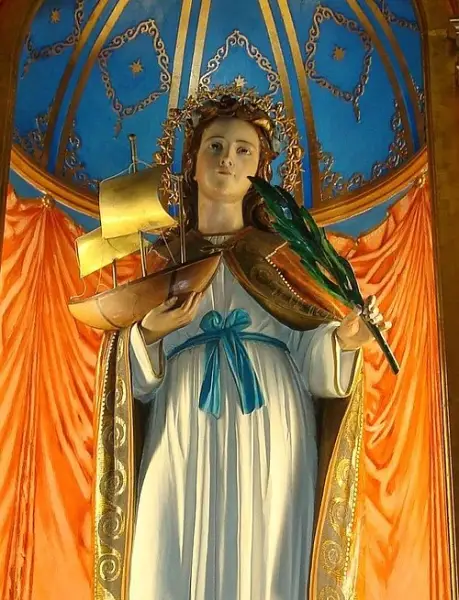
Overview
Firmina of Rome is honoured as an early Christian virgin martyr, patroness of Civitavecchia and titular of the cathedral of Amelia in Umbria. According to her legend, she belonged to a family of the highest Roman rank: her father Calpurnius held the urban prefecture of Rome. When Olympiadis, a senior official, attempted her chastity, she won him instead to the Christian faith, and for it he was put to death. Firmina then left her father's house to give herself to prayer in seclusion near Amelia, where — in the simplest form of her story — she was arrested in the persecution of Diocletian, suffered martyrdom, and was buried. Other versions of the legend have her martyred and buried at Civitavecchia instead, and later oral tradition added further, sometimes conflicting, details. Many miracles are ascribed to her, above all the calming of a violent storm at sea during a voyage to Centumcellae, the modern Civitavecchia, and she is supposed to have dwelt for a while in a grotto beside the harbour, on ground where Forte Michelangelo would later rise. Her historicity is uncertain: everything told of her comes from a vita written no earlier than the sixth century, and some scholars have suggested that her cult, with those of the Umbrian virgins Felicissima and Illuminata, represents local devotion to the African martyr Firmina named in the Martyrologium Hieronymianum.
The Complete Life
A Prefect's Daughter
The simplest version of Firmina's legend makes her a daughter of the Roman aristocracy at its height. Her father Calpurnius held the prefecture of the city of Rome — the praefectus urbis, the capital's highest civic office — and the girl grew up amid the wealth and influence such a household commanded. Everything we know of her, however, comes with a caution: no source for her life survives that was written earlier than the sixth century, and later oral tradition supplemented that late vita with details that sometimes contradict one another. The historian of her cult must therefore work with the shape of the legend rather than its certainty. What the legend insists on is the contrast between Firmina's social position and her faith: a young woman of the governing class who embraced a religion the state was preparing to persecute. That theme — the great household producing a martyr — was a favourite of early Christian hagiography, and it is impossible now to say how much history and how much literary convention lie behind Firmina's story. What can be said is that by the early middle ages her cult was firmly established at Amelia and at Civitavecchia, and that the two towns have never ceased to dispute, or to share, her memory.
§ Life
The Conversion of Olympiadis
The turning point of the legend comes with Olympiadis, a high official who attempted to seduce the prefect's daughter. In the story's economy the assault is reversed: instead of losing her faith, Firmina wins his. Olympiadis was converted by her to the Christian religion, and for that conversion he paid with his life, winning the martyr's crown before the woman whose words had brought him to Christ followed him to it. Firmina's response to her own danger was flight into solitude. Forsaking her family — the prefect's Rome household, with all the safety it offered — she retired to a hidden life of prayer near Amelia in Umbria. There, in the simplest version of the legend, the persecution of Diocletian found her; she was martyred and buried in that same countryside. Other tellings transfer her martyrdom and burial to Civitavecchia, the ancient Centumcellae on the Tyrrhenian coast, and the two cities have kept the argument alive for centuries in their rival feasts. Behind the differing endings stands a consistent figure: a Roman woman who traded rank for prayer, and prayer, when the trial came, for death.
§ Life
Feasts of Two Cities
Firmina's veneration belongs to the earliest, pre-congregational age of the church, when the tombs of martyrs needed no formal process to be honoured. Her cult divided, characteristically, between her two claimant cities. Amelia keeps the feast of her burial there on 24 November; Civitavecchia keeps the feast of her burial there on 20 December. Neither date, however, is the day of Civitavecchia's great celebration: on 28 April each year the port city holds a procession in her honour unlike any other. Her statue is borne to the water and embarked on a boat that steams out to where the old lighthouse stood, while every vessel and fishing craft in the roads salutes with sounding horns — a civic and maritime feast commemorating, in liturgical form, the miracle of the storm that the saint was believed to have stilled on her own sea passage to Centumcellae. Her body's principal shrine is the cathedral of Amelia, which is dedicated to her; at Civitavecchia she is honoured as patroness, and her grotto by the port, on which the fortress of Forte Michelangelo was later built, remained a place of her legend. Her iconography is the simplest and most ancient of all: the martyr's palm.
§ Veneration
One Saint or Three?
Modern scholarship has added a final complication to Firmina's story. Her name is frequently joined to those of two further Umbrian virgin martyrs, Felicissima and Illuminata, honoured in the same district; and it has been suggested that all three are, in reality, local devotions to a single saint — the African martyr Firmina who is commemorated in the Martyrologium Hieronymianum in October. On this reading, the Roman prefect's daughter, the recluse of Amelia, and the virgin of Civitavecchia would be devotional expansions of one older, simpler commemoration, multiplied as her cult spread along the Umbrian and coastal churches. Whatever the truth, the shared name has bound the three cults together and given the region a common patroness. Meanwhile the legend itself continues to nourish local religion: the storm at sea, the grotto by the harbour, the statue borne out over the water each April are living memories, not antiquarian curiosities. Firmina stands among those early Roman martyrs whose history cannot be separated from the devotion they inspired — a saint whose story is, in a real sense, the story of the two cities that have loved her, their cathedral and their harbour alike under her protection for well over a thousand years.
§ Veneration
Timeline
- 250
By tradition lives in the third century as a daughter of Calpurnius, prefect of the city of Rome.
§ Life
- 303
Suffers martyrdom near Amelia, by the traditional account, in the persecution of Diocletian; some versions place her death and burial at Civitavecchia.
§ Life
- 24 Nov 303
Amelia keeps the feast of her burial there on 24 November, honouring the saint entombed in its cathedral.
§ Veneration
- 20 Dec 303
Civitavecchia commemorates her burial in that city with a feast kept on 20 December.
§ Veneration
- 550
A vita of Firmina is written, the earliest source for her life, no earlier than the sixth century.
§ Life
The Record
- Patron of
- Civitavecchia, Italy·Amelia, Italy
- Symbols
- palm frond
- Canonization
- Pre-congregation; venerated as a saint from the earliest Christian era
Prayer
Bibliography
Show 4 sources
- Monks of Ramsgate. "Firmina". Book of Saints, 1921. CatholicSaints.Info, 28 April 2013.
- Holweck, Frederick George. A Biographical Dictionary of the Saints. B. Herder Book Company, 1924, p. 373.
- Santi e beati: Firmina.
- Santiebeati: Firmina (in Italian).
Profile text adapted from the Wikipedia article, licensed CC BY-SA 4.0.
Pray with this saint every day
Save St. Firmina to your favorites, read the full profile, and get feast-day reminders in the Saints app.
Get the Saints AppFree on the App Store for iPhone and iPad