
died AD 64·Feast June 30
The First Martyrs of the Church of Rome
Christians Put to Death in Nero's Persecution of 64
Overview
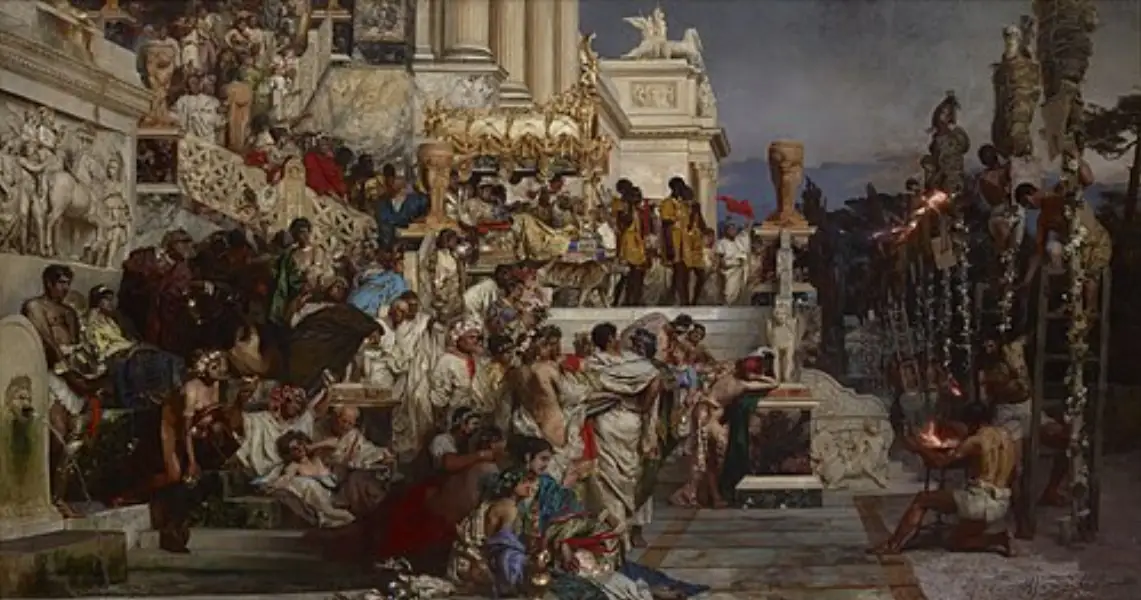
The First Martyrs of the Church of Rome are the Christians put to death in the city of Rome during Nero's persecution in the year 64. When fire devastated Rome in July of that year — a frequent calamity in a city of wooden tenements — rumour blamed the unpopular emperor, who was said to want room for his palace; Nero deflected the accusation onto the Christians. The historian Tacitus records that many were condemned not so much for arson as for hatred of the human race, and describes the horrors of their executions: covered in the skins of beasts to be torn apart by dogs, nailed to crosses, or burned as living torches to light the emperor's gardens at night, while Nero exhibited a circus show and mingled with the crowd in charioteer's dress. Pity, Tacitus allows, crept over even a Roman crowd hardened to cruelty, for the deaths appeared to serve no public end — only the gratification of one man's savagery. The event is recorded by Tacitus and Pope Clement I, among others, and Peter and Paul were probably among its victims. The Catholic Church honours the whole company with an optional memorial on 30 June, the day after the Solemnity of Saints Peter and Paul, a feast introduced by the 1969 calendar reform to commemorate all the early Roman martyrs at once.
The Complete Life
A Church Before Paul Came
The Christians who died in Nero's persecution belonged to a community older than any apostle's visit. Rome had a large Jewish population, and among the immigrants were Priscilla and Aquila, tent makers from Pontus whom Paul would meet in Corinth; they had settled in Rome until Claudius commanded every Jew out of the city, an edict Suetonius connects with unrest between the Jewish community and the partisans of one 'Christus'. Christians could be found in the capital scarcely a dozen years after Jesus' death, and Paul was not their teacher: his letter to them, penned in 57 or 58, preceded any visit of his, and it saluted a church of Jews and Gentiles together. The community that emerges from these notices is one of remarkable maturity — founded by unknown evangelists, tested by an imperial expulsion that split it from its Jewish roots, and already substantial enough to receive the longest of Paul's letters. It was this mixed, unheroic, ordinary congregation, perhaps three decades old, that in 64 found itself the object of the first imperial persecution in Christian history, and furnished from its ranks the company the church now honours as the first of Rome's martyrs.
§ Background
Fire in July
In July of 64 Rome burned. The city, largely built of wooden tenements, knew fire as a frequent visitor, but this conflagration was on another scale, and rumour quickly assigned it an author: the unpopular emperor Nero, who was said to have wanted the ground to enlarge his palace. Nero answered the accusation in the manner of tyrants, by finding someone more defenceless to accuse — and he accused the Christians. What followed Tacitus set down in the fifteenth book of his Annals. The charge against them, he records, rested less on city-burning than on misanthropy — hatred of the human race. Some were sewn into the hides of wild beasts for the dogs to maul to death; some were fixed alive to crosses; others, reserved for the fire, were set alight after nightfall to light the emperor's grounds. Nero threw open his own gardens for the display and staged circus games, himself moving among the crowd in a charioteer's colors or perched aloft on a car. Compassion, Tacitus concludes, stole over spectators who knew the condemned deserved the extreme penalty, for the slaughter served no common good — only the savagery of a single man. Peter and Paul were likely numbered among the persecution's dead.
§ History
A Feast Created in 1969
The veneration of Rome's first martyrs is as old as the church's memory of its own origins — Clement I recorded the persecution — but the feast now kept on 30 June is a modern creation. It entered the General Roman Calendar with the liturgical reforms of 1969, and its intention is to give the early Roman martyrs a single general celebration. Before the reform, the calendar carried dozens of relatively minor Roman martyr feasts, several of them supported by scant historical evidence yet sheltered by immemorial tradition. The 1969 commemoration replaced them, allowing a less cluttered sanctoral calendar organised around the dies natale of the major saints, and and freeing room for the fuller keeping of the ferias — giving partial effect to the Council's wish that the Proper of Time regain its primacy. The early Roman martyrs lost none of their standing in the change: all keep their entries in the Martyrology and may still be kept in particular calendars or by private devotion where no higher feast claims the day. The date was chosen with care: it falls directly after the Solemnity of Saints Peter and Paul, Rome's principal patrons, and the martyrs commemorated there are associated with that patronage — the day was formerly occupied with a Commemoration of St Paul within the apostles' Octave.
§ Veneration
Memory in Stone
The legacy of the martyrs of 64 is the city of Rome itself, whose church was built upon their blood long before the phrase was written. Their company is commemorated in the liturgies of both East and West: the Catholic Church keeps the optional memorial of 30 June, and the Orthodox Church celebrates the same martyrs on 30 June in its calendar, honouring them as pre-schism Western saints common to the undivided church. In Rome a parish church, Santi Protomartiri a Via Aurelia Antica, bears their name — the 'First Martyrs' standing in the calendar of the city they watered with witness. The feast also serves as the great annual remembrance of all the anonymous victims of Nero's gardens: the men and women whose names history did not record, whom the 1969 reform deliberately gathered into one commemoration so that no early Roman martyr would lack a celebration. Art has carried their memory too; the persecutions of the Christians under Nero inspired painters such as Henryk Siemiradzki, whose canvases of Nero's torches and of the martyrdoms in the gardens fixed the scene in the modern imagination. Tacitus's reluctant testimony remains their most powerful monument: a hostile witness compelled to record that Rome pitied them, and that the cruelty was one man's.
§ Veneration
Timeline
- 54
Death of the emperor Claudius, who had ordered all Jews to leave Rome after disturbances over followers of 'Christus'.
§ Background
- 57
Paul writes his Epistle to the Romans, addressing a mixed community of Jews and Gentiles he has not yet visited.
§ Background
- Jul 64
Fire devastates Rome; Nero accuses the Christians, and many are put to death in his gardens and circus, as Tacitus records.
§ History
- 1969
The memorial of the First Martyrs of the Church of Rome enters the General Roman Calendar in the liturgical reforms, replacing dozens of minor Roman martyr feasts.
§ Veneration
In Their Own Words
Not so much of the crime of firing the city, as of hatred against mankind.
The Record
- Symbols
- cross·flame·palm of martyrdom
- Canonization
- Pre-congregation; kept as an optional memorial in the Catholic Church on 30 June since the 1969 calendar reform
Prayer
Bibliography
Show 4 sources
- Suetonius. Claudius 25.4 (on the expulsion of the Jews from Rome).
- Foley O.F.M., Leonard. "First Martyrs of the Church of Rome". Saint of the Day, Lives, Lessons and Feast (revised by Pat McCloskey O.F.M.). Franciscan Media.
- Tacitus. Annals XV, 44.
- "Santi Protomartiri Romani". July 30, 2013.
Profile text adapted from the Wikipedia article, licensed CC BY-SA 4.0.
Pray with this saint every day
Save The First Martyrs of the Church of Rome to your favorites, read the full profile, and get feast-day reminders in the Saints app.
Get the Saints AppFree on the App Store for iPhone and iPad