
fl. c. 640·Feast December 18
St. Flannan
First Bishop of Killaloe and Monastic Preacher
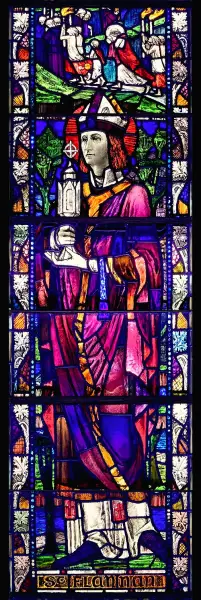
Overview
Flannán mac Toirrdelbaig, in Latin Flannanus, was an Irish churchman of the seventh century whose activity is placed around the year 640. He was the son of Toirdhealbhach, a chieftain of the Dál gCais, the kindred that dominated Thomond in the west of Munster, and he turned from that noble inheritance to the monastic school of Mo Lua at Killaloe on the River Shannon. There he is believed to have risen to the office of abbot, and tradition remembers him above all as a powerful preacher. In the course of his life he undertook the pilgrimage to Rome that Irish ecclesiastics made when they sought sanction for a mission, and there Pope John IV consecrated him as first bishop of the see of Killaloe, of which he remains the patron saint. Tradition also extends his preaching beyond Ireland to the Hebrides. He died, by the general account, at Killaloe itself. His feast is kept on December 18 in both the Roman Catholic and Eastern Orthodox churches, and his name remains fixed to the places of his ministry — in St. Flannan's College at Killaloe and in the Flannan Isles that carry it out to sea.
The Complete Life
A Chieftain's Son
Flannán was born into the ruling circle of the Dál gCais, the north Munster kindred from which some of the most powerful dynasties of later Irish history would spring. His father, Toirdhealbhach, was a chieftain of that people, and by the custom of the age the son could have expected a career of cattle raiding, alliance, and lordship in Thomond. Instead the sources place him, while still a young man, in the monastery founded by Mo Lua at Killaloe, a monastic settlement on a bend of the Shannon whose school drew the sons of the provincial nobility into the Church. The choice was a familiar one in early Ireland, where the great monastic families and the great dynasties were often branches of the same lineages, but it was never a small one: it meant the surrender of a chief's inheritance to a lifetime of psalmody, study, and obedience. The learned tradition that collected his story, beginning with Ware's survey of Irish writers in 1639, dated his maturity to the middle of the seventh century, and the chronology of his later career — his Roman pilgrimage and consecration by John IV — fits within those same decades.
§ Introduction
The Monastery at Killaloe
At Killaloe Flannán passed from the world of the chieftains into the discipline of Mo Lua's foundation, and there, the tradition believes, he rose to govern it as abbot. The abbacy of an Irish monastery was an office of real weight: the abbot was often the superior of daughter houses, the master of a school, the arbiter of disputes, and the voice of the community before kings. That the sources are content to say of Flannán only that he is 'believed' to have held the office shows how thin the documentation is, but the belief is old and continuous, and it explains what follows. A man trained in that monastery, marked by its rule and learning, was exactly the candidate the west of Ireland would send to Rome when the time came to order its episcopal life. His reputation in the tradition rests on a particular gift: he is remembered as a great preacher, one whose sermons drew and held the hearers of the Shannon country. Preaching was the public work of the Irish monk, the point where cloister and countryside met, and in Flannán's case it became the bridge from the abbey at Killaloe to the episcopate.
§ Introduction
Rome, Consecration, and the Hebrides
The decisive journey of Flannán's life was the pilgrimage to Rome. Irish churchmen crossed to the continent and to the apostolic see for many reasons — to study, to settle disciplinary questions, and above all to obtain confirmation for the foundation and governance of bishoprics at home — and Flannán made the journey that ended in his consecration by Pope John IV as first bishop of the see of Killaloe. The act bound the young church of Thomond to the church of Rome and gave the monastery's daughter region its own ordinary, with Flannán himself as the living link between the Shannon and the Tiber. His ministry was not confined to his own diocese. Tradition sends him to preach in the Hebrides, the island chain off western Scotland where Irish monks had long planted the faith, and the detail recalls the missionary reach of the seventh-century Irish Church, whose wandering preachers carried the gospel across seas that Rome's own missionaries rarely crossed. Preacher, abbot, and bishop in one, Flannán embodied the layered ministry of the early Irish Church, in which the same man might govern a monastery, feed a diocese, and evangelize islands all within a single lifetime.
§ Introduction
Return to Killaloe
The tradition closes Flannán's life where it had opened it, at Killaloe. He died there, in the town on the Shannon that held his monastery and his see, and his death is placed by the sources only loosely within the seventh and eighth centuries — a sign of how far legend and chronology had already fused by the time his cult was written down. What the record preserves without ambiguity is the attachment of the place to his memory: he was honored as the patron saint of Killaloe, the diocese he had been consecrated to lead, and his feast was fixed on December 18, the day still observed in the Roman Catholic and Eastern Orthodox calendars. For the church of the Shannon, the saint bishop was a founding figure of the same kind that other Irish sees claimed in their own first abbots and bishops: the man who had carried the faith to them, ordered their church, and left his name on the place. The medieval diocese and its modern successors, Catholic and Anglican alike, stand in the succession that began with his consecration in Rome.
§ Introduction
A Name on the Map
Few Irish saints of the early period have left their name on the landscape so plainly as Flannán. At Killaloe, St. Flannan's College keeps his memory in the town of his monastery and his see, and the Roman Catholic Diocese of Killaloe, together with its Church of Ireland counterpart in the united diocese of Limerick and Killaloe, traces its episcopal origin to his consecration. Far from the Shannon, the Flannan Isles — a remote island group off the Irish coast — carry his dedication out into the Atlantic, a standing witness to the reach of his cult along the western seaboard where his preaching in the Hebrides was remembered. In the learned tradition his name entered the historiography of Ireland early: Ware included him in his seventeenth-century survey of Irish writers, and the Catholic directories of the modern era have kept his feast in their calendars. The Dalcassian kindred that produced him counted him among its own notables, listed in the genealogical compilations of the sept alongside the kings and abbots of Thomond. He remains, in the compact formula of the sources, the son of Toirdhealbhach, the abbot of Killaloe, and the first bishop in the succession of that see.
§ Introduction
The Record
- Patron of
- Patron saint of Killaloe·Roman Catholic Diocese of Killaloe
- Symbols
- Bishop's crozier·Abbot's habit
- Canonization
- Pre-congregation; venerated by long custom in the Roman Catholic and Eastern Orthodox churches
Prayer
Bibliography
Show 3 sources
- Ware, James (1639). "Cap. XIII: De biographis ætatis incertæ". De scriptoribvs Hiberniæ (in Latin). Vol. Liber primus. Dublin: Societatis Bibliopolarum. p. 91.
- "St. Flannan - Saints & Angels". Catholic Online. Retrieved 2 August 2021.
- "Saint Flannan". Library Ireland. Retrieved 9 August 2020.
Profile text adapted from the Wikipedia article, licensed CC BY-SA 4.0.
Pray with this saint every day
Save St. Flannan to your favorites, read the full profile, and get feast-day reminders in the Saints app.
Get the Saints AppFree on the App Store for iPhone and iPad