
died c. 96·Feast May 7 (Catholic); May 12 (Orthodox)
St. Flavia Domitilla
Noblewoman of the Imperial Flavian House and Martyr (1st century)
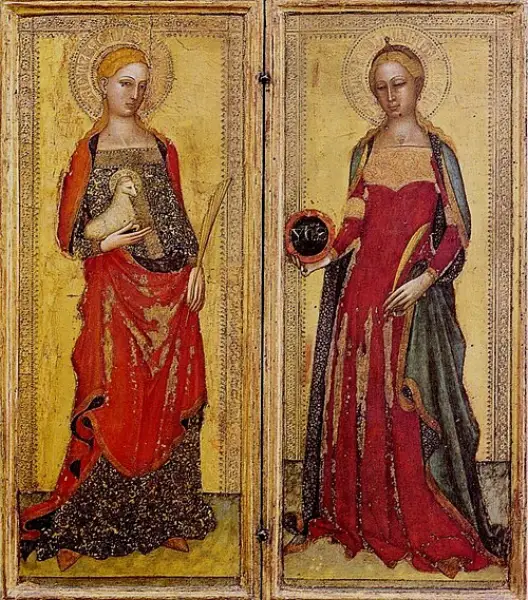
Overview
Flavia Domitilla belonged to the very summit of Roman society: granddaughter of the emperor Vespasian, niece of Titus and Domitian, and wife of her second cousin Titus Flavius Clemens, consul in 95 and a grand-nephew of Vespasian. An inscription records that she bore Clemens seven children, two of whom Domitian renamed Vespasian and Domitian when he marked them out as his successors. That favor curdled quickly. In 96 Domitian suddenly put Clemens to death on a charge that Cassius Dio describes as sacrilege or godlessness, brought against many who had drifted toward Jewish ways, and banished Domitilla to the island of Pandateria. Christian memory told the story differently and more nobly. Eusebius, citing the earlier writer Brutius, records that a Flavia Domitilla suffered banishment to the island of Pontia on account of her confession of Christ, and Jerome, writing on Saint Paula's pilgrimage, points out the cells where that illustrious lady endured her long martyrdom. The sources do not entirely agree on whether the exiled wife, the exiled niece, and the venerated saint were one woman or two cousins of the same name. What the Church kept was the substance: a woman of the imperial house who lost position, husband and freedom rather than deny Christ, honored by both Catholic and Orthodox liturgies.
The Complete Life
The Flavian Princess
Flavia Domitilla belonged to the very summit of Roman society: she was a granddaughter of the emperor Vespasian, daughter of Domitilla the Younger — perhaps by Quintus Petillius Cerialis — and a niece of the emperors Titus and Domitian. She became the wife of a second cousin, Titus Flavius Clemens, himself a grand-nephew of Vespasian by way of his father Titus Flavius Sabinus. An inscription of the period records her as the mother of seven children by Clemens, who were thereby grandnephews and grandnieces of Domitian. Suetonius, a writer of the same era, states that Domitian designated two of her very young sons as his successors, changing their names to Domitian and Vespasian; Quintilian mentions that the emperor entrusted him with the tutelage of the two boys. She stood, in the mid-90s, at the center of the Flavian succession: her husband consul in 95, her sons the named heirs of the last Flavian emperor.
§ Introduction
Catastrophe of 96
That favor curdled with suspicious speed. In 96 Domitian had Clemens put to death abruptly and on the flimsiest of pretexts, almost before his consulship had run its course, as Suetonius tells it. Cassius Dio describes the charge as sacrilege or godlessness, brought against many who had drifted toward Jewish ways — a description that Christian tradition read as a veiled account of conversion, whether to Judaism or to Christ. Domitilla herself was banished, Suetonius says, to the island of Pandateria. Domitian was assassinated the same year, but the banishment was not reversed. Christian memory told the story differently and more nobly: Eusebius, citing the earlier writer Brutius, records that a Flavia Domitilla suffered banishment to the island of Pontia on account of her confession of Christ, and Jerome, in his letter on Saint Paula's pilgrimage a generation later, points out to her the cells where that illustrious lady endured her long martyrdom of exile.
§ Christian
The Ancient Cult
The sources do not entirely agree on whether the exiled wife of Clemens, the exiled niece of Domitian banished to Pandateria, and the venerated Christian confessor of Pontia were one woman or two — or even three, for some traditions add another Domitilla altogether. The Roman martyrology tradition honored her as a saint and martyr of the Flavian house, and her cult is pre-congregation, reaching back through Jerome and Eusebius to the church of the second century. She is commemorated on 7 May in the West and 12 May in the Orthodox East. Modern scholarship tends to distinguish the historical noblewoman from the hagiographic consolidation, while acknowledging that something real lies behind the tradition: the destruction of a great Christian-leaning family at the hands of Domitian.
§ Christian
Legacy
Flavia Domitilla's legacy is the earliest joining of imperial blood to Christian suffering. Whatever the exact identity of the confessor, the tradition that a granddaughter of Vespasian was banished for the name of Christ fixed in Christian memory the truth that the gospel had reached the palace itself within two generations of the apostles. Her islands — Pandateria and Pontia, the small volcanic prisons off the coast of Naples — became by her association and that of other exiled women a kind of martyrs' island, visited by pilgrims from Paula's day to our own. She remains a reminder that the first persecutions cut across all ranks of Roman society.
§ Christian
Timeline
- 95
Eusebius records that in the fifteenth year of Domitian she was exiled to Pontia for her testimony to Christ.
§ Christian
- 96
Cassius Dio reports Domitian killed her husband Clemens and banished her to Pandateria for drifting into Jewish ways.
§ Banishment
- 96
Eusebius, citing Brutius, places many martyrs under Domitian, with Domitilla banished to Pontia for confessing herself a Christian.
§ Christian
- 18 Sep 96
Her steward Stephanus took part in the assassination of Emperor Domitian, according to Suetonius.
§ Banishment
- 404
Jerome writes that Saint Paula, landing at Pontia, saw the cells of Domitilla's long exile and yearned for the Holy Land.
§ Christian
- 800
The ninth-century martyrology of Florus of Lyon first lists her as a saint, fixing her feast on 7 May.
§ Liturgy
- 1595
Caesar Baronius had Domitilla's name added to the General Roman Calendar alongside Nereus and Achilleus.
§ Liturgy
- 1597
Cardinal Baronius arranged with great solemnity the translation of her relics and those of Nereus and Achilleus.
§ Liturgy
- 1969
Her name was removed from the General Roman Calendar because her liturgical cult lacked a basis in Roman tradition.
§ Liturgy
- 2001
The revised Roman Martyrology kept a 7 May commemoration of her banishment to Pontia and martyrdom under Domitian.
§ Liturgy
The Record
- Symbols
- Palm of martyrdom·Imperial diadem laid aside
- Canonization
- Pre-congregation (ancient cult, commemorated by Eusebius and Jerome)
Prayer
Bibliography
Show 1 sources
Profile text adapted from the Wikipedia article, licensed CC BY-SA 4.0.
Pray with this saint every day
Save St. Flavia Domitilla to your favorites, read the full profile, and get feast-day reminders in the Saints app.
Get the Saints AppFree on the App Store for iPhone and iPad