
died 449·Feast February 18
St. Flavian of Constantinople
Archbishop of Constantinople and Martyr of the Robber Synod
Overview
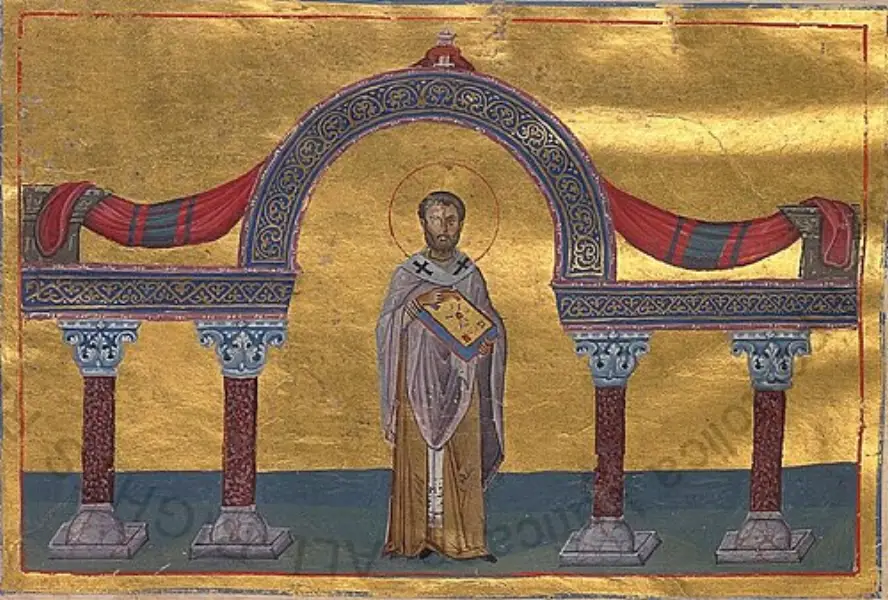
Flavian was archbishop of Constantinople from 446 until his death on August 11, 449, and is honored as a saint and martyr by the Eastern Orthodox and Catholic churches. A presbyter of the Great Church and keeper of its sacred vessels, he was noted — in the notice of Nikephoros Kallistos Xanthopoulos — for the holiness of his life when he was chosen to succeed Proclus. At his consecration the court eunuch Chrysaphius demanded a gift of gold for Emperor Theodosius II; refused, he turned against the new archbishop and threw his patronage to the archimandrite Eutyches, then at odds with Flavian over doctrine. At a synod of forty bishops held at Constantinople on November 8, 448, Flavian received Eusebius of Dorylaeum's indictment of Eutyches and presided over the old monk's deposition. Eutyches appealed to Dioscorus of Alexandria, and Theodosius, still resentful over the refused bribe, summoned a council to Ephesus that opened on August 8, 449. There Eutyches was declared orthodox and restored, while Flavian was anathematized, deposed, and ordered into exile; set upon by monks of Barsauma's band, he was beaten and trampled. He died of his injuries three days later at Epipus in Lydia and was buried without ceremony. Pope Leo protested, calling the assembly a robber synod; in 451 the Council of Chalcedon condemned Eutyches, ratified Leo's Tome, and enrolled Flavian among the martyrs.
The Complete Life
A Presbyter of the Great Church
Nothing is recorded of Flavian's origin or upbringing; he enters history as a presbyter of the Great Church of Constantinople, entrusted with the guardianship of its sacred vessels — an office of trust within the imperial capital's principal shrine, and one that brought its holder into daily contact with the liturgy, the clergy, and the court that attended it. The Byzantine historian Nikephoros Kallistos Xanthopoulos preserves the reputation he had earned by that service: he was said to lead a saintly life. Reputation of that kind mattered in the Constantinopolitan church of the 440s. When Archbishop Proclus died in 446, the choice of a successor fell on this unblemished presbyter rather than on any of the courtiers of the imperial city, and Flavian was elevated from keeper of the vessels to occupant of the second see of Christendom. The election signaled the clergy's confidence in his character, but it also placed a man of no political experience before the most dangerous court in the world — the court of Theodosius II, where eunuchs managed the emperor's conscience and sold access to his favor. Flavian's sanctity, his one credential, would prove in the coming three years both his strength and his sentence.
§ Consecration as archbishop and imperial dispute
Gold Refused
The quarrel that would cost Flavian his life began at his own consecration. Emperor Theodosius II was staying across the strait at Chalcedon when the new archbishop was installed, and on the emperor's behalf his eunuch Chrysaphius sent to demand the customary present of gold — in substance, a bribe for the imperial favor that had allowed the election. Flavian refused to pay it. The refusal was an assertion that the church of the capital was not a fief of the palace, and Chrysaphius, rebuffed, resolved to destroy the man who had made it. He found his instrument already at hand: the archimandrite Eutyches, an influential and aged monk, head of a house outside the walls, who was then locked in a doctrinal dispute with the archbishop over the natures of Christ. The eunuch threw the court's patronage behind Eutyches, and from that moment the theological quarrel became a political one, with the emperor's favorite backing the monk against the patriarch. Flavian thus began his brief episcopate in the worst possible position for a man of scrupulous conscience — hated by power, opposed by a popular ascetic, and required to be both pastor and defendant at once.
§ Consecration as archbishop and imperial dispute
The Synod of November 448
Flavian met the crisis with procedure rather than polemic. On November 8, 448, he presided at a council of forty bishops in Constantinople, convened to settle a dispute between the metropolitan of Sardis and two bishops answerable to him; into that routine agenda came Eusebius of Dorylaeum, a layman-turned-bishop of sharp mind, who presented a formal indictment of Eutyches for heresy. The archbishop allowed the case to be heard, and his own closing speech has survived — a measured appeal that Eutyches be examined personally and given the chance to answer for himself before the holy assembly. The synod deliberated, and in the end it deposed Eutyches. Judgment, however, only escalated the war. Eutyches protested the verdict, fled for support to Alexandria, and found in Pope Dioscorus a champion of his teaching; Chrysaphius, working on an emperor already angered by the refused bribe, persuaded Theodosius to summon a new council at Ephesus to review the case. Before that gathering met, Flavian also took care to inform the West: he wrote a letter to Pope Leo, which the papal legate Hilarius — himself a future pope — carried to Rome only after escaping Ephesus with great difficulty. The letter would become the hinge of Flavian's vindication.
§ Home Synod of Constantinople
Ephesus and the Beating
The council that opened at Ephesus on August 8, 449, was choreographed to reverse the synod of 448. Under Dioscorus's presidency Eutyches emerged as a teacher of sound doctrine and was restored to communion, while Flavian was anathematized, stripped of his see, and sentenced to banishment. When the condemnation was read, violence broke out in the church: the bishops opposed to Eutyches's Monophysitism were assaulted, and Flavian's supporters who rushed to appeal to Dioscorus were driven back by imperial counts and soldiers led by the proconsul. Flavian himself took refuge in the sacristy, where he was held under guard, and there, beaten and kicked and trampled by monks of Barsauma's band, he received the injuries that killed him. He succumbed three days later at Epipus in Lydia and was buried obscurely. The exact circumstances were contested from the first: Flavian's own letter to Leo mentions soldiers with drawn swords but no physical assault, while the earliest account, Nestorius's, holds that he was beaten but not mortally, and died from his injuries and the hardship of the forced journey to exile at Hypaepa. At Chalcedon two years later, eyewitnesses gave conflicting testimony — several blaming Dioscorus directly — and modern historians such as Price and Gaddis warn that the witnesses had every reason to shift the guilt onto him.
§ Death and martyrdom
From Robber Synod to Chalcedon
Pope Leo I, whose legates had been ignored at Ephesus, protested at once: he branded the assembly a robber synod and swept its decisions aside — the first act in the undoing of everything Flavian had suffered. Politics turned within a year. Theodosius II died in 450; power passed to his sister Pulcheria, now wed to the officer Marcian, and the new imperial couple ordered Flavian's remains brought back to Constantinople in a procession that a chronicler said resembled a triumph more than a funeral. In 451 the Council of Chalcedon condemned Eutyches, confirmed Leo's Tome, and enrolled Flavian among the martyrs — the formal canonization of the archbishop the robber synod had deposed. His cult settled into both East and West: the Eastern Orthodox and Catholic churches venerate him as a saint and martyr, the Roman Martyrology assigns his commemoration to February 18, and his relics have been honored in Italy. A curious footnote ties his memory to another see: Flavian of Ricina, a third-century bishop-martyr of Picenum, is sometimes identified with him, an indication of how the fame of the Constantinopolitan confessor could be folded into local Italian traditions. The synod he called in 448 stands, in retrospect, as the first act of the drama that ended at Chalcedon.
§ Aftermath
Timeline
- 446
Chosen to succeed Proclus as archbishop of Constantinople; refuses Chrysaphius's demand for gold
§ Consecration as archbishop and imperial dispute
- 8 Nov 448
Presides at the home synod of forty bishops at which Eusebius of Dorylaeum's indictment leads to Eutyches's deposition
§ Home Synod of Constantinople
- 8 Aug 449
The council assembled at Ephesus reinstates Eutyches, anathematizes Flavian, and orders him into exile
§ Second Council of Ephesus
- 11 Aug 449
Beaten at Ephesus by monks of Barsauma's band; dies of his injuries at Epipus in Lydia
§ Death and martyrdom
- 450
Theodosius II dies; Pulcheria and Marcian take power and have Flavian's remains brought back to Constantinople
§ Aftermath
- 451
The Council of Chalcedon condemns Eutyches, confirms Leo's Tome, and honors Flavian as a martyr
§ Aftermath
In Their Own Words
Let your reverence condescend to visit him and argue with him about the true faith, and if he shall be found in very truth to err, then he shall be called to our holy assembly and shall answer for himself
The Record
- Major works
- Closing address to the Home Synod of Constantinople (448), whose final appeal survives·Last letter to Pope Leo I, carried to Rome by the legate Hilarius
- Symbols
- Patriarchal vestments
- Canonization
- Canonized in 451 by the Council of Chalcedon, which honored him as a martyr
Prayer
Bibliography
Show 6 sources
- Rudge, F.M. "St. Flavian", Catholic Encyclopedia Vol. 6, New York, 1909, 6 February 2019.
- "Saint Flavian the Confessor, Patriarch of Constantinople". www.oca.org.
- "Memory of Saint Flavian, Patriarch of Constantinople". orthodoxtimes.com. Orthodox Times. Retrieved 10 May 2024.
- Chadwick, Henry (1955). The Exile and Death of Flavian of Constantinople: A Prologue to the Council of Chalcedon. Oxford Publishing Limited (England).
- Price, Richard; Gaddis, Michael (2007). The Acts of the Council of Chalcedon. Liverpool University Press. ISBN 978-1-84631-100-0.
- Meyendorff, John (1989). Imperial unity and Christian divisions - The Church 450–680 AD. The Church in history. Vol. 2. Crestwood, NY: Saint Vladimir's Seminary Press. ISBN 978-0-88-141056-3.
Profile text adapted from the Wikipedia article, licensed CC BY-SA 4.0.
Pray with this saint every day
Save St. Flavian of Constantinople to your favorites, read the full profile, and get feast-day reminders in the Saints app.
Get the Saints AppFree on the App Store for iPhone and iPad