
died 3rd century·Feast November 24
St. Flavian of Ricina
Early Bishop and Martyr of the Marche
Overview
Flavian of Ricina is venerated by the Catholic Church as a martyr and bishop of the third century, traditionally the bishop of Helvia Ricina, a Roman town of Picenum near the modern Macerata. The historical record on him is meager: his cult is ancient and spread widely through the Marche and Umbria, where many churches and abbeys bear his dedication, yet the facts of his life rest on a handful of details and pious traditions. He is said to have suffered martyrdom on November 24. Some writers identify him with Flavian of Constantinople, the archbishop killed in 449, though the two traditions are distinct. His memory took root in the institutions of his region: a fourth-century successor in the see, Saint Claudius, fixed the date of his feast and built a church in his honor; when Gothic destruction emptied Ricina in the fifth and sixth centuries, its refugees carried his cult to Recanati, while other groups bore his relics toward Tolentino, where the Benedictine abbey of Rambona still venerates them. A plague that struck Recanati in 1483 revived his feast there, marked by a solemn procession and a panegyric from the scholar Bonfini. He is patron of Conversano and of Recanati.
The Complete Life
Bishop of a Vanished Town
The tradition that has reached us assigns Flavian to the episcopal throne of Helvia Ricina, a Roman municipium in the Picene hill country whose remains lie near the modern city of Macerata, in the third century. Of his family, his formation, and his years as bishop the sources preserve nothing; he belongs to that generation of Italian bishops whose exploits, if they were ever written, were lost before the medieval revival, and whose memory survived only in the devotion of the communities they had served. What the tradition does fix is the manner of his end: he was martyred, it says, on November 24 — a date precise enough to suggest an old local calendar behind it, though the year and the circumstances of his death are unknown. Some later writers, struck by the shared name and shared martyrdom, have identified him with Flavian of Constantinople, the archbishop beaten to death at Ephesus in 449; the identification remains a conjecture, and the two cults kept separate feasts and separate geographies. What is certain is the antiquity of the veneration: his cult was already ancient, and spread widely across the Marche and Umbria, when the first documents that mention it were written.
§ Introduction
Martyrdom and First Memorial
The first act of remembrance on record belongs to the century after his death. Saint Claudius, honored himself as a saint and counted among Flavian's successors in the see of Ricina, fixed the date of his predecessor's feast and built a church in his honor — a double act that presupposed an organized local cult, complete with a calendar and a place of gathering, within roughly a hundred years of the martyrdom. The church of Ricina thus became the first center of the saint's veneration, and it held that position until the town itself disappeared. In the fifth and sixth centuries the Gothic wars destroyed Ricina, and its inhabitants emigrated; the tradition records that they settled at Recanati, on the Adriatic side of the hills, and that the transfer of population carried Flavian's cult with them. Other groups of refugees took a different road, moving toward Tolentino and bearing the relics of the saint with them; on the way they raised an oratory in his honor on a site that local memory associated, perhaps, with an older pagan shrine. From those two currents of displacement — one carrying the memory, one carrying the bones — the later geography of the cult was fixed.
§ Veneration
Rambona, Recanati, and the Relics
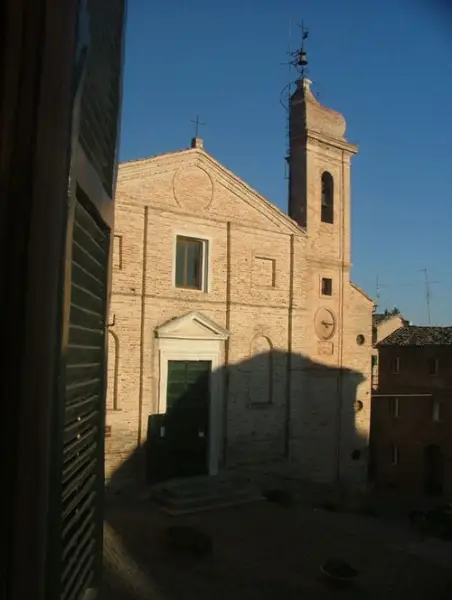
On the site of the refugees' oratory the Benedictines eventually raised Rambona Abbey, which preserves Flavian's relics to this day as the major shrine of his cult. The authenticity of those relics, however, has long been debated: the sarcophagus that purports to hold them dates from the fourth century, and Antonio Borelli observed that this casts doubt on remains said to have been carried there — by the tradition's own account — two centuries later. One explanation holds that the relics were never brought from Ricina at all but were already venerated at Rambona when the refugees arrived; another, that the bones belong to a different saint altogether, Amicus, the abbot of Rambona. The cult at Recanati followed its own fortunes: it had nearly died out by the fifteenth century, then flared back to life when plague struck the city in 1483. A solemn procession was held in the saint's honor that November, and Bonfini, the learned man from Ascoli Piceno, composed a panegyric for the occasion — the first literary monument to the saint since late antiquity. Recanati built a cathedral under his patronage in 1804, and he is honored as patron both of that city and of Conversano in Apulia.
§ Veneration
Timeline
- 24 Nov 201
Tradition holds that this third-century bishop of Helvia Ricina, near modern Macerata, is martyred on November 24.
§ Introduction
- 301
Saint Claudius, a fourth-century successor in the see of Ricina, fixes the date of Flavian's feast and builds a church dedicated to him.
§ Veneration
- 301
The sarcophagus purported to carry his relics is carved; its fourth-century date casts doubt, as Antonio Borelli notes, on relics tradition says arrived two centuries later.
§ Veneration
- 401
Ricina is destroyed by the Goths in the fifth and sixth centuries; refugees spread his cult to Recanati, and others carry his relics toward Tolentino, raising an oratory that becomes Rambona Abbey.
§ Veneration
- Nov 1483
After plague strikes Recanati, a procession is held in his honor and Father Bonfini writes a panegyric in his praise.
§ Veneration
- 1804
Recanati Cathedral, dedicated to San Flaviano, is built.
§ Veneration
The Record
- Patron of
- Conversano·Recanati
- Symbols
- Bishop's vestments·Martyr's palm
- Canonization
- Pre-congregation; venerated as a martyr and bishop from antiquity in the Catholic Church
Prayer
Bibliography
Profile text adapted from the Wikipedia article, licensed CC BY-SA 4.0.
Pray with this saint every day
Save St. Flavian of Ricina to your favorites, read the full profile, and get feast-day reminders in the Saints app.
Get the Saints AppFree on the App Store for iPhone and iPad