
c. 1300 – 1347·Feast October 5
St. Flora of Beaulieu
Hospitaller nun and Eucharistic mystic of Quercy
Overview
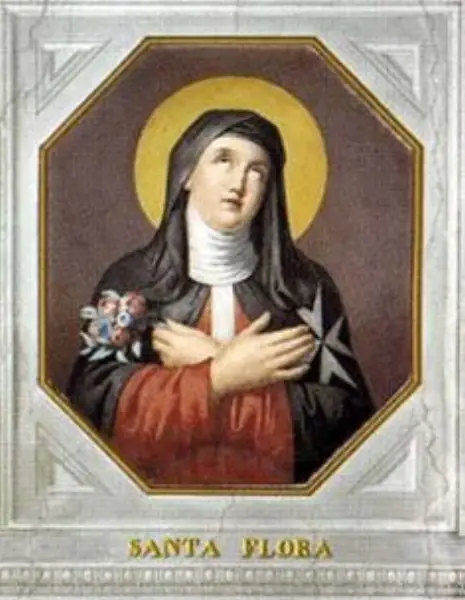
Fleur of Issendolus, known in French as Fleur or Flore and in English as Flora of Beaulieu, was a French sister of the Order of Saint John of Jerusalem, professed at the Beaulieu hospital within Saint-Julien d'Issendolus parish, in what was once the province of Quercy. Born at Maurs in Auvergne around 1300 to a noble family, she refused the marriage arranged by her kin and entered religious life, reportedly at about the age of fourteen, eventually joining the Hospitaller sisters at Beaulieu, where she is attested by at least 1327. The medieval dossier depicts a visionary whose Eucharistic devotion took its shape from the Passion of Christ, marked by daily confession, ecstasies during Mass, and bodily identification with the sufferings of the crucified Lord. Though later devotional writers associated her with the care of the sick, her documented sanctity is contemplative rather than active. She died at Beaulieu in 1347. Over a hundred wonders came to be credited to her intercession; her grave drew regional pilgrims for close to a hundred years, women above all. Her cult, attested by the late fourteenth century, received formal recognition from the Catholic Church only in 1852, when Pope Pius IX approved her veneration with a feast on October 5.
The Complete Life
A Noble Childhood in Auvergne
According to her medieval life, Fleur was born at Maurs, a town in what is now the department of Cantal, to parents named Pons and Melhors, whom the vita describes as noble. The family was large: ten children, three sons and seven daughters, and four of the daughters eventually became religious women of the Order of Saint John at Beaulieu. Later devotional tradition supplied surnames, identifying the father as Pons de Corbie and the mother as Melhors de Merle, but modern scholars treat these genealogical details with caution, since the medieval text itself records only first names and the place of birth. Her date of birth is likewise uncertain; traditional accounts propose around 1300 or 1309, calculations that rest on later assumptions about her age at death rather than on contemporary evidence. The vita portrays a childhood already oriented toward God. Fleur avoided games and frivolous conversation, stayed close to her devout mother, and learned to read so that she could recite the Hours. When her father and relatives arranged a marriage for her, she refused it. Hagiographic tradition holds that she entered religious life at about fourteen, a step that set the whole course of her existence within the Hospitaller order.
§ Life
The Hospital of Beaulieu
Fleur professed herself among the sisters of the Order of Saint John of Jerusalem at the Beaulieu hospital, in Cahors diocese, within Saint-Julien d'Issendolus parish. Pilgrims making their way from Figeac to Rocamadour passed by the house, though the Hospitallers had not been its first owners: Guibert de Thémines together with his wife Aigline had founded it, most likely in the 1230s, and the Order received it in 1259. In 1298 the grand master Guillaume de Villaret granted the community statutes that fixed the maximum number of professed sisters at thirty-nine and listed thirty-five then living there, making Beaulieu one of the most significant houses of Hospitaller women in medieval France. Although later Catholic sources associate Fleur with the nursing of the sick and the welcome of pilgrims, the surviving dossier does not actually depict her engaged in such active work; her documented life is one of liturgy, sacrament, and contemplation. Her earliest years there tested her spiritually: the opulence of the establishment disturbed her conscience, since she doubted that such plenty could sit beside the poverty she had vowed, until a spiritual adviser convinced her that its resources might aid souls still unsteady in their loving of God. Severe temptations followed, and her weeping and ecstasies led some of the sisters, and visiting religious, to judge her mad.
§ Life
A Saint for a Wounded Quercy
Whatever her earthly mission may have been, Fleur's most visible work was accomplished after her death, through the pilgrimage that gathered at her tomb at Hôpital-Beaulieu. The collection of her miracles, edited by Clovis Brunel in 1946, contains 109 numbered articles and records roughly a century of devotion. The accounts enumerate 69 unambiguous cures, 6 deliveries free of danger, 2 conceptions bestowed on women who had wanted children, and a single rescue from spiritual affliction. She was invoked for fevers, paralysis, wounds, fractures, blindness, deafness, muteness, epilepsy and difficult births. Yet the collection answers to more than illness. About fifteen miracles concern the misery inflicted by English soldiers and armed bands during the Hundred Years' War: pillage, capture, ransom, devastated property and threatened strongholds. Her cult thus became a refuge for a rural society living under the insecurity of war. Its beneficiaries were disproportionately women, especially in matters of pregnancy and childbirth, though nobles, religious, and benefactors of the Hospital also appear. Geographically the devotion centered on Beaulieu itself and the country within ten kilometers, extending along the Figeac-Rocamadour route to Gourdon, Loubressac, Figeac and beyond, with distant cases recorded from Cahors, Montpellier, Limoges and Gascony.
§ Miracles and cult
Visionary and Eucharistic Mystic
The life of Fleur combines the classic motifs of hagiography — noble birth, refused marriage, virginity, humility, obedience, abstinence, love of the divine office — with the affective spirituality of the later Middle Ages, marked by Franciscan inspiration: poverty, penance, and meditation on the Passion. The life relates that the Christ of the wounds showed himself to her for roughly a quarter of a year under the likeness of the angel painted beneath the cloister roof, and her suffering was inward: the crucified Lord and his cross, it seemed, dwelt within her; she felt the cross driven through her frame, with pain settling in her right side, her hands and her feet, above all on Fridays and through Holy Week. Her devotion was rooted in the Eucharist. She approached confession each day, sometimes passing into ecstasy once absolution or communion had been given; as the Eucharistic prayer opened she perceived her heavenly king drawing near, and once she had received, two sisters frequently had to guide her back to her stall. Her visions followed the liturgical year, from Christmas and Candlemas to Easter, Pentecost and the feasts of Our Lady and Saint Cecilia. Her life was organized around seven devotional themes, from confession and the altar to the longing for heaven, and her experience was described in intensely sensory language of sweetness, melody, perfume and light, with symbolic visions of a sword, a golden cup, a tree spanning earth and heaven, an eagle cross-shaped in flight, and a brilliant stone revealing the orders of angels and the elect.
§ Spirituality
Death and the Fate of Her Relics
Fleur died at Hôpital-Beaulieu in 1347, after at least twenty years in the monastery. Neither the precise day nor the circumstances of her death have survived, and this very obscurity bred confusion in later writers: several devotional accounts gave June 11 as the day of her death, when that date in fact belongs to something else entirely, when her remains were carried in 1360 to the church of Saint-Julien at Issendolus. There they rested while the pilgrimage at her tomb flourished through the last third of the century and beyond. Her remains met a violent end in the modern era: in 1793 revolutionaries put the hospital to the torch, profaning her remains in the flames. The faithful saved her skull and one tibia, and in 1866 the bishop of Cahors saw them installed in the church of Issendolus, restoring the saint to the village whose name she carries. Her relics are kept in an ostensorium-shaped reliquary of gilt metal and glass, made at the turn of the twentieth century, which stands in the parish church of Saint-Julien and received formal protection from the French state in 1984. Her final years thus close not in obscurity but in a continuing, tangible presence among the people of Quercy.
§ Miracles and cult
Recognition of the Cult
Fleur's veneration began locally and immediately: devotion to her is attested from the close of the fourteenth century, fed by the Beaulieu pilgrimage and by the miracle book gathered at her grave. Formal recognition by the Catholic Church, however, came only in the nineteenth century. In 1852 veneration of her received the approval of Pope Pius IX, and entry in the Roman Martyrology followed, with October 5 as her feast. Her case proceeded as a confirmation of veneration — a de confirmatione cultus — the form appropriate to an ancient devotion rather than a modern canonical process, resting on the hagiographic tradition carried in the Acta Sanctorum and on the unbroken devotion of Issendolus and Maurs. Her feast on October 5 keeps her among the virgin saints of the Catholic Church, with particular commemoration at Issendolus and Maurs and among those who remember the Hospitaller sisters of Beaulieu. The recognition of 1852 thereby ratified what the miracle collection had recorded five centuries earlier: that a contemplative nun, known in life partly for being judged mad by her own community, had become for the people of Quercy a refuge in sickness, childbirth and war, and a figure of enduring intercession for the Church of the diocese of Cahors.
§ Miracles and cult
The Textual Tradition and Modern Memory
Fleur is known to history through a medieval hagiographic dossier: her life together with her book of wonders. The Latin vita, by tradition the work of her unnamed confessor, has perished; the text survives in a fifteenth-century Occitan version titled Vida e miracles de sancta Flor. The earliest printed account appeared in the work of the Hospitaller historian Giacomo Bosio, from which Jean Baudoin published a French adaptation in 1631, with an engraving of the saint. In 1667 Jean-François de Doat transcribed the Occitan text, now kept at the Bibliothèque nationale de France; the Bollandists worked from a loose Latin recasting made by Hugues Amadieu, priest of Saint-Urcisse in Cahors, printed in the Acta Sanctorum. Modern scholarship recovered the saint's authentic profile only gradually: Clovis Brunel edited the Occitan text in 1946, reviewed by Jacques Monfrin in 1948, and Francesca Gambino published a critical edition with notes and glossary in 2008. Even once Brunel's edition existed, popular retellings went on recycling unverified legends, mistakes of chronology and invented genealogies. Today her legacy lives in the reliquary at Issendolus, in the scholarship that has restored her as one of the few medieval female saints of the Order of Saint John, and in local devotion at Issendolus and Maurs, which preserves the remembrance of the Beaulieu sisters of the Hospital.
§ Name and sources
Timeline
- 1230
Guibert de Thémines and his wife Aigline found the hospital of Beaulieu, probably during this decade.
§ Life
- 1259
The house of Beaulieu is handed over to the Order of Saint John of Jerusalem.
§ Life
- 1298
Grand master Guillaume de Villaret grants statutes to Beaulieu, capping the community at thirty-nine nuns.
§ Life
- 1300
Traditional accounts place Fleur's birth at Maurs in Auvergne, to the noble couple Pons and Melhors.
§ Life
- 1327
Her recorded years in religion show Fleur was at Hôpital-Beaulieu by this date, though she may have entered earlier.
§ Life
- 1347
Fleur dies at the Beaulieu hospital; when exactly, and in what circumstances, is nowhere recorded.
§ Life
- 11 Jun 1360
Her relics are translated to the church of Saint-Julien d'Issendolus, a date later writers mistook for her death day.
§ Miracles and cult
- 1631
Jean Baudoin publishes a French adaptation of Bosio's collection of Hospitaller saints' lives, including Saint Flora.
§ Name and sources
- 1667
Jean-François de Doat copies the Occitan Vida e miracles de sancta Flor together with a French translation.
§ Name and sources
- 1715
Hugues Amadieu's free Latin rearrangement of her life appears in the Acta Sanctorum materials used by the Bollandists.
§ Name and sources
- 1793
Revolutionary flames consume the hospital and her relics; a skull and a shinbone are saved from the blaze.
§ Miracles and cult
- 1852
Pope Pius IX approves her veneration and she is inscribed in the Roman Martyrology with a feast on 5 October.
§ Miracles and cult
- 1866
The Bishop of Cahors has her rescued skull and tibia placed in the church of Issendolus.
§ Miracles and cult
- 1946
Clovis Brunel edits and publishes the Occitan text of her life and miracles.
§ Name and sources
- 1984
France adds the Issendolus reliquary of the saint to its register of protected movable heritage.
§ Miracles and cult
- 2008
Francesca Gambino publishes a critical edition of the Occitan life with notes and glossary.
§ Name and sources
The Record
- Major works
- Vida e miracles de sancta Flor (medieval life and miracle collection)
- Patron of
- invoked against infectious diseases and fevers·patron of safe childbirth and against sterility·patron of the Hospitaller women of Beaulieu
- Canonization
- Local cult attested from the late fourteenth century; veneration approved by Pope Pius IX in 1852 and inscribed in the Roman Martyrology.
Prayer
Bibliography
Show 4 sources
- Brunel, Clovis (1946). "Vida e miracles de sancta Flor". Analecta Bollandiana 64 (1–2). Brussels: Société des Bollandistes: 5–49. doi:10.1484/J.ABOL.4.02212
- L'Hermite-Leclercq, Paulette (2006). "Fleur de Beaulieu (d. 1347), Saint of the Hospital of Saint John of Jerusalem". In Luttrell, Anthony; Nicholson, Helen J. (eds.). Hospitaller Women in the Middle Ages. Ashgate. pp. 209–231. doi:10.4324/9781315253213-8
- Montagnes, Bernard (2006). "Une sainte quercynoise de l'ordre de l'Hôpital : sainte Fleur († 1347)". Les ordres religieux militaires dans le Midi (XIIe-XIVe siècle). Cahiers de Fanjeaux, vol. 41. Toulouse: Éditions Privat. pp. 115–135. doi:10.3406/cafan.2006.1893
- Gambino, Francesca (2008). "Vita e miracoli di santa Flora di Beaulieu. Edizione del testo provenzale con note e glossario". Zeitschrift für romanische Philologie 124 (3): 418–513. doi:10.1515/ZRPH.2008.046
Profile text adapted from the Wikipedia article, licensed CC BY-SA 4.0.
Pray with this saint every day
Save St. Flora of Beaulieu to your favorites, read the full profile, and get feast-day reminders in the Saints app.
Get the Saints AppFree on the App Store for iPhone and iPad