
died 24 November 851·Feast November 24
St. Flora of Córdoba
Mozarabic virgin martyr of ninth-century Córdoba
Overview
Flora of Córdoba was a Mozarabic woman put to death in the city of Córdoba on November 24, 851, in the reign of the Umayyad emir Abd ar-Rahman II. Born of a Muslim father and a Christian mother, she lost her father while still young and was raised with her sisters in the Christian faith by her mother. When her elder brother pressed her to adopt Islam, she refused and sought refuge elsewhere. In time she met María, another young woman of mixed parentage formed by martyr stories, at the church of Saint Acisclus, and the two resolved together to declare their Christian faith before an Islamic judge. Both were imprisoned. Flora was offered pardon if she would return to Islam, but answered that she had never held any belief except the Christian one; the court rejected the argument, holding that a child of a Muslim father belonged to Islam by law. Flora was accordingly condemned for apostasy and María for blasphemy, and after being threatened with dishonor the two virgins were beheaded. Their bodies were exposed and cast into the river; María's was recovered, but Flora's was never found, while the heads of both were buried at the church of Saint Acisclus. Remembered through the writings of Eulogius of Córdoba, they were the first two of the nine female Martyrs of Córdoba, and their example moved other Christians to offer themselves.
The Complete Life
A Household Divided
Flora was born in ninth-century Córdoba, a native of a place called Ausinianos, into a family marked by the religious frontier of al-Andalus: her father was a Muslim, her mother a Christian. Her father died while she was still young, and the direction of her childhood fell to her mother, who brought up Flora and her sisters in the Christian faith. In the plural society of Umayyad Córdoba such a household stood under a standing legal tension, for Islamic law regarded the child of even one Muslim parent as belonging to Islam, whatever the practice of the family. The hagiography of Eulogius of Córdoba, the priest who recorded the martyrs of the city, preserves what came of that tension: when Flora's elder brother demanded that she convert to Islam, she refused. Her refusal was not an argument but an act of self-disposition, and it cost her her home. She sought refuge elsewhere, choosing the faith received from her mother over the claims of her paternal kin. The Christian formation of a girl in a mixed marriage, quietly maintained through her father's death and her brother's pressure, proved the seed of one of the most remembered martyrdoms of the Córdoba movement.
§ Flora
Virgin Consecrated to God
Flora's vocation, as she stated it publicly, was one of consecrated virginity. When she at last stood before the qadi, the Islamic judge of Córdoba, she described herself as a Christian who had consecrated her virginity to God. Behind that public declaration stood the story of her upbringing: a mother's faith, a fatherless household of sisters, and a refusal of the Islam claimed for her by her father's line. Her chosen companion in martyrdom had been formed by an even darker schooling. María, the daughter of a Christian father and a Muslim mother who was baptized after her marriage, had been carried as a child from Elche to the village of Fronianus to escape charges of apostasy. Left motherless young, she was placed by her father in the convent of Cuteclara, where the abbess Artemia told her how she had watched her own sons executed by the Muslim rulers thirty years before. María's brother Walabonsus, educated at the monastery of Saint Felix and later made a supervisor of her convent, was put to death on July 16, 851. Between the virgin of Ausinianos and the orphan of Cuteclara, meeting at the church of Saint Acisclus, there grew a shared resolve: to go together before the judge and confess Christ.
§ María
Judgment, Prison, and Beheading
Once they had denounced Islam before the qadi, Flora and María were locked up. In prison a complete pardon was put before Flora if she would go back to Islam; her answer was that she had never believed anything but the Christian faith, since she had been raised in it from childhood by her mother. The court would not take that answer, ruling on Islamic legal principle that the child of even a single Muslim parent is bound to have professed Islam, and the two were accordingly found guilty of separate crimes: Flora of apostasy, María of blasphemy. Before execution, dishonor was held over the pair: they were told they would be cast onto the streets to ply prostitution — a menace shaped to horrify virgins. Neither relented. They were beheaded on November 24, 851. For a day the two bodies lay exposed, after which they were cast into the river. María's could be recovered and brought back to her convent; Flora's was never found. The heads of both women were buried at the church of Saint Acisclus in Córdoba, the parish where they had first met and resolved on their confession. Among those who visited them in prison was Sabigotho, who spent a night in their cell, console them and confiding her own intention to die.
§ Imprisonment and martyrdom
Veneration of the Virgin Martyr
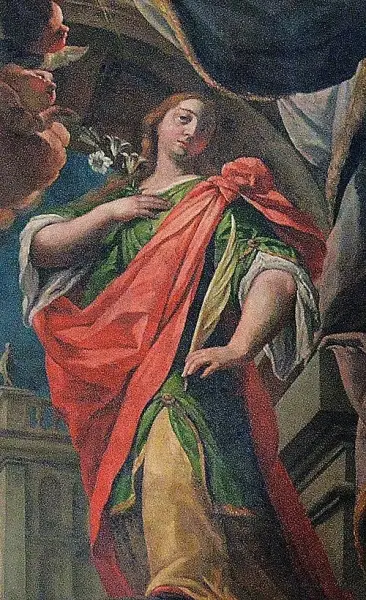
Flora was venerated in the Roman Catholic Church as a virgin martyr almost immediately after her death. No formal canonization process existed in the ninth century; her cult arose, like those of the other Martyrs of Córdoba, from the devotion of the Christian community of the city and from the literature it produced. The principal literary witness is Eulogius of Córdoba, whose account of the martyrs preserved Flora's story, her mixed parentage, her brother's demand, her declaration of consecrated virginity before the qadi, and her execution in the reign of Abd ar-Rahman II. Her feast is kept on November 24, the anniversary of her martyrdom, and she appears in the Roman Martyrology on that date. Artistic memory keeps her too: she is depicted at the Mosque-Cathedral of Córdoba, the church of the city where she died, shown in the company of other martyrs of the Andalusian persecutions. As one of the first two of the nine female martyrs of the Córdoba movement described by Eulogius, she shares with María the distinction of opening the record of women's witness in that community. Her veneration has therefore never depended on papal decree, but on the continuous memory of a Church that counted her death as martyrdom from the day it occurred.
§ Legacy
The First of the Women of Córdoba
At the head of the nine women whom Eulogius of Córdoba enumerates in his Memorial of the Saints stand Flora and María; their execution in November 851 opened the record of that company. Their example was not without effect: according to the sources, it inspired other Christians of the city to seek martyrdom in their turn, joining a movement that Eulogius chronicled and that modern historians such as Kenneth Baxter Wolf and Ann Christys have studied as a deliberate, controversial witness within Muslim Spain. The details preserved of their last days — the prison visits of Sabigotho, who would later seek the same crown; the pardon offered to Flora and her quiet refusal; the threat of public dishonor; the river that received their bodies — gave the Christian community of Córdoba a narrative of feminine constancy under a legal order that claimed their persons for Islam. Flora's own body was never recovered, an absence that itself became part of her memory, while her head rested at Saint Acisclus with María's. Centuries later she was painted among the saints at the Mosque-Cathedral of Córdoba, and her name remains fixed in the Roman Martyrology on November 24, kept wherever the martyrs of al-Andalus are honored.
§ Legacy
Timeline
- 822
Abd ar-Rahman II begins his reign, under which Flora will be condemned and executed.
§ Flora
- 16 Jul 851
María's brother Walabonsus is executed by the Muslim authorities, strengthening her resolve to follow him.
§ María
- 24 Nov 851
Flora and María are beheaded in Córdoba, Flora for apostasy and María for blasphemy; their heads are buried at Saint Acisclus.
§ Imprisonment and martyrdom
In Their Own Words
with being thrown upon the streets as prostitutes
as if she herself were shackled, not only to console the two soldiers, but to confide in them her own intention to die
The Record
- Patron of
- patron of converts and of those pressed to abandon their faith
- Symbols
- palm of martyrdom·sword
- Canonization
- Pre-congregation martyr, venerated in the Roman Catholic Church since the ninth century.
Prayer
Bibliography
Show 6 sources
- Haines, Charles Reginald (November 25, 2019). Christianity and Islam in Spain, A.D. 756-1031: Exploring religious coexistence and conflict in medieval Spain. Good Press. Retrieved November 12, 2024
- Wolf, Kenneth Baxter (1984). Christian Martyrs in Muslim Spain: Eulogius of Cordoba and the Making of a Martyr's Movement. Stanford University. Retrieved November 13, 2024
- Flórez, Enrique (1792). España sagrada, theatro geographico-historico de la Iglesia de España. Vol. 10. Universidad Complutense de Madrid. Retrieved November 13, 2024
- Christys, Ann Rosemary (January 11, 2013). Christians in Al-Andalus 711-1000. Taylor & Francis. ISBN 978-1136127304. Retrieved November 13, 2024
- Fell, Charles; Challoner, Richard (1750). The Lives of Saints: Collected from Authentick Records of Church History... T. Osborne. pp. 251–254. Retrieved November 13, 2024
- Thiébaux, Marcelle (1994). The Writings of Medieval Women: an anthology. Psychology Press. p. 180. ISBN 9780815313922
Profile text adapted from the Wikipedia article, licensed CC BY-SA 4.0.
Pray with this saint every day
Save St. Flora of Córdoba to your favorites, read the full profile, and get feast-day reminders in the Saints app.
Get the Saints AppFree on the App Store for iPhone and iPad