
died c. 612·Feast June 20
St. Florentina
Abbess and Sister of Three Spanish Bishops
Overview
Florentina of Cartagena belonged to one of the most extraordinary families of the Visigothic Spanish Church: her brothers Leander, Isidore, and Fulgentius all became bishops, and each of the four was in time raised to the honours of the altar. She first saw the light of day about the midpoint of the sixth century at Cartagena in Hispania; both her parents died while she was still a child, and her care passed of Leander, who had taken monastic vows and would serve as Archbishop of Seville. Under his guidance she embraced the ascetic life and gathered around herself a company of virgins who likewise wished to renounce the world, forming them into a religious community over which she eventually presided as abbess. Later tradition associates their residence with the convent of Santa Maria de Valle near Ecija, the city where her brother Fulgentius was bishop. Leander composed for her an enduring treatise on the rule of life for consecrated virgins, and she ordered her days according to its counsels. She died early in the seventh century, around the year 612, and was honoured as a saint soon afterward.
The Complete Life
A Family of Saints
Florentina first saw the light of day at Cartagena in Hispania, around the midpoint of the sixth century, into a household whose witness would shape the Spanish Church for generations. Her three brothers all rose to the episcopate under Visigothic rule: Leander became Archbishop of Seville, Isidore followed him in that same see, and Fulgentius governed the church of Ecija. Each of the four siblings was ultimately canonized, a distinction shared by very few families in Christian history. Florentina stood between the two greatest of them in age, younger than Leander yet older than Isidore, and her own path of holiness grew from the same root. The parents died while the children were still young, and the orphaned girl was placed under the guardianship of Leander, who by that time had embraced the monastic state. In a home ordered by his vows and learning, she learned early to weigh the world lightly. The Christian faith her family professed was no private possession but a public force in a kingdom still settling its religious future, and from this atmosphere of conviction and study Florentina drew the resolve that would govern the rest of her life.
§ Saint Florentina
Mother of a Community
Under the influence of her brother Leander, Florentina embraced the ascetic life and did not pursue it alone. She drew to her side a number of virgins who, like herself, desired to forsake the world, and she formed them into a stable religious community. Later writers identified their dwelling with the convent of Santa Maria de Valle near Ecija, the city over which her brother Fulgentius presided as bishop, though the certainty of that identification rests on later testimony. What is clear is that the group lived under her care and that her leadership was recognised, for in time she became abbess of the community she had gathered. This was a consequential undertaking in sixth-century Hispania: consecrated virginity offered Christian women a path of deliberate renunciation within a society still marked by upheaval, and a house of prayer under Florentina's governance gave such women both shelter and discipline. She proved that the sanctity for which her brothers were named was not a prerogative of the episcopal throne. In her convent the same faith that filled the cathedrals of Seville and Ecija took root quietly, in a life of shared prayer, work, and perpetual consecration.
§ Saint Florentina
The Rule Her Brother Wrote
Sometime before the year 600, Leander, who would die in 600 or 601, composed for his sister an extant work concerning a nun's rule of life and the contempt for the world that sustains it. In this treatise the archbishop laid down how cloistered consecrated virgins should regulate their days. He urged upon them a strict reserve toward women of the secular world and toward men, above all the young; he counselled strict temperance in eating and drinking; he directed their reading and meditation toward Holy Scripture; and he enjoined an equal love and friendship among all who dwelt together in community. Above all he exhorted his sister earnestly to persevere in the holy state she had chosen. Florentina took this counsel to heart and made it the pattern of her days, giving herself with ardent energy to the life it set before her. The document is one of the earliest specimens of its genre in the Latin West, and it preserves the shape of the spirituality she practised: guardedness without harshness, sobriety of body, feasting on the Scriptures, and charity without favourites within the cloister wall. Her sanctity was thus formed by obedience to a written wisdom crafted precisely for her.
§ Saint Florentina
Death in the Seventh Century
Florentina governed and sanctified her community until her death, which came sometime early in the seventh century, around the year 612. She had outlived Leander, whose archbishopric passed to Isidore, and she saw the work of her family carried forward in a Spain that was growing into one of the great Christian kingdoms of the West. The account of her passing is brief, as the accounts of hidden lives usually are: she died as she had lived, in the obscurity that consecrated virginity deliberately embraces, and was honoured as a saint by the faithful soon after. No dramatic martyrdom marked her end; her claim to the crown of sanctity rested instead on a long fidelity to the rule she had received and on the community she had built and led. In this she stands as a witness that the Church's holiness is carried not only by bishops and writers like her brothers but by women who make of a convent a school of perfect charity. Her death closed a life wholly given, and the veneration that followed it spread with her family's memory across the Spanish Church.
§ Saint Florentina
Veneration and Relics
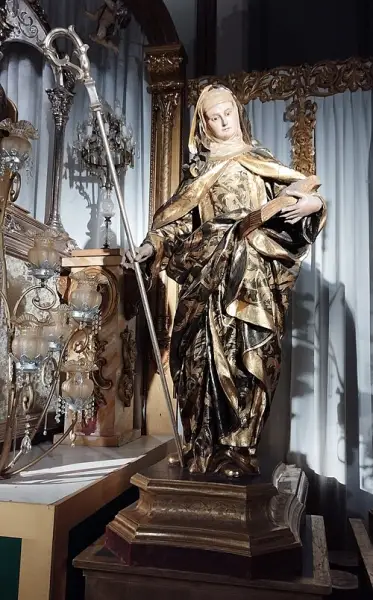
Florentina's cult endured in Spain through the centuries, and she is venerated today by both the Catholic Church and the Eastern Orthodox Church, having been canonized in the pre-congregation era. She is honoured as patroness of the diocese of Plasencia. Her feast is kept on 20 June, though the Roman Martyrology records her name under the form Florentia; scholars agree that Florentina is without doubt the correct form of the name. Her bodily remains were divided among Spanish sanctuaries in the course of time. A portion of her bones rests in the cathedral of Murcia, where the faithful continue to venerate them. The greater part, however, is preserved at Berzocana, where she is honoured together with her brother Fulgentius, so that the two siblings who served God so differently remain united in the devotion of the people. A statue depicting her stands in the church of Santa Maria de Gracia in Cartagena, the city of her birth, a quiet reminder that the great episcopal dynasty of Seville and Ecija had its origin in one family's total gift of itself to the Gospel.
§ Veneration
Timeline
- 600
Before this year, her brother Leander composed for her an extant work on the rule of life for cloistered consecrated virgins
§ Saint Florentina
- 600
Her brother Leander, Archbishop of Seville, died in this year or the next, and Isidore succeeded him in the same see
§ Saint Florentina
- 612
Died early in the seventh century, around this year, after leading her community of consecrated virgins as abbess
§ Saint Florentina
The Record
- Major works
- Religious community of consecrated virgins, traditionally identified with the convent of Santa Maria de Valle near Ecija
- Patron of
- Patroness of the diocese of Plasencia
- Canonization
- Pre-congregation; honoured as a saint after her death by the Catholic Church
Prayer
Bibliography
Show 4 sources
- St. Florentina - Saints & Angels - Catholic Online
- "Saint Florentina of Cartagena". Saints.SQPN.com. Retrieved 2012-07-16.
- "St. Florentina of Spain", Antiochian Orthodox Christian Archdiocese
- Kirsch, Johann Peter. "St. Florentina." The Catholic Encyclopedia Vol. 6. New York: Robert Appleton Company, 1909.
Profile text adapted from the Wikipedia article, licensed CC BY-SA 4.0.
Pray with this saint every day
Save St. Florentina to your favorites, read the full profile, and get feast-day reminders in the Saints app.
Get the Saints AppFree on the App Store for iPhone and iPad