
died 30 September 390 (traditional)·Feast September 22
St. Florentius of Anjou
Hermit of the Loire and evangelizer of Saumur
Overview
Florentius of Anjou — Florent d'Anjou in French — is honored as a fourth-century hermit, priest, abbot and saint of the lower Loire. History can say little of him with certainty: he appears to have lived first as a hermit on the island of Yeu, where so many disciples gathered that he established a monastery, and he is remembered as the evangelizer of the region around Saumur. His recorded feast day, September 22, is the date of his burial on Mont Glonne, the hill above the Loire now occupied by the town of Saint-Florent-le-Vieil. Everything else is the work of legend, rewritten several times and generously expanded by the monks around the year 1000 to make his sanctity more popular. The legend makes him a Danube-born Roman soldier and brother of the martyr Florian of Lorch, miraculously spared from drowning, ordained by Saint Martin of Tours, and sent to clear Mont Glonne of the serpents that symbolized pagan custom. It credits him with wonders along the river, chief among them the revival of a drowned child at Candes and the sight restored to the child's blind mother. Historians give the legend little credit, allowing it only symbolic weight, but the cult is real: two Angevin abbeys and a collegiate church in Picardy bear his name, a Renaissance tapestry narrated his life, and pilgrimage to his tomb on Mont Glonne endured for centuries.
The Complete Life
A Danube Soldier, Spared from the River
The legend that grew around Florentius begins far from the Loire, on the banks of the Danube, where he is said to have grown up with his brother Florian — the great martyr of Lorch — before the two entered service as Roman soldiers. The story follows the pattern of the military martyrs of the Danubian frontier: the prefect Aquilianus tortured the brothers and condemned them to death by drowning in the river Enns, with stones hung around their necks, for refusing to sacrifice to idols. Here the Angevin saint's tale parts from his brother's. As Florentius was being led to the execution site, an angel appeared and directed him to go instead and join Saint Martin in Tours. Forewarned by another appearance of the angel, Martin received him and ordained him a priest on arrival, while Florian went on to the martyrdom that made his name north of the Alps. The Benedictines and every specialist who has studied the dossier judge the legend fanciful, and historians attribute little historical importance to it, though they allow it symbolic meaning. Whatever the truth, the story bound the new saint of the Loire to two of the great names of Gaulish Christianity — Martin of Tours and Florian of Lorch — and gave the evangelizer of Anjou an origin worthy of an apostle.
§ Hagiography
Hermit of the Île d'Yeu, Abbot of Mont Glonne
Behind the legend stands a core of tradition that historians are more willing to credit: Florentius was a fourth-century hermit, and he lived on the île d'Yeu, the island off the Atlantic coast. His withdrawal did not last as solitude. So many disciples gathered around him on the island that he was compelled to establish a monastery, turning a hermit's refuge into the school of a community — the familiar trajectory of the desert fathers of the West. From the island his path led to the Loire, and specifically to Mont Glonne, the hill above the river where the legend says he went to expel the serpents that infested the place. The hagiographers themselves, or their modern readers, explain the image: the dragons must be read as an emblem of pagan practice; driving out the serpents is nothing other than the evangelization of the countryside of the lower Loire. There, on the hill that would take the name Mont Glonne and later the name Saint-Florent-le-Vieil, he settled as priest, abbot and missionary, and there he was buried. The abbey that grew around his tomb became one of the great religious houses of Anjou, and the little hermit of Yeu became the founding memory of an entire region's Christianity.
§ Hagiography
Evangelizing the Saumur Country
The legend sends Florentius traveling widely through the country of the lower Loire, working many miracles and evangelizing the region around Saumur. Two wonders stand out in his dossier. The best known concerns a child drowned at Candes — the same riverine town where Saint Martin himself would die — after three days under the water; by a miracle Florentius brought it back and, in the same act of mercy, gave its blind mother back her sight. The second tells how a dragon terrorized the country around Saumur until the saint put it to flight solely by prayer, and it never returned. Modern readers, and even the editors of the legend, gloss these creatures soberly: a dragon may represent a plague or epidemic afflicting the region, and the taming of rivers, serpents and monsters is the narrative dress of a missionary's confrontation with pagan custom and rural fear. It is difficult, the sources admit, to find historically trustworthy material beneath these stories. But the map of the legends — Candes, Saumur, Mont Glonne, the island of Yeu — is precisely the map of a missionary circuit along the Loire, and the abbeys that claimed his name are the permanent monuments of whatever real work the fourth-century Florentius accomplished there.
§ Hagiography
Death and Burial on Mont Glonne
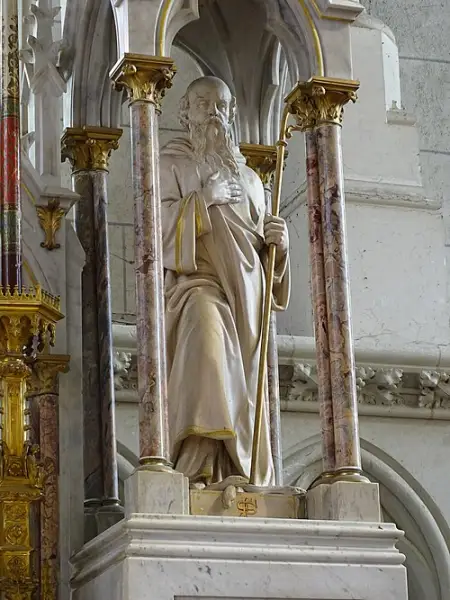
The legend records that Florentius died on September 30, in the year 390, near Mont Glonne, at a very old age — the peaceful death of a confessor rather than the violent death of the martyr his brother became. His grave was a modest chapel within the monastery on Mont Glonne; that burial, remarkably, anchors the one firm date of his cult: his feast is observed on September 22, the date the sources give for his burial on the hill, in the town known today as Saint-Florent-le-Vieil. Over his tomb a pilgrimage developed in the course of time, drawing the faithful of the Loire country to the abbey church where his statue still stands. The grave of a saint, however, proved in the centuries after his death to be as perilous as any mission field: the Viking raids of the ninth century drove his monks into exile with his bones, beginning a wanderings of the relics that would take them across France and divide them among rival churches. But the hill itself remained the head of his cult. When the relics were finally gathered again in the nineteenth century, it was to the crypt of Saint-Florent-le-Vieil that they were brought, returning the old hermit to the chapel-grave where the Loire country had first honored him.
§ Hagiography
An Ancient Cult and Its Rewriting
Florentius was never canonized by any formal process; he belongs to the ancient company of saints whose cult arose around a tomb and was confirmed by use. His feast of September 22, fixed by the date of his burial on Mont Glonne, attests a liturgical memory already organized at his abbey. The decisive act in the making of his sanctity, however, was literary: around the end of the 900s the monks recast his life to give his holiness and reach wider appeal; the resulting legend exists in several versions, since the text was reworked more than once. It was this rewriting that joined him to Florian of Lorch, to Saint Martin of Tours, and to the dragon-fighting wonders of the Angevin countryside. The Benedictines and all specialists find the legend fanciful, and historians attribute little historical importance to it, though they concede that it may carry symbolic significance — a dragon as a plague or epidemic, serpents as pagan customs. Yet the critical verdict has not dissolved the cult. Pilgrimage continued at his tomb, his feast endured, and the Church kept him among her saints as she keeps the saints of the first evangelization of Gaul: on the evidence of altars, abbeys and the prayer of the people rather than on the verification of documents.
§ Hagiography
Abbeys, Relics, and a Renaissance Tapestry
Florentius left his name across the map of medieval France. The Angevin monasteries of Saint-Florent-le-Vieil — the ancient Mont Glonne, the mother house of his cult — and Saint-Florent-le-Jeune, founded near Saumur after the relics were carried there from Tournus, both commemorate him, as does the collegiate church at Roye in the Somme. The relics themselves had a turbulent history worthy of an epic: carried off before the Vikings in 853, stolen back by the monk Absalon and hidden in a grotto at Montsoreau, installed at Saumur, burned out in 1022 and 1025, seized in 1077 by the count of Vermandois for Roye, ordered home by Louis XI in 1475 and hijacked for five years by the people of Noyant, and finally divided in 1496 by decree of the Parliament of Paris between Saint-George de Roye and Saint-Florent-le-Jeune. The Protestants destroyed the Saumur reliquary in 1562, though its contents were saved, only to vanish in the Revolution. In 1850 bones from Roye were moved into the crypt of Saint-Florent-le-Vieil, and relics still remain in the church of Saint-Pierre at Roye. The abbey of Saint-Florent in Saumur also commissioned, around 1524, a tapestry depicting episodes of the saint's life, preserved to this day in Saumur — a Renaissance monument to a saint whose documentary history is thin but whose hold on Anjou never lapsed.
§ Relics
Timeline
- 350
Lives as a hermit on the île d'Yeu, where so many disciples gather around him that he founds a monastery.
§ Introduction
- 30 Sep 390
The legend records his death on this day near Mont Glonne at a very old age, followed by burial on the hill.
§ Hagiography
- 853
Viking invasions drive the monks from Mont Glonne into the Berry and on to Tournus; Absalon later steals the relics to Anjou.
§ Relics
- 1000
Around the close of the tenth century the monks rework his life story to widen devotion to his holiness and fame.
§ Introduction
- 1022
The new abbey of Saint-Florent-le-Jeune near Saumur, home of the relics, is destroyed by fire.
§ Relics
- 1025
The Saumur abbey is destroyed again when the town is captured by Foulques Nerra.
§ Relics
- 1077
The count of Vermandois seizes the relics and transfers them to Roye near Amiens.
§ Relics
- 1475
Louis XI resolves to return the relics to Saumur, but the people of Noyant seize them en route for five years.
§ Relics
- 1496
The Parliament of Paris orders the relics divided between Saint-George de Roye and Saint-Florent-le-Jeune.
§ Relics
- 1524
The abbey of Saint-Florent in Saumur commissions a tapestry of scenes from his life, still kept there.
§ Introduction
- 1562
Protestants destroy the Saumur reliquary; its contents are rescued but vanish during the French Revolution.
§ Relics
- 1850
Relics long kept at Roye find a new resting place in the crypt of the Saint-Florent-le-Vieil church.
§ Relics
The Record
- Major works
- Monastery founded on the île d'Yeu·Abbeys of Saint-Florent-le-Vieil (Mont Glonne) and Saint-Florent-le-Jeune (Saumur) named in his honor
- Patron of
- patron of Saumur and the Angevin country·invoked against drowning
- Symbols
- hermit's habit·dragon at his feet·drowned child restored to life
- Canonization
- Pre-congregation saint with an ancient local cult; his biography was rewritten by the monks of Mont Glonne around the end of the tenth century.
Prayer
Bibliography
Show 3 sources
- Port, Célestin (1978) [1876]. Dictionnaire historique, géographique et biographique de Maine-et-Loire et de l'ancienne province d'Anjou, revised by Jacques Levron, Pierre d'Herbécourt, Robert Favreau and Cécile Souchon - D-M. Vol. 2 (2 ed.). Angers: H. Siraudeau et Cie. p. 149-150. BnF 34649310
- Hamon, Maurice. "La Vie de saint Florent et les origines de l'abbaye du Mont-Glonne", Bibliothèque de l'École des Chartes, 1971, p. 215-238 (in French)
- Bénédictins de Paris, Vies des Saints et Bienheureux, vol. 9, 1950, p. 463 (in French)
Profile text adapted from the Wikipedia article, licensed CC BY-SA 4.0.
Pray with this saint every day
Save St. Florentius of Anjou to your favorites, read the full profile, and get feast-day reminders in the Saints app.
Get the Saints AppFree on the App Store for iPhone and iPad