
250 – c. 304·Feast May 4
St. Florian
Roman Soldier-Martyr and Protector Against Fire
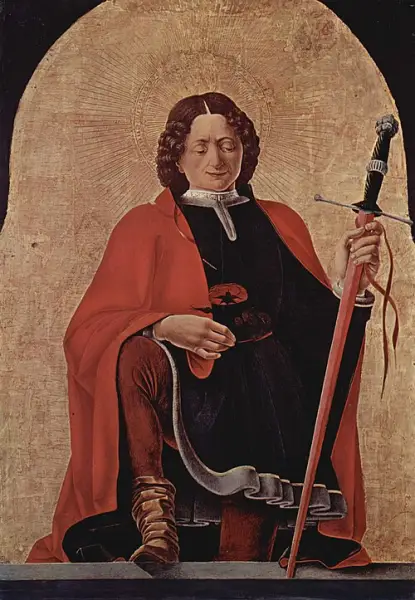
Overview
Florian, in Latin Florianus, was born around the year 250 in the Roman city of Aelium Cetium, today's Sankt Pölten in Austria, and died a martyr around 304. He entered the Roman Army and rose through its ranks to become commander of the imperial army in the province of Noricum, where, alongside his military duties, he organised and led firefighting brigades, training an elite corps of soldiers devoted solely to battling fires. When the Diocletianic Persecution reached his territory, reports reached Rome that Florian was refusing to enforce the edicts against Christians. The investigator Aquilinus ordered him to sacrifice to the Roman gods; Florian refused and was condemned to be burned alive. Standing on the pyre he challenged the soldiers to light it, and unnerved, they drowned him in the Enns River with a millstone around his neck instead. Christians recovered his body and buried it near Lorch; a vision later guided a woman named Valeria to see it moved to the site of the future monastery of St. Florian. He is venerated across Central Europe as patron of firefighters, chimneysweeps, soap boilers, and brewers, and invoked against fire, floods, and lightning.
The Complete Life
A Soldier of Noricum
Florian was born around the year 250 in Aelium Cetium, the Roman town that grew into the Austrian city of Sankt Pölten, in the frontier province through which Rome guarded the Danube. He chose a military career and advanced steadily through the ranks until he attained command of the imperial army in the province of Noricum. His responsibilities, however, extended beyond soldiering: he was charged with organising and leading firefighting brigades, and he formed and trained an elite body of soldiers whose single duty was to fight fires. In an age when timber-built towns burned with terrifying ease, this was a service of genuine public importance, and Florian appears to have brought to it the same discipline that distinguished his military career. The combination was formative both for his legend and for his afterlife in Christian devotion: the officer who commanded men against flames became, in the memory of the Church, the heavenly officer whom Christians call upon when flames threaten. His early life thus joined the two identities, soldier and protector against fire, that his iconography of Roman armour and water pitcher would later unite.
§ Life
A Christian in the Imperial Service
Florian's service in Noricum unfolded during the decades in which the Church was spreading quietly through the towns of the Danube frontier, and he himself was a Christian holding high office under a regime that would finally turn to destroying the faith. As commander, he bore responsibility for enforcing the imperial will in his territory; as a Christian, he bore a higher law. When the Diocletianic Persecution was proclaimed, reports travelled to Rome that Florian was not applying the proscriptions against Christians within his command. The empire dispatched Aquilinus to investigate. Aquilinus required him to perform the sacrificial rites the imperial cult demanded; Florian would not comply, and the refusal converted his commission into a trial and his office into a confession. Here the two duties of his life met and only one could survive. The man who had spent his strength saving towns from fire would not save himself by a gesture of idolatry, and the organiser of fire brigades stood condemned to die by fire, a coincidence his legend has never let pass unnoticed. His fidelity under investigation marks the transition from public servant to public witness.
§ Life
The Pyre and the River
Condemned for his refusal, the sentence that followed condemned him to death by fire. The soldiers raised the pyre and placed him upon it, but he did not wait for the fire as a victim; he turned it into his final challenge. Reputedly he called out to the executioners that if they wished to know he feared no torture, they should light the flames, and in the name of the Lord he would climb onto the pyre himself. The words unnerved them. Apprehensive before a prisoner so far from terror, the soldiers did not burn him at all. Instead they executed him by drowning, tying a millstone around his neck and casting him into the Enns River, near the town of that name. The manner of his death added its own symbolism to his story: the martyr whom fire could not claim was taken by water, and the water that killed him became the element of his protection, the reason artists show him with a pitcher and legend credits him with quenching a blaze by a single jug. A Roman officer's discipline, a confessor's defiance, and a double martyrdom by flame and flood came together in a single death on the Danube frontier.
§ Life
Burial and the Vision of Valeria
After the drowning, Christians recovered Florian's body and buried it at an Augustinian monastery near Lorch, in sight of the Roman frontier he had served. The story then takes a turn beloved of Central European hagiography. A woman named Valeria received a vision in which the martyr appeared to her and declared his wish to rest in a more fitting place. Acting on what she had seen, she had the relics carried to the place where the abbey of St. Florian would one day stand, the great baroque abbey that became the heart of his cult and gave its name to the Austrian town of Sankt Florian that grew around it. According to legend his body lies interred there still. Translation of relics governed the geography of medieval devotion, and Valeria's vision fixed Florian's: the commander of Noricum was to be venerated not at the river that killed him nor the old fort of Lorch, but at the place whose monks would keep his memory for well over a thousand years. His grave became a centre of pilgrimage, and from it his patronage spread across Austria, Bavaria, Poland, and beyond.
§ Life
Patron of All Who Face the Flames
Florian's cult spread across Central Europe as few martyrs' have. In 1184, at the request of Prince Casimir II, Pope Lucius III consented to send his relics to Poland, making him that country's patron saint; Kraków claims a portion of them, and the fire of 1528 that ravaged its neighbourhood yet spared St. Florian's Church bound the city to him ever more closely. He is patron of Upper Austria jointly with Leopold III, of Linz, of firefighters, chimneysweeps, soap boilers, and brewers, the last association owing to the legend of the fire he quenched with a single pitcher. Catholics in Bavaria and Austria long gave at least one son the name Florian to secure his protection against fire, and in Austria and Germany his name is the radio call sign of fire engines. In 1935 a statue by Josef Josephu was unveiled at Vienna's main firehouse in the Am Hof square; bombed out in 1945, it found a home in the Fire Brigade Museum. Even his name entered the language: the ironic prayer begging the saint to spare one's own house and set fire to another gave German the 'Sankt-Florians-Prinzip', and in art he is shown as a Roman soldier with a pitcher of water, standing upon fire.
§ Veneration
Timeline
- 250
Born around this year at Aelium Cetium in Noricum, the town today called Sankt Pölten in Austria
§ Life
- 304
Refused Aquilinus's command to sacrifice to the Roman gods during the Diocletianic Persecution and met his death by drowning in the Enns, a millstone fastened at his neck
§ Life
- 1184
Adopted as patron saint of Poland when Pope Lucius III consented to Prince Casimir II's request and sent his relics to Kraków
§ Veneration
- 1528
A fire burned the whole neighbourhood around St. Florian's Church in Kraków without destroying the church, intensifying devotion there
§ Patronage
- 1935
A statue by Josef Josephu was unveiled in Vienna at the main firehouse on the square of Am Hof
§ Veneration
- 1945
The Vienna firehouse was bombed in the Second World War, and his statue was moved to the Fire Brigade Museum
§ Veneration
In Their Own Words
If you wish to know that I am not afraid of your torture, light the fire, and in the name of the Lord I will climb onto it.
The Record
- Major works
- Organised and trained an elite firefighting corps of soldiers in the Roman province of Noricum
- Patron of
- Patron of firefighters·Patron of chimneysweeps·Patron of soap boilers·Patron of brewers·Patron of Upper Austria (with Leopold III)·Patron of Linz·Patron of Kraków·Patron saint of Poland·Invoked against fire, floods, lightning, and the pains of Purgatory
- Symbols
- Attire of a Roman soldier·Pitcher of water·Fire
- Canonization
- Pre-congregation martyr, put to death during the Diocletianic Persecution
Prayer
Bibliography
Show 9 sources
- Ὥ Ἅγιος Φλωριανὸς ὁ Μάρτυρας. 4 Μαΐου. ΜΕΓΑΣ ΣΥΝΑΞΑΡΙΣΤΗΣ (in Greek).
- Mendler, Mitch. "Saint Florian – the patron saint of the fire service". Retrieved 16 January 2019.
- "St. Florian", Saint Florian Roman Catholic Church.
- "St. Florian History", Brookline Firefighters Association, Brookline, Massachusetts.
- Turkalj, Nikola (2018). Rimski vojnik i vatrogasac. Split: Redak. p. 19. ISBN 978-953-336-489-6.
- "Florian". Cyclopedia of Biblical, Theological and Ecclesiastical Literature. McClintock and Strong. 1870.
- St Florian, Catholic.org. Accessed 9 January 2025.
- Lanzi, Fernando and Lanzi, Gioia: "Florian of Lorch, Martyr", Saints and Their Symbols: Recognizing Saints in Art and in Popular Images, pg. 86. Liturgical Press, 2004; ISBN 0-8146-2970-9.
- Delehaye, Hippolyte (1911). "Florian, Saint". Encyclopædia Britannica. Vol. 10 (11th ed.). p. 539.
Profile text adapted from the Wikipedia article, licensed CC BY-SA 4.0.
Pray with this saint every day
Save St. Florian to your favorites, read the full profile, and get feast-day reminders in the Saints app.
Get the Saints AppFree on the App Store for iPhone and iPad