
died 856·Feast November 17
St. Florinus of Remüs
Alpine priest and confessor of the Engadin valleys
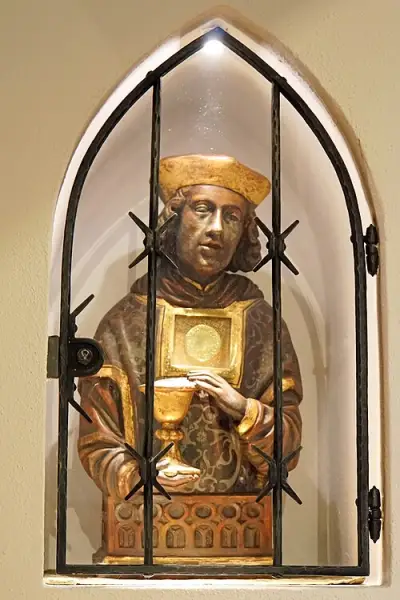
Overview
Florinus of Remüs (died 856), known also as Florin, Florian of Chur, Florinus of Matsch, and Florinus of Vinschgau, is a saint of the Catholic Church honored especially in the dioceses of Chur and Bolzano-Brixen, in the Archdiocese of Vaduz, and across the Rhineland. No early vita of his life survives, and what is told of him comes from later tradition. He is said to have been the son of a mixed marriage — an Anglo-Saxon father and a Jewish mother — who had both embraced the Christian faith and made their home at Matsch (Mazia) in the Vinschgau Valley, halting there as they came back from pilgrimage to Rome. Educated by a priest in the Lower Engadin, he was ordained there and served as priest at Remüs (Ramosch). Miracles were credited to him in life, above all the changing of water into wine, and after his death wonders without number were told where he lay in the church of Remüs. The Church remembers him as a confessor, not a martyr; devotion deepened through the Middle Ages: his relics were distributed to churches including the Florinskirche at Koblenz in 950 and Regensburg, while Vaduz Cathedral and the parish church of Matsch are dedicated to him. He is the patron saint of Chur, invoked across the Alps he served.
The Complete Life
A Pilgrim Family at Matsch
No early vita of Florinus exists, and the outline of his life rests on traditions gathered long after his death. According to these, he was the child of a striking parentage: his father an Anglo-Saxon, his mother a Jewish woman, and both of them converts to Christianity. The couple had made the pilgrimage to Rome, and on the journey home they settled at Matsch — Mazia in Italian — in the Vinschgau Valley, where the saint is remembered as Florinus of Matsch and of the Vinschgau.
Whatever the precise truth of the family story, it places Florinus at a crossroads of peoples. The Vinschgau in the early Middle Ages lay on the routes that carried pilgrims, traders, and missionaries across the Alps between the German lands and Italy, and an Anglo-Saxon traveler returning from Rome would have been one more wanderer on roads the English pilgrims knew well. That the son of such a household should become a priest of the local church, and eventually its most famous saint, is the kind of transformation the Alpine valleys loved to remember.
The abundance of his later names — Florin, Florian of Chur, Florinus of Matsch, Florinus of Vinschgau — marks the different communities that each claimed him for their own.
§ History
Priest of Remüs
The schooling of Florinus was entrusted to a priest of Unterengadin, in the Lower Engadin, and by the same hands he was ordained. Formed within the local church rather than in some distant school, he belongs to the country clergy of the Raetian valleys, raised and ordained among the people he would serve.
After his ordination he worked as priest at Remüs, today's Ramosch, a parish of the Lower Engadin. The charge of a village priest in the ninth century embraced everything from the sacraments at the altar to the settling of quarrels at the church door, and the sources preserve for Florinus no office, title, or writing beyond this simple pastoral work. The Church keeps him among her confessors, not her martyrs — a man whose holiness was wrought in daily duty, not cut short by violence.
The scarcity of the record is itself part of his story. Where other saints of the early medieval Alps received elaborate passions filled with improbable trials, Florinus was remembered for what a village community could verify: a priest who lived among them, whose tomb in the parish church of Remüs drew pilgrims by the reported wonders worked there.
§ History
Water Made Wine
Miracles were attributed to Florinus during his lifetime, the most beloved of them the changing of water into wine — an echo of Cana that gave him a natural place in the imagination of the wine-growing valleys and explains why his iconographic attribute is a bottle or a glass of wine. After his death the place of his burial, the church of Remüs, became known for marvels without number, and the pilgrims' stream made the quiet priest's grave one of the shrines of the Raetian Alps.
He is honored as a confessor of the Faith rather than as a martyr: one who confessed Christ by a lifetime of fidelity, not by a death of violence. The distinction matters for the character of his cult. The confessors of the early medieval church were venerated for purity of life and pastoral labor, and it was as a good shepherd, not a hero of persecution, that Florinus was invoked by the people of the Engadin, the Vinschgau, and the lands beyond the passes.
The picture that emerges is of sanctity formed in small places — a parish, a valley, a mountain road — and of a grace that made ordinary things, water itself included, bear witness to the Giver of every good gift.
§ History
A Cult Across the Alps
After his death the popularity of Florinus's cult increased steadily, and his relics were distributed to many places. In 950 they reached the Florinskirche at Koblenz on the Rhine, and Regensburg also received them — evidence that his fame had crossed the Alps into the German lands. Closer to home, churches took his name: Vaduz Cathedral and the parish church of his native Matsch (Mazia) both stand under his invocation, and a window of Chur Cathedral portrays him in stained glass.
His formal patronages gather the communities that claimed him: the Vinschgau Valley, the Engadin, the Roman Catholic Archdiocese of Vaduz, and the Diocese of Chur, of which he is honored as patron. His feast is kept on 17 November, and he is venerated with special devotion in the dioceses of Chur and Bolzano-Brixen, in Vaduz, and throughout the Rhineland.
The geography of his cult forms a biography of its own: born of a pilgrim family at Matsch, ordained in the Engadin, buried at Remüs, his name traveled along the very routes — the valley roads and river highways — that had carried his parents to Rome and carried his own memory to Koblenz and Regensburg.
§ Veneration
Timeline
- 856
Died at Remüs, where his tomb in the parish church became the scene of numerous reported miracles.
§ History
- 950
His relics were translated to the Florinskirche at Koblenz, carrying his cult across the Alps into the Rhineland.
§ Veneration
The Record
- Patron of
- Vinschgau Valley·Engadin·Roman Catholic Archdiocese of Vaduz·Diocese of Chur
- Symbols
- bottle or glass of wine
- Canonization
- Pre-congregation confessor; venerated by popular acclaim since the early medieval period.
Prayer
Bibliography
Show 6 sources
- Thomas Mollen (November 2005). "Heiliger Florinus vom Vinschgau". Kirchensite. Retrieved 26 August 2008
- "St Florin", The British Museum
- Jan-Andrea Bernhard: Geschichtliche Einführung in das Wirken und die Wirkung des heiligen Florinus, in: Der Schlern 81 (2007), S. 20–47
- Jan-Andrea Bernhard: Streit um einen Heiligen: der Heilige Florinus von Ramosch als Zankapfel in Geschichte und Gegenwart, in: Bündner Monatsblatt 2006, Nr. 1, S. 35–67
- Alfred Pothmann: Der heilige Florinus: aus der Geschichte der Heiligenverehrung im Stift Essen, in: Das Münster am Hellweg 37 (1984), S. 14–21
- Hedwig Röckelein: Der Kult des heiligen Florinus im Stift Essen, in: Jan Gerchow et al. (eds.): Essen und die sächsischen Frauenstifte im frühen Mittelalter, Essen 2003, S. 59–86
Profile text adapted from the Wikipedia article, licensed CC BY-SA 4.0.
Pray with this saint every day
Save St. Florinus of Remüs to your favorites, read the full profile, and get feast-day reminders in the Saints app.
Get the Saints AppFree on the App Store for iPhone and iPad